Roosevelt helped Amanda Wornhoff find her way. Now she is helping other
students find theirs.
Despite her stellar academic performance in high school, by the mid-1990s Amanda Wornhoff found herself adrift at two different Big 10 universities, struggling to excel as a first-generation college student. Faced with the added strain of family health and financial hardships, Wornhoff eventually left school to find work. But years later, determined to complete her college education, she enrolled at Roosevelt University where she soared in the classroom, earning two degrees before landing a job on the faculty.
“I was looking for a school that was going to respect my educational and life experiences up to that point and give me the support I needed to better my life,” Wornhoff said. “Roosevelt had the most attractive program because they showed interest in having me as a student and respected where I was at that moment. Roosevelt made me feel like I could do it.”
Though she originally pursued math and engineering, at Roosevelt Wornhoff found English to be her real passion. She earned a bachelor’s degree in 2005 and master’s degree in 2008 both in English. The following year she was hired as a full-time member of Roosevelt’s faculty and now, in addition to her work as a lecturer and interim director of the English Composition Program, Wornhoff serves as co-chair of Foundations of Excellence, a self-study process designed to improve experiences of first-year students.
“Roosevelt had the most attractive program because they showed interest in having me as a student and respected where I was at that moment. Roosevelt made me feel like I could do it.”
Amanda Wornhoff
“The Foundations of Excellence work is a perfect fit for me — it addresses all of the questions I’ve asked myself many times about my own experiences as a college student, particularly as a first-generation college student who faced personal obstacles in earning my degree,” Wornhoff said. “In hindsight, I now realize how my first year in college set the tone for my overall trajectory in higher ed, which in turn affected many other areas of my life.”
Foundations of Excellence
Foundations of Excellence started at Roosevelt during the 2013-14 academic year when more than 130 members of the University community began studying and surveying the experiences of first-year students. The group looked at issues such as classes in which freshmen struggled, better ways to provide support and strategies to increase retention.
Roosevelt currently has the largest full-time freshman class in its history, and Wornhoff believes this is the right time to more closely examine the many variables of the student experience in order to create structures that provide a strong foundation of academic, social and financial support for today’s first-year students. “This is especially important for Roosevelt students, whose personal success is often a catalyst for improving the lives of their families and their communities,” she said.
Wornhoff and Linda Jones, co-chair of Foundations of Excellence and dean of Undergraduate Studies, have spent the academic year whittling down a list of recommendations and figuring out which ideas can be put into practice. Some improvements may include the creation of an advisory board of first-year students and the establishment of a single office or department to oversee all things related to freshmen.
“Amanda brings to this project her experience of working regularly with freshmen in the English Composition Program,” Jones said. “She has great insights into what freshmen need, what they are capable of and what they cannot do at this point in their lives. And it’s really useful that Amanda knows Roosevelt inside and out because she came here as a student herself.”
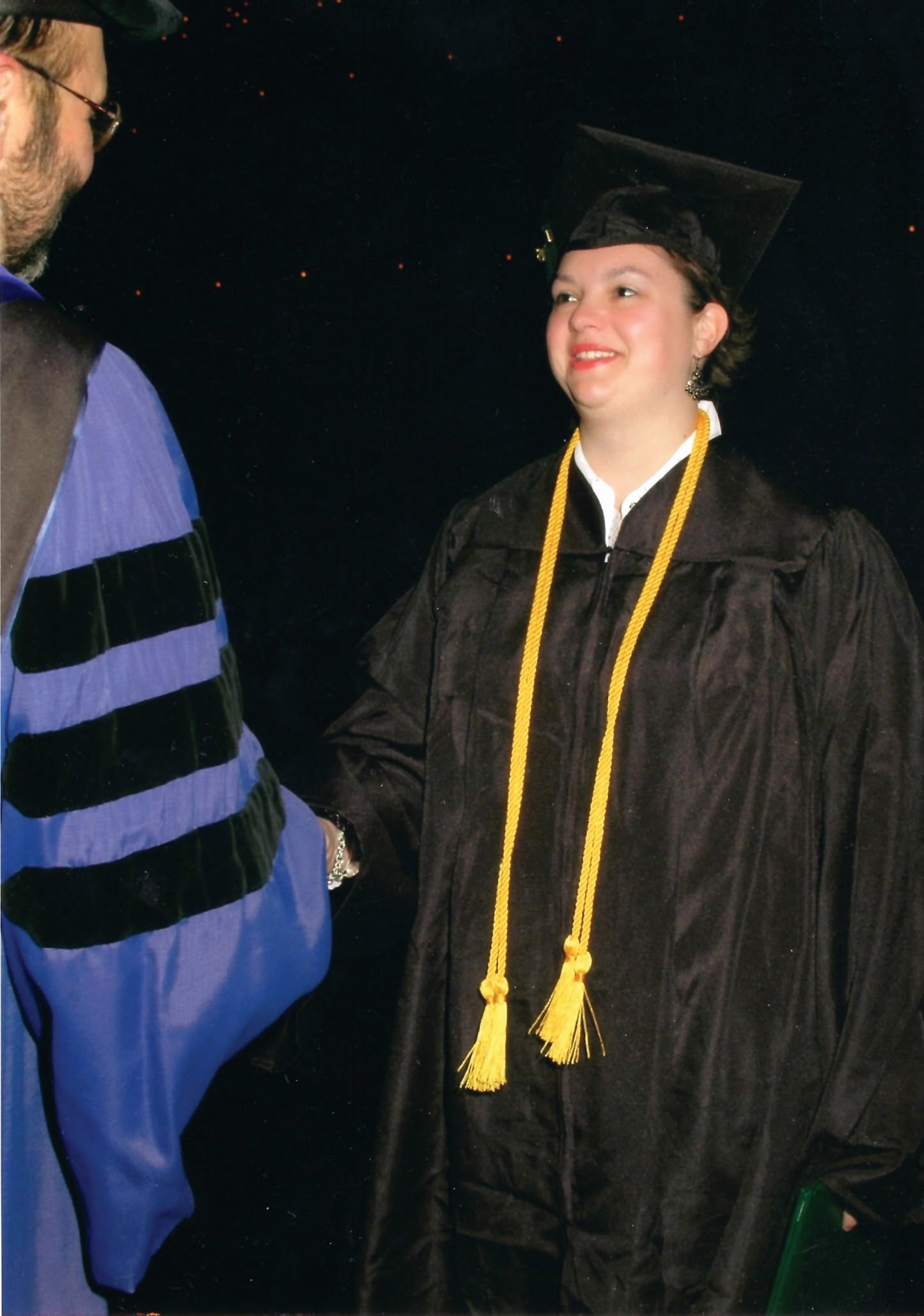
Amanda Wornhoff, English composition lecturer and co-chair of Foundations of Excellence, received both bachelor’s and master’s degrees from Roosevelt.
A native of Pittsburgh who grew up in Crown Point, Ind., Wornhoff and her husband, Jeff, whom she met in the high school band, now reside in the Rogers Park neighborhood of Chicago. They have season tickets to the Chicago Fire Soccer team and enjoy taking in live music around the city.
After graduating from high school in Crown Point, Wornhoff went to Purdue University as an engineering student, but quickly found college to be difficult, requiring a degree of independence and connection that she struggled to find. She ended up transferring to Indiana University to study math. Despite soon realizing that large university campuses were not for her, she continued on for several years until she was close to graduating. By then her father had fallen ill, her mother was working two jobs and she had trouble paying the bills. Wornhoff left school and spent the next six years as a legal secretary at various firms. In 2003, she was living in Chicago, had recently gotten married and decided it was the right time to complete her college education.
Bonnie Gunzenhauser, now dean of the College of Arts and Sciences who taught Wornhoff as a student and also had her as a teaching intern, said Wornhoff was academically strong and a dynamic presence in the classroom, contributing her own ideas as well as listening to others. “She was just a natural. She was a facilitator as a student, a facilitator as a teaching intern and now is a facilitator with the Foundations of Excellence,” Gunzenhauser said. “Her Foundations of Excellence work requires bringing people together from across the University and she’s very effective at it.”
“Amanda has a keen understanding of where students are coming from and how to give them extra help and support,” said Ellen O’Brien, associate professor of English and director of Women’s and Gender Studies. “I think that’s due to her own experiences,” said O’Brien, who also taught Wornhoff as a student. “She’s effective because she holds students to high standards and supports them.”
Indeed, Roosevelt sophomore Chinanita Leslie said she spent time during her freshman year trying to figure out whether college was right for her. With the help of Wornhoff’s guidance, enthusiasm and support, Leslie continues to pursue a bachelor’s degree in English at the University. “I must admit I was dubious at times in my ability to be successful in college. Professor Wornhoff never doubted me for a second. She was confident in my ability and her confidence transferred to me,” Leslie said. “She also is always trying to find a way to make Roosevelt better. She spends a lot of time advocating for the students and trying to find ways to create more programs and resources.”
One of Wornhoff’s former students, Giacomo Luca, 22, attributes his own achievements as a television reporter in part to the mentoring he received from Wornhoff after taking one of her classes as a freshman. “Amanda is one of the reasons that students continue to further their education at Roosevelt. It’s professors like her that make students feel like they belong here,” said Luca, who received his bachelor’s degree in journalism in May 2014. “There is a quote on the University’s seal about the ‘enlightenment of the human spirit.’ I think that Amanda in all aspects of the phrase is committed to the enlightenment of the human spirit, and to the enlightenment of her students.”
Wornhoff said it might sound like a cliché, but students are her heroes. “Our students’ courage and perseverance in pursuing their education, often in the face of serious challenges, are what inspires me and keeps me coming back for more. There’s no better feeling than sensing a student’s pride when she completes a difficult writing assignment, or witnessing a student’s discovery of new ideas, or watching a student’s confidence grow before my eyes. I am grateful for those moments when I get to share in students’ victories, big and small.”
“Our students’ courage and perseverance in pursuing their education, often in the face of serious challenges, are what inspires me and keeps me coming back for more.
Amanda Wornhoff
As the University focuses on the most important aspects of first-year students’ lives to help improve academic quality and increase retention, Wornhoff’s experiences will be invaluable. “I’m really proud to work at a place where people are so committed. I’m constantly impressed and inspired by the people who work here and how committed they are to students’ success,” Wornhoff said.
“When I first visited Roosevelt as a new student, I had the feeling that whoever I was and whatever I had done was okay, that I had a clean slate, and that Roosevelt wanted to help me get to the next level in my life. Today I know we all still want those same things for our students here, and I’m honored to have the opportunity to pay it forward a little bit each day.”