Feature 4, Feature Stories, Spring 2017

The Business of Caring: Students Find Role Models in Career Mentoring Program

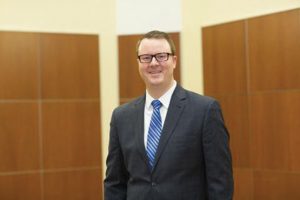
James Davis (BBA, ’17; EMSHTM, ’18).

James Davis (BBA, ’17; EMSHTM, ’18).

When Roosevelt University undergraduate James Davis grew impatient with lack of promotion at his hotel job, his mentor — a Roosevelt alumnus and hotel manager — was there to talk the 21-year-old down from the ledge.

“In our industry, you don’t want to be a job hopper,” said John Wells, a 2013 graduate of Roosevelt’s Hospitality and Tourism Management master’s program and the general manager of Chicago Hilton and Towers.

“Your energy, aspirations and ambition are really impressive,” Wells told his mentee in November. “I would give the job a bit more of a run and see where it takes you.”

One of approximately 50 students already paired with professionals in Roosevelt’s new Career Mentoring Program, Davis accepted Wells’ advice and offer to help revamp his resume. Three months later, Davis got a promotion and a raise.
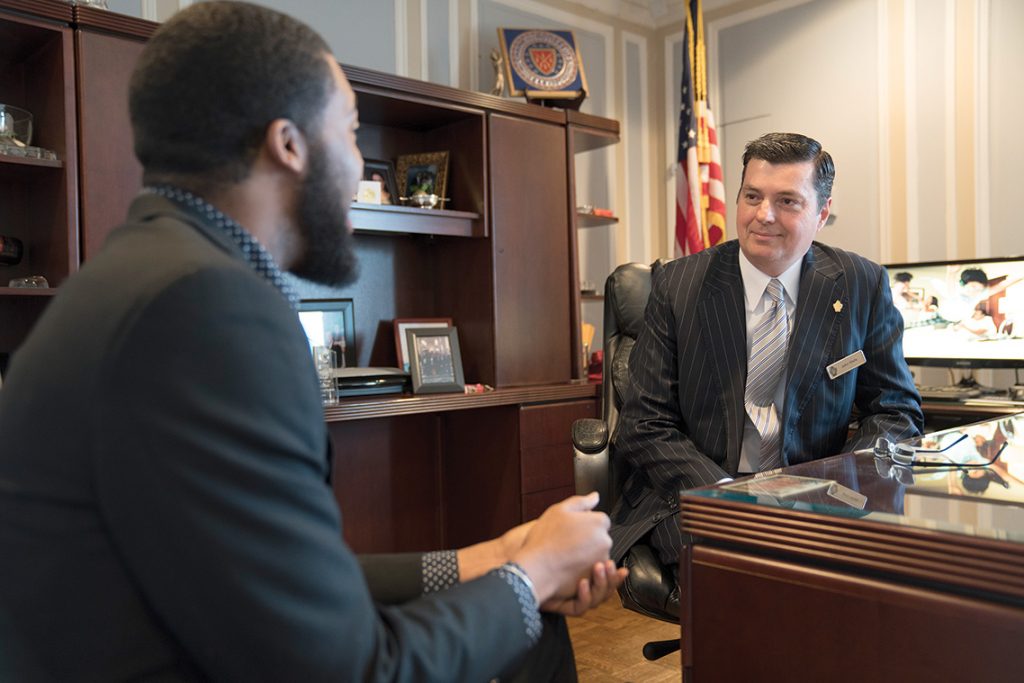
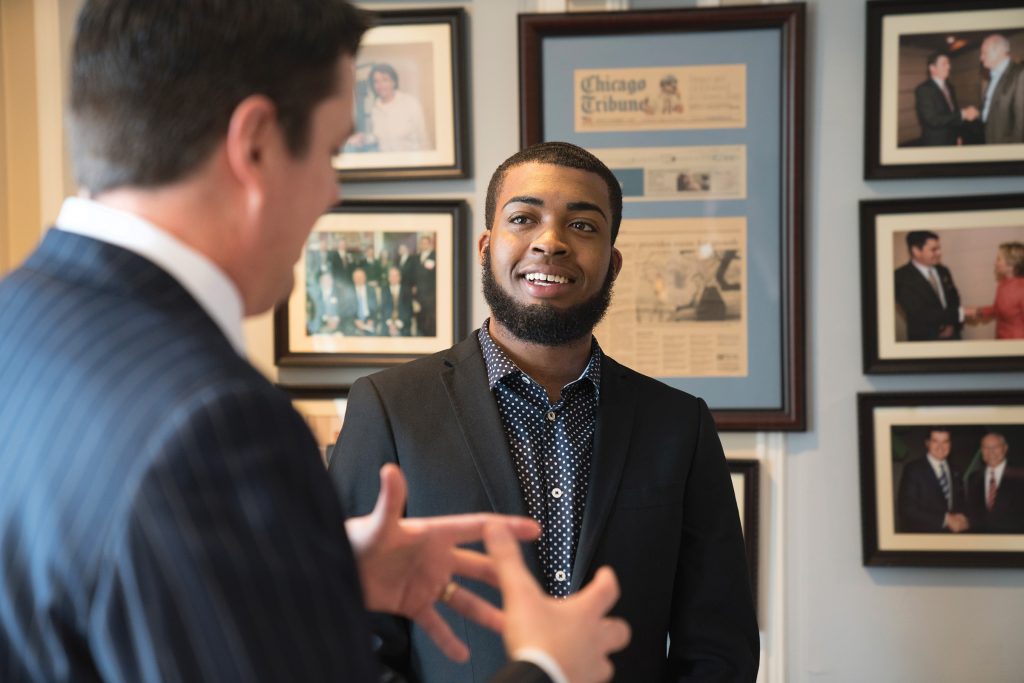
Student meeting with mentor

James Davis (left) meets with Roosevelt mentor John Wells (MSHTM, ’13).

“It’s been an amazing experience,” said Davis, whose bi-weekly, two-hour meetings with his mentor fly by with talk about the hotel industry and their personal experiences at Roosevelt, in life and on the job.

“I’m glad Roosevelt is giving us an opportunity to interact with successful people,” said Davis, a human resources major who will pursue a hotel management career after he graduates in December. “I’m discovering who I am and where I want to be in the future.”

“I’m glad Roosevelt is giving us an opportunity to interact with successful people. I’m discovering who I am and where I want to be in the future.”
– James Davis (BBA, ’17; EMSHTM, ’18)

Introduced by President Ali Malekzadeh, Roosevelt’s Mentoring Program is similar to programs that he started at business schools in 2003 at Xavier University in Cincinnati and in 2011 at Kansas State University.

“The idea behind mentoring is that someone besides your own family cares about you,” said Malekzadeh, who hit on the idea of undergraduates working with successful mentors about 20 years ago when his daughters were away at college.

Launched with 24 business executive mentors, the Xavier program today is a university-wide initiative with more than 700 matches annually. The Kansas State College of Business Administration initiative, meanwhile, has approximately 500 matches annually, and is a model for mentoring programs run by other colleges at Kansas State.

“It’s clear to me that mentors are absolute crucial linchpins to one’s success,” said Malekzadeh, whose ultimate goal is to make available a mentor to every Roosevelt undergraduate who wants one.

Supporting that sentiment, a national study of more than 30,000 college graduates recently found that workplace engagement was more than double among those who had caring professors and a mentor while in college.

“When it comes to finding the secret to success, it’s not ‘where you go,’ it’s ‘how you do it’ that makes all the difference in higher education,” according to the Great Jobs Great Lives Gallup-Purdue Index Report released in 2014.

With the future well-being of students in mind, Roosevelt began rolling out the Mentoring Program last fall that, in a word, is purposeful. Among its tenets, students and mentors are custom-matched and establish mandatory monthly meetings/conversations. Workshops, goal-setting and evaluations are part of the extensive process, which also offers the Roosevelt Office of Career and Professional Development’s new Graduation Plan for Success (GPS).

“Almost everyone I’ve ever asked has said, ‘Yes, I’ll be a mentor, but you’ve got to do it well because I’ve been a mentor before and nothing ever came out of it,’” Malekzadeh said.

Job placement rates for mentees graduating from Xavier and Kansas State have been as high as 98 percent — a full point lower than the 99 percent job placement rate that the president envisions Roosevelt mentees achieving.

“This will be a signature program for Roosevelt,” Malekzadeh said. “Its magic will come from a staff that works well with both mentors and mentees.”

So far, 11 alumni and nine members of the Roosevelt Board of Trustees have signed on as mentors, and even those who are too busy to be mentors are enthusiastically supporting the new program. A grant from the Robert R. McCormick Foundation also supports the program.

“It’s one thing to get into college, and another to get through college,” said Robert Wieseneck, a Roosevelt trustee and alumnus who travels frequently, but is financially supporting the initiative. “We need to do whatever it takes to help our students graduate and be successful citizens.”

60+ mentors have committed to the Roosevelt Career Mentoring Program

Members of Roosevelt’s growing pool of mentors include bankers, researchers, marketing and communications professionals, presidents, vice presidents, and seven executives from Chicago marketing and entertainment company Intersport.

“A lot of us joined because we wanted to help Roosevelt students who will be the first in their family to graduate from college,” said Steve Stroud, vice president of marketing and development at Intersport.

“It wasn’t mandatory, just a good way to give back,” said Stroud, whose mentee — Macedonian native Metodi Popovski, a history major and son of a fast food worker and cab driver — has been inspired by Stroud’s professional success.

“I’ve never met someone as successful as you,” Popovski told his mentor during a recent meeting at Intersport. “Hold on,” Stroud replied, emphasizing what is really at stake. “If people around you are happy and living fulfilled lives, that’s true success.”

Mentees include first-generation college student Erika Gomez, a human resources major and junior who is paired with David Fairhurst, executive vice president and chief people officer at McDonald’s; Amber Barkes, a 19-year-old Plano, Illinois English major exploring potential career options with Emily Osborne, public communications manager at the Chicago History Museum; and Peter Catchings, an MBA international business, finance and pre-law student and Roosevelt Lakers basketball player, who is paired with Robert Gibbs, McDonald’s executive vice president and global chief communications officer, and former press secretary to President Barack Obama.

“We are off to a good start with quite a diverse array of mentors and mentees who are engaged in the program,” said Katrina Coakley, associate provost for student success and manager of the program. “Our goal is to build a showcase program that ultimately benefits students in their careers and lives after graduation.”
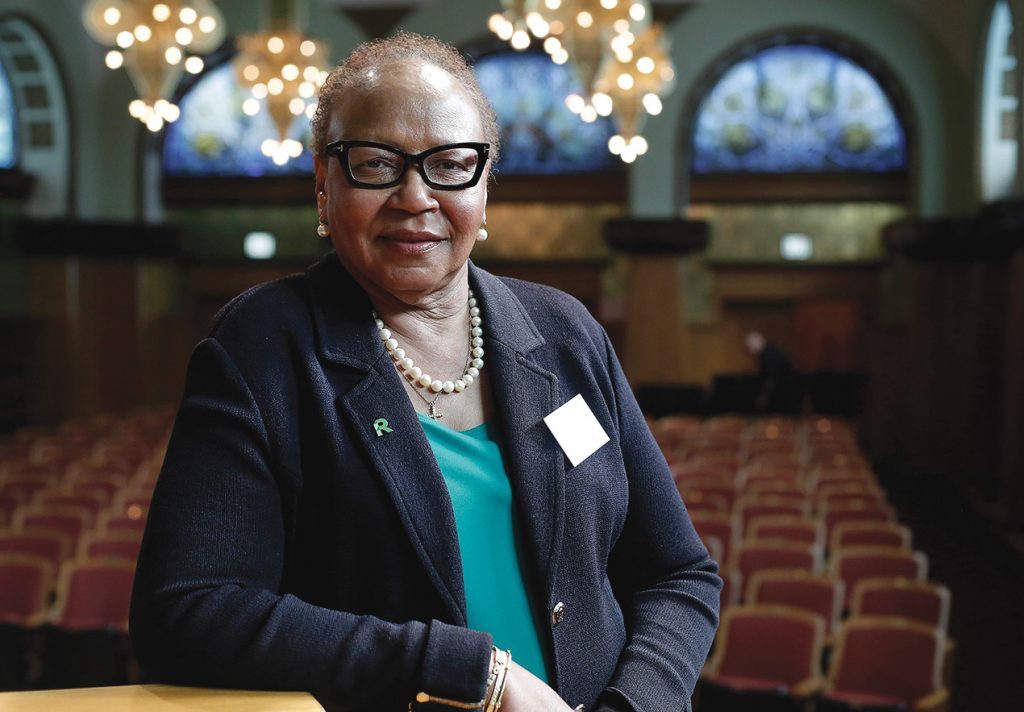
Patricia Harris, (BGS, ’80) Retired Global Chief Diversity Officer, McDonald’s Corp. Chair, Roosevelt Board of Trustees

Patricia Harris, (BGS, ’80) Retired Global Chief Diversity Officer, McDonald’s Corp. Chair, Roosevelt Board of Trustees

The Roosevelt Board of Trustees, led by Chair Patricia Harris, has been wholeheartedly in support of the program.

“I want to be there for young people, and particularly young women who are looking for role models,” said Harris, retired global chief diversity officer for McDonald’s Corp. and current mentor to 20-year-old Roosevelt junior Ta’ Tee-Etta McBride, an English and secondary education major.

“Pat is very professional and someone whom I want to continue to build a relationship with,” McBride said.

Harris (BGS, ’80) shared with her mentee the prospect of internship opportunities at McDonald’s, and suggested McBride reach out and network for contacts through People United to Serve Humanity (PUSH) Excel, the youth division of Rainbow PUSH, about her passion for high school teaching.

“When I was a student at Roosevelt, I didn’t necessarily have the kind of support that our new Mentoring Program offers, which is why it’s important for me to give back,” said Harris, who has been a mentor to several Roosevelt students prior to the program’s start.

“When I was a student at Roosevelt, I didn’t necessarily have the kind of support that our new Career Mentoring Program offers, which is why it’s important for me to give back.”
Patricia Harris, (BGS, ’80) Retired Global Chief Diversity Officer, McDonald’s Corp. Chair, Roosevelt Board of Trustees

Two of her Roosevelt mentees — 27-year-old international studies major Tierra Jackson and 22-year-old business marketing major Carlita Kelly — graduated from Roosevelt in 2016, landing jobs shortly thereafter.

“There aren’t many women of color in higher-end positions,” said Jackson, who interned with Harris at McDonald’s in 2014.

“Pat not only has been a role model, she’s also been a friend,” said Jackson, who got help from Harris obtaining furniture for her new apartment after landing a job as a program development specialist for a Chicago nonprofit agency.
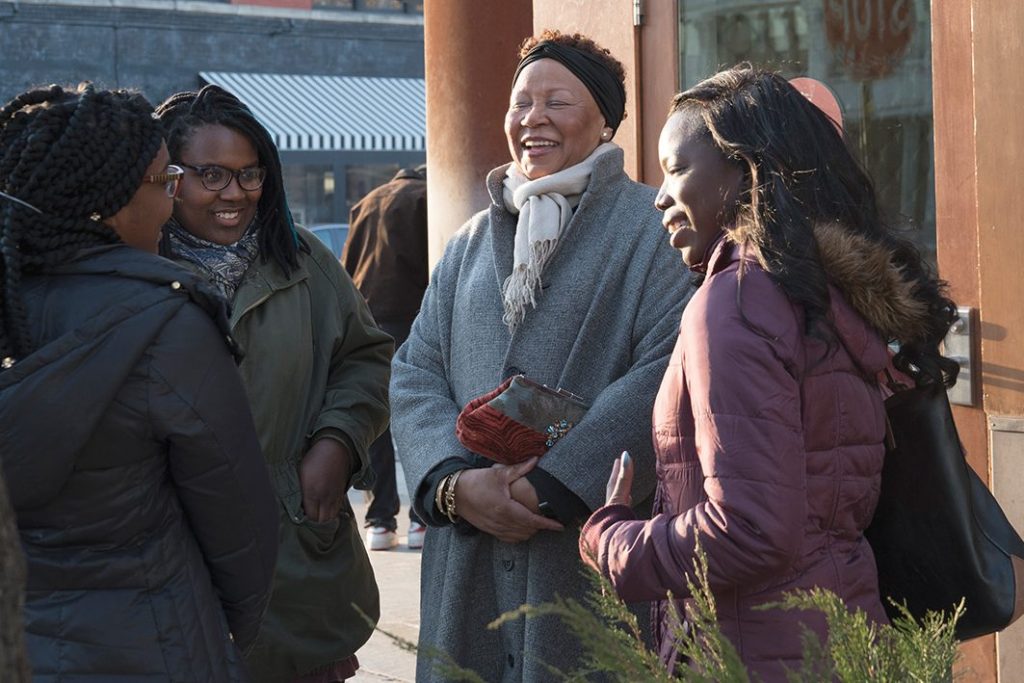
Pat Harris laughs with mentees (left to right) Carlita Kelly, Ta’ Tee-Etta McBride and Tierra Jackson.

Pat Harris laughs with mentees (left to right) Carlita Kelly, Ta’ Tee-Etta McBride and Tierra Jackson.

“I got a new job as a social media manager. Pat noticed it right away on my LinkedIn page and reached out to me,” said Kelly, who is now working to earn an MBA at Roosevelt and is a student trustee on Roosevelt’s Board of Trustees.

Both mentees say they will continue to check in from time to time and keep Harris updated as they move ahead with their lives and careers.

“I want to be a good role model to my mentees and other mentors,” said Harris, whose goal is to recruit fellow trustees as mentors. “My hope is that many, if not all of our trustees, will become mentors.”


To learn more about becoming a career mentor, visit roosevelt.edu/mentoring or contact Katrina Coakley at kcoakley01@roosevelt.edu.

Standard
Fall 2016, Feature 1, Feature Stories

The American Dream Conference: What Does the American Dream Mean Today?

1,008 attendees. 4 consecutive days. 580+ service day volunteers. 6 scholarship winners. 200+ “call to action” discussion participants.

1,008 attendees. 4 consecutive days. 580+ service day volunteers. 6 scholarship winners. 200+ “call to action” discussion participants.

What does the American Dream mean today?  That was the topic of a major conference Roosevelt University hosted Sept. 12-15 at its Chicago Campus attended by 1,008 people.

At more than a dozen lectures and discussions, leading American scholars, activists and entrepreneurs analyzed the American Dream and how it affects millennials, education, health care, real estate, immigration, politics and more.

“The American Dream is about every individual who aspires to achieve more in life,” said Ali Malekzadeh (left), president of Roosevelt University and a native of Iran. “Understanding our national ethos of democracy and equality has never been more urgent.  At the American Dream Reconsidered Conference, we heard many viewpoints on what it means to be an American in these challenging times.”

The conference, sponsored by BlueCross BlueShield of Illinois, McDonald’s Corporation and other organizations, also celebrated Malekzadeh’s first year in office. It was held in lieu of the formal and expensive presidential installation ceremonies commonly held on university campuses.  Instead, Malekzadeh led an effort to discuss the future of the American Dream and he initiated a new scholarship program for six outstanding Roosevelt students.

Monday, Sept. 12

11 a.m.

Center for Diversity and Inclusion, National Racial Climate Discussion
The conference began with a discussion regarding the nation’s racial climate, sponsored by Roosevelt University’s new Center for Diversity and Inclusion. “This is a call to action,” Sharron Evans, assistant vice president for inclusion and equity, told nearly 200 participants.  “As a nation, we’re dealing with things like economic issues and police shootings. It’s a fragile time right now.  There’s been a lot of unrest and turmoil, and our goal is to figure out how we, as a university, can and should respond,” said Evans. Five task forces presented blueprints for moving forward as a university on everything from gender neutral restrooms to making classroom spaces and pedagogy more inclusive and inviting for all Roosevelt students.

1:30 p.m.

rufall16_pg18_4

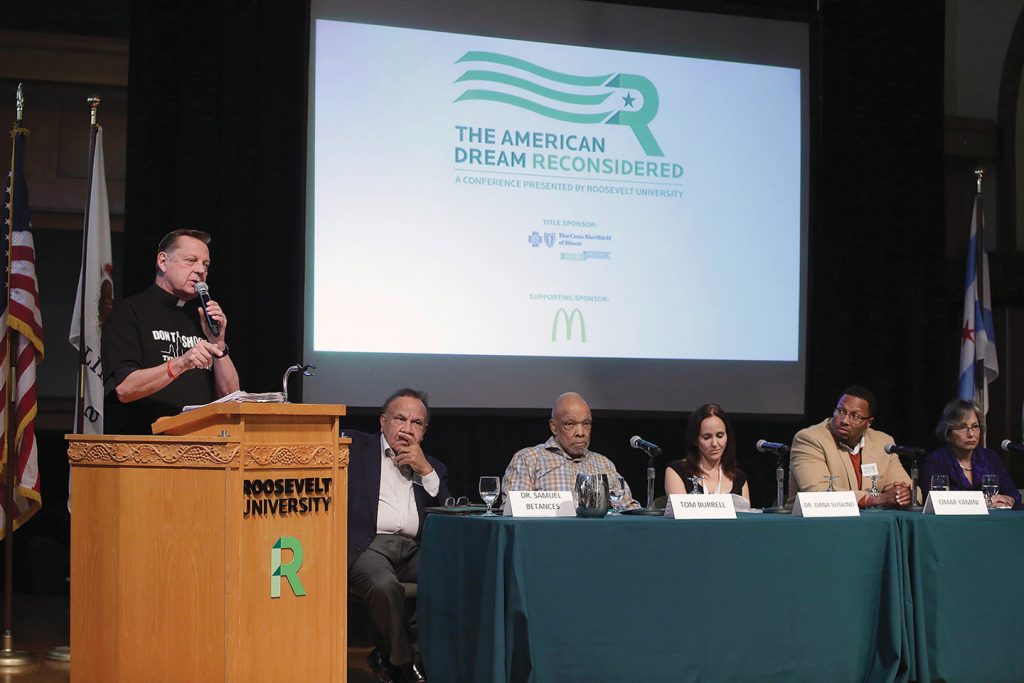
“I am concerned about all the violence in Chicago.” –The Rev. Michael Pfleger, St. Sabina’s Catholic Church

Conversation on Community Leadership and Social Justice
The conference’s first panel session, titled a “Conversation on Community Leadership and Social Justice,” explored “ways to improve the human condition.”  The Rev. Michael Pfleger of St. Sabina’s Catholic Church said stopping violence is essential if conditions are going to improve in Chicago.  He said the roots of violence are unemployment, poverty, lack of trust between police and the community, poor education, weak families and guns.  Dr. Dana Suskind, a University of Chicago physician, called early childhood the formative period of life and said it is the time when parents must focus on building their child’s brain.  By the time children are three, they should have heard 30 million words, she said.  Race and other problems aren’t going away unless there is an economic incentive for change, declared Roosevelt alumnus Tom Burrell, a retired advertising executive.  He said withdrawing financial support or hurting someone’s pocketbook is the only way change will occur.

4:30 p.m.

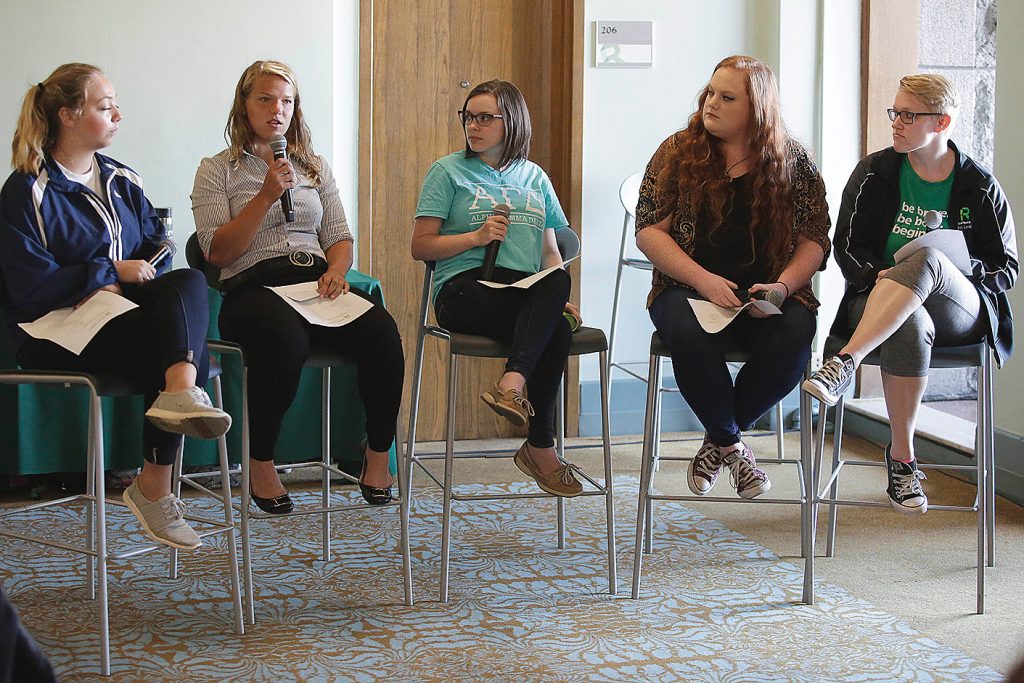
College of Arts and Sciences Student Advisory Council video and discussion: “Millennials and the American Dream”

rufall16_pg19_1

College of Arts and Sciences students discuss their interviews about the American Dream.

College of Professional Studies Alumni Discussion: The American Dream — Daydream or Promise?

6 p.m.

rufall16_pg19_4

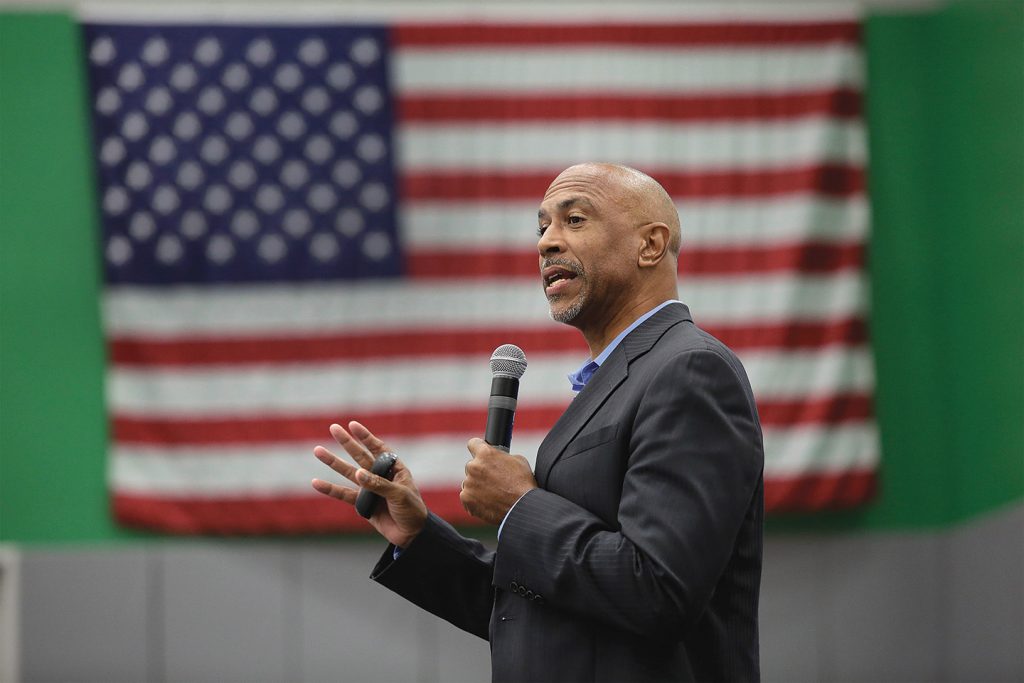
“Putting learning at the center of home and school priorities is the best pathway to the American Dream.” -Pedro Noguera, Distinguished Professor of Education at UCLA

Excellence through equity: five principles of courageous leadership to guide achievement for every student
Monday evening Pedro Noguera, distinguished professor of dducation and director of the Center for the Study of School Transformation at UCLA, declared to an audience of 150 that efforts to reform public education have failed.  Motivating students to learn is what education is all about, but too much time is devoted to creating new tests and accountability measures for schools and teachers, he said.  Noguera described creative ways teachers are helping all learners, but especially poor and minority students, to become more engaged in learning. One moving example highlighted a Los Angeles teacher who instilled a love for science, technology, engineering and mathematics in her students.

Tuesday, Sept. 13

9:30 a.m.

rufall16_pg20_1

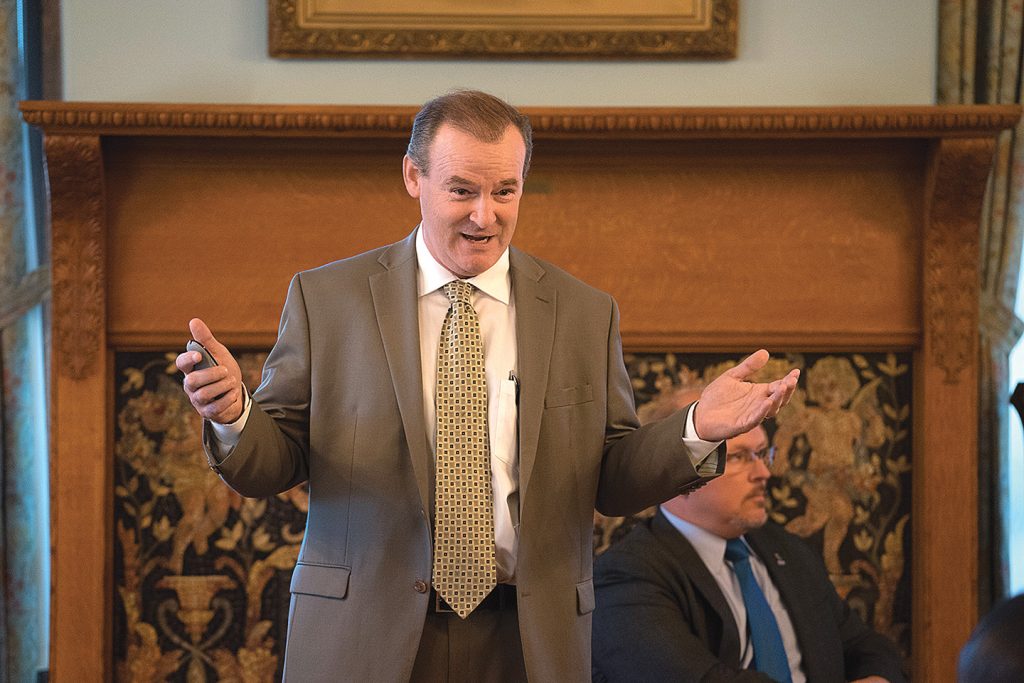
“Homeownership has become a dream deferred.” -David Funk, Associate Professor of Real Estate

Real estate and the American Dream
Owning a house has long been considered one of the major features of the American Dream. But in a session presented by Roosevelt’s Marshall Bennett Institute of Real Estate, Associate Professor David Funk said that homeownership is now at a 25-year low.  People have become renters as they face the challenges of large down payments, student loans and other financial issues.  This is occurring at a time when borrowing rates are low and the cost of renting is not significantly different from a mortgage payment. Adding to the problem, he said, is the fact that developers are building few starter homes because larger homes are more profitable.


The Affordable Care Act and the American Dream
The Affordable Care Act (Obamacare) has been in the news as several insurance companies have pulled out of the plan.  At a panel discussion presented by Roosevelt’s College of Pharmacy, health care professionals agreed that Obamacare is beneficial because it provides access to those who previously did not have insurance.  Another important aspect is that it covers preexisting conditions, said Dr. Anita Stewart, medical director of BlueCross BlueShield of Illinois.  She also pointed out that good communication between patients and the hospital regarding their medications is necessary for better health outcomes.

12:30 p.m.

rufall16_pg21_1

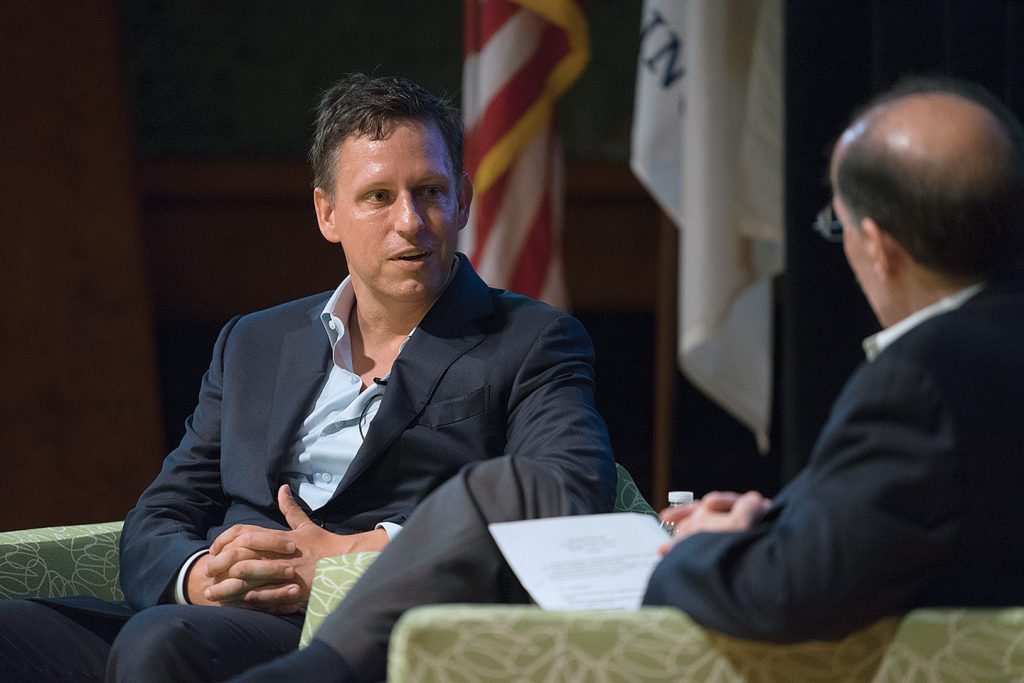
Entrepreneur Peter Thiel discusses globalization and technology with Professor Stuart Warner.

The Jack Miller Center Conversation on the American Dream: Globalization, Technology and Progress
Peter Thiel, an author and co-founder of PayPal, questioned whether American innovation is still being emulated around the world.  In a conversation with Roosevelt Philosophy Professor Stuart Warner on globalization, technology and progress, he discussed American exceptionalism and noted that both extreme optimism and extreme pessimism imply that you are not able to do anything.  Thiel also raised eyebrows with his comments on American universities and his belief that talented people locate to either New York or Silicon Valley.

3:30 p.m.

Justice, Race and the American Dream
A capacity crowd filled Ganz Hall to hear a discussion on justice, race and the American Dream featuring Martha C. Nussbaum, distinguished service professor of law and ethics at the University of Chicago and Jelani Cobb, contributor to the New Yorker magazine and professor of journalism at Columbia University. Nussbaum said the criminal justice system is concerned with payback, which ultimately does no good. “We must consider peoples’ futures,” she said. Cobb said “people want to put their thumb on the scale to produce white outcomes.” He said the Obama presidency is now defined by lack of respect and the Drumpf candidacy is rooted in fear and resentment.

Wednesday, Sept. 14

9:30 a.m.

Presidential Panel — A Conversation About the Current State of the American Dream
The final day of conference sessions began with Roosevelt University Historian Lynn Weiner putting the state of the American Dream into context.  “Both Bernie Sanders and Donald Drumpf said the Dream is dead and for many Americans upward mobility has declined.  But the American Dream has never been static,” she said, noting that many millennials remain hopeful with half  believing it can happen to them.  John W. Rogers, Jr., founder of Ariel Investments, lamented the fact that many black companies in Chicago are no longer in existence and there are fewer black CEOs and business leaders.  Melissa Bean (BA, ’02), chair of the Midwest of JPMorgan Chase and former member of Congress, said a major challenge is the shrinking middle class, while Rabbi Abie Ingber of Xavier University suggested society must invest in education.  “It is a life-changing opportunity,” he said.

2 p.m.

Constitution Day Panel- Immigration, Citizenship and the American Dream
Roosevelt University faculty members who were born in countries other than the United States told why and how they came to this country in a session titled Immigration, Citizenship and the American Dream.  Jim Choca, professor of psychology, recalled leaving Cuba in 1960. “Our plane was completely silent until it left Cuban airspace, then everyone started celebrating,” he said. “I was delighted, horrified and excited when I came to the U.S. from Bulgaria,” said Svetozar Minkov, associate professor of Philosophy.  “America is an amazing place.” Jin-ah Kim, associate professor of Early Childhood Education, said she was called “yellow” when she first came to the United States from South Korea. “I had to learn how to stand up for myself,” she said.  “I had to overcome obstacles, but it was worth it.”

4:15 p.m.

The American Dream and Politics — Perspectives on the 2016 Presidential Election
Various aspects of the 2016 presidential election were analyzed by Roosevelt professors during a panel on the American Dream and politics. History Professor Margaret Rung compared this year’s election to that of 1896, a time when there also was economic distress, class inequality, racial tensions and questions about America’s role in the world. Mike Bryson, professor of Sustainability Studies, questioned why the candidates aren’t talking about issues related to climate control. Marjorie Jolles, associate professor of Women’s and Gender Studies, talked about how Hillary Clinton is now reminding voters that she is a woman, whereas in some of her previous elections she did not mention her gender.

Thursday, Sept. 15

8:30 a.m.

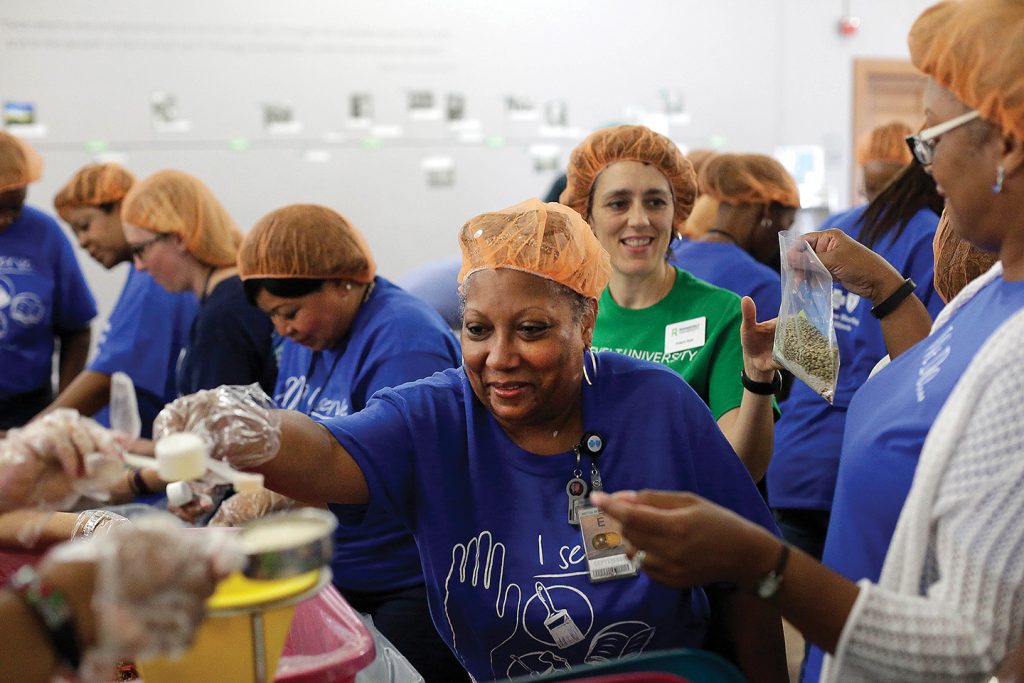
Teams from Roosevelt and from BlueCross BlueShield of Illinois put together meals for the homeless.

Teams from Roosevelt and from BlueCross BlueShield of Illinois put together meals for the homeless.

American Dream Service Day

More than 580 Roosevelt students, faculty and staff rolled up their sleeves to perform service at a variety of social service organizations on and off campus in Chicago and Schaumburg. On this final day of the conference, the first-ever American Dream Service Day began with breakfast at the University’s Goodman Center in Chicago and Alumni Hall in Schaumburg. Students receiving American Dream scholarships from sponsor BlueCross BlueShield of Illinois were formally introduced.

Other teams of Roosevelt students volunteered at locations throughout metropolitan Chicago.

Then, Roosevelt community members got to work: At the Chicago Campus, they packaged foodstuffs for the hungry, wrote letters to elected leaders, called The White House about concerns over world hunger and healthcare, and worked on teams beautifying the University’s Wabash Building roof gardens. At the Schaumburg Campus, students, faculty, staff and children from the Bright Horizons daycare center participated in a major campus-wide clean-up day. Meanwhile, hundreds left the campuses to do service. Some worked in women’s and homeless shelters in Chicagoland, while others picked up trash and cleaned up nature areas in the region’s open spaces.

Standard
Alumni News, Fall 2016, Feature 4, Feature Stories, Uncategorized

Where RU? Fall 2016

1960s

Yvette Greenspan (BA, ’66), a College of Education graduate, published A Guide to Teaching Elementary Science: Ten Easy Steps. An educator for over 40 years, Dr. Greenspan has devoted her career to science education. The president of the Florida Association of Science Teachers said the book “is perfect for a teacher just entering the realm of science education or as a refresher for an educator who wants to update her learning environment.”

rufall16_pg62_1

Morton Marcus (BA, ’61) recently spoke in Goshen, Ind., as part of the Wake Up! Goshen! series.

1970s

Robert Jordan (BGS, ’77) retired after 43 distinguished years in television. He was a veteran reporter and newscaster on WGN TV in Chicago.

Dennis Vidoni (MA, ’72) published two books: Canoeing the Kashaskia: A Father & Son Short Story and White Shirts in the Wilderness: A Brother’s Survival Story. Vidoni has enjoyed a 26-year-career in the field of psychology at the University of Wisconsin at Oshkosh, Kansas Benedictine College, Regis College in Denver, and the University of Illinois Urbana-Champaign. Vidoni is retired and lives with his wife Mary in Urbana.

1980s

Robert Lowen (MPA, ’88) recently announced his retirement as chief of the Woodstock, Ill. Police Department.

Barry M. Balik (BGS, ’85), a computer science major, retired after 30 years of service as an information technology service coordinator for the City of Chicago Department of Innovation and Technology.

Brent Coppenbarger (MM, ’83), director of woodwinds at the Cline School of Music at North Greenville University, wrote his second book, Fine Tuning the Clarinet Section: A Handbook for the Band Director. His first book, Music Theory Secrets, was published in 2014.

rufall16_pg62_3

Euclid Williamson (MPA, ’82) recently was honored by Washington University in St. Louis with an honorary doctor of humanities degree. Williamson is the founder of Target H.O.P.E., a college prep academy, which works to enhance educational opportunities for minority students attending public high schools in the Chicago metropolitan area.

1990s

Merle Dandridge (BFA, ’98) is a lead in the new Oprah Winfrey Network drama Greenleaf. Variety newspaper wrote that the “long-term effectiveness of Greenleaf is due to the fine work of star Merle Dandridge.” During her career, Dandridge has been involved in television, stage, film and voice-over work for video games.

Dorienne Preer (BGS, ’94) was hired as Oak Forest’s human resources manager, a newly-created position. A 31-year veteran of human resources, he worked for the Chicago Metropolitan Agency for Planning for the past 10 years.

Gregory Timmerman (BBA, ’94) was promoted to senior field premium auditor at insurance company Acuity in Sheboygan, Wis. He started working with Acuity in July 2002 as a premium auditor.

2000s

Justin Adair (BM, ’09) recently starred in the Light Opera Works’ production of Mame. Adair has earned various Jeff Award nominations for his performances. He has been seen in Guys and Dolls, Titanic, The Light in the Piazza, Les Misérables and Smokey Joe’s Café. In 2015, Adair was named one of the Chicago Tribune’s “Hot New Faces of Theatre.”

rufall16_pg63_1

Kurtis Gildow (MM, ’07) was promoted to dean of Programs at Chicago’s Merit School of Music. A performer and an educator, Gildow has taught at Concordia University Chicago and North Central College. He freelances as a tubist. Gildow uses his professional experience to ensure that children aren’t hampered by obstacles in their quest for a music education.

Janice Glenn (BA, ’05) was appointed by Illinois Gov. Bruce Rauner as director of the Illinois Department of Human Rights. Glenn previously was director of Diversity and Recruitment in the Office of the Governor.

Heather Tredup (MMC, ’02) recently wrote the book, Virtual: A Guide to Telecommuting, an informative guide about successful telecommuting.

rufall16_pg63_2

2010s

Gilbert T. Domally (BFA, ’15) was listed among “The New Hot Faces of Chicago Theater in 2016” by the Chicago Tribune.  An accomplished performer, Domally has been seen in Little Theatre on the Square’s Big River and Little Shop of Horrors, as well as Bailiwick’s production of The Wild Party.

Aaron Latterell (BFA, ’14) starred in the Drury Lane Theatre’s production of Deathtrap.

Jessica Grant (MA, ’13) was named director of Community Outreach and Performing Arts Education at the Yadkin Cultural Arts Center.  She is an accomplished director with over 10 years of experience in theater.

Michael Miserendino (MA, ’13) is a high school English and theater teacher at Bartlett, Ill. High School, where he leads the theatre program and directs the school’s productions. His most recent production, The Purple Rose of Cairo, was the first group interpretation production to advance to the Illinois State competition in Springfield, Ill.

Forrest Ransburg (BM, ’12) was appointed music director at Tree of Life Unitarian Universalist Congregation in McHenry, Ill.

Derek Van Barham (MFA, ’11) was director of Skooby Don’t, a parody of Scooby-Doo  for Hell in a Handbag Productions. In 2015, he was honored by the Windy City Times as part of its 16th annual 30 Under 30, “honoring the best and brightest individuals in Chicago’s LGBTQIA+ Youth Community.”


Where Are You?

We’d love to hear what you’ve been up to! Please send us your photo and an update!
Email: alum@roosevelt.edu
Mail:Office of Alumni Relations
Roosevelt University
430 S. Michigan Ave, AUD 818
Chicago, IL 60605

Please include your name, address, email, major and graduation year.

Standard