Attending the 2011 ASLE Conference

Tomorrow I head down to Bloomington, Indiana, to participate in one of my favorite professional conferences — the biannual meeting of ASLE, the Association for the Study of Literature and Environment. As a scholar whose work straddles the humanities and natural sciences, and as someone teaching in RU’s newly-developed Sustainability Studies program, I’m always delighted to attend this energetic and intellectually-stimulating gathering of writers, teachers, scholars, artists, and activists. All of them are committed to advancing the cause of environmentalism, but from a myriad of perspectives and methods. Plus, we always manage to take a good field trip or two in between the formal conference proceedings.

This year’s ASLE meeting is hosted by Indiana University, and my journey this week will mark my first visit to that university as well as to Bloomington — another reason I’m looking forward to the adventure.

Indiana University's campus in Bloomington, IN

I’m very familiar with the “other Bloomington” of the Midwest — the one in Illinois where I went to college at Illinois Wesleyan University and which I still visit periodically with my family — but I’ve always had a notion to see this much-touted community that was the setting for the wonderful 1979 film, Breaking Away.

I’m taking part in a roundtable-style panel entitled “Sustainability Education: Multidisciplinary Perspectives and Approaches” that includes faculty participants from colleges and universities all across the US. My fellow panelists are presenting on topics ranging from teaching sustainability and literature in Appalachia, to designing interdisciplinary courses on climate change, to the creation of a sustainability blog that showcases student writing and art, to exploring ways in which sustainability can be infused throughout the general education curriculum for undergraduates.

My own presentation focuses on the new Sustainability Studies (SUST) program here at Roosevelt University. The program grew out of an experimental course on urban sustainability I team-taught back in the spring of 2009, an experience described in an essay from the July 2010 issue of Metropolitan Universities. As a new undergraduate degree housed in Roosevelt’s College of Professional Studies, the nascent SUST program just finished its third semester and has approximately 25 majors enrolled at Roosevelt’s two campuses (Chicago and Schaumburg, IL) and taking online courses. The curriculum’s core is a series of interdisciplinary courses that integrate the natural and social sciences with the humanities and address key issues and themes such as water; food; waste; biodiversity; energy and climate change; sprawl and transportation; and policy and ethics.

Three things strike me about our program as relevant to this panel’s discussion of sustainability education. The first is the institutional context in which our program emerged at RU, since many colleges and universities are considering ways to incorporate sustainability into their curriculum, whether as new ways to teach existing courses or in the shape of new courses and/or programs. In our case at Roosevelt, the university had some “vacant land” within the undergraduate curriculum which provided us with an opportunity to propose and develop this new major. While RU has well-established programs in biology and chemistry, there were no majors in environmental policy, studies, or science. My home college has an entrepreneurial orientation, and thus the development of the SUST curriculum received strong in-house support from our dean. It was favorably received by university-wide faculty committees, as well, in part because we took pains to show how the program was meant to complement existing science programs, rather than compete/conflict with them. By developing solid cross-college relationships with faculty colleagues in biology, chemistry, environmental science, math, and business, we hope to engage in future collaborations on many levels. One promising example of this is that SUST faculty were invited to participate in the current revamping of RU’s environmental science minor.

A second observation is how sustainability education contributes to an institution’s overall work to improve its physical operations and thus serve as a model of a sustainable community (a process I describe in my “Sustaining Sustainability” essay circulated previously). We at RU are behind many other US colleges and universities (such as Dickinson College, as chronicled by Professor Ashton Nichols), but we have become galvanized recently around a common goal of improving the sustainability of our two campuses and connecting this improvement as much as possible to our teaching, research, and service-learning activities. In this respect, sustainability education — whatever form it takes in a particular institution — can be an powerful force in getting people (from college administrators to alumni to community members) to see the ethical importance and economic benefits of reducing resource use, reducing waste, recycling materials, conserving water and energy, fostering local food production, and educating eco-literate citizens.

Lastly, there’s the transformative potential of technology, field experiences, and service-learning for sustainability education, all of which are exciting areas of inquiry and experimentation that can revitalize our teaching and stoke the inherent enthusiasm we’ve observed in our students for the ideas and practical applications of sustainability. In line with the College of Professional Studies’ tradition of serving adult / non-traditional learners (quite often parents juggling work, family, and school), we use technology to offer courses in a mix of formats — face to face, fully online, hybrid, and weekend — a course delivery approach which, though challenging to manage, greatly increases student access to our program. Just as significantly, our Sustainability Studies @ Roosevelt University blog, authored and maintained by my colleague Carl Zimring, serves triple duty as a teaching resource, marketing tool, and go-to news source about environmental issues impacting the Chicago region.

Another key feature of the SUST curriculum is its emphasis on field experiences to supplement classroom and online instruction. In my SUST 210 Sustainable Future and SUST 220 Water courses, as well as other classes, I take students out to various sites in the city and suburbs where they can talk with experts, gather and analyze empirical data, examine innovations in sustainable design and planning, and engage community members in environmental/social justice issues. Recent field trip sites have included the Chicago Center for Green Technology, the Field Museum of Natural History’s zoology collection and laboratories, the Chicago Wilderness “Wild Things” biannual environmental conference at University of Illinois at Chicago, the Chicago River, and local nature preserves and restoration sites. Many students describe these trips as powerfully transformative experiences that introduce them to places they never knew existed, educate them about social and environmental problems in a way no course reading or lecture could, and dramatically shift their perceptions about the status and potential of urban natural resources.

Closely connected to these field experiences are the service-learning activities we are currently engaged in as well as planning for the future. These run the gamut from students in our SUST 330 Biodiversity class working side-by-side with Field Museum scientists analyzing data and cataloguing specimens, to SUST 230 Food students contributing their labor to local urban farms. Service-learning is the explicit focus of SUST 350 Service & Sustainability, a course I will debut next spring as “Urban Farming, Community Development, and Social Justice.” Students here will learn about one of the most important components of sustainability, food production and consumption, in the context of urban neighborhoods and ecosystems. By doing hands-in-the-dirt labor at the Chicago Lights Urban Farm operation in Chicago’s Cabrini-Green neighborhood, they will gain direct knowledge of modern organic/urban agricultural systems as well as learn about pressing urban social justice issues such as food deserts, gentrification, pollution, environmental racism, and persistent poverty.
SUST 220 Water — Fall Preview

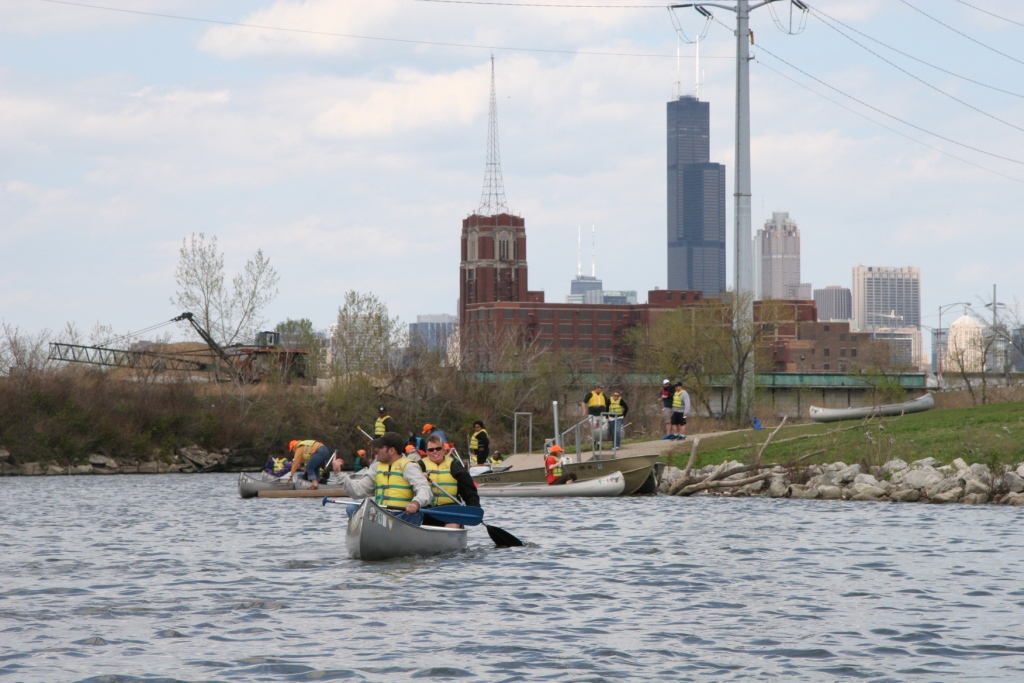
This coming fall semester, SUST 220 Water will be offered for the first time at RU’s Schaumburg Campus. The 12-week course will run in a unique “hybrid” format combining four Saturday meetings (from 10am to 4pm) with online interaction via the course Blackboard site during the intervening weeks. This weekend/hybrid schedule not only makes the course accessible to students in the suburbs as well as the city, it provides us with the opportunity to pursue some interesting water-focused field trips to instructive sites in the region, such as the Chicago River (which just received this good news about its future water quality) and the Des Plaines River Wetland Demonstration Project (just to mention a couple of places I have taken past classes).

RU students & faculty canoe the Chicago River, May 2009 (photo by B. Hunt)

Course Profile / Registration Info

  • SUST 220 Water, section L30 (Schaumburg Campus) / Fall 2011
  • Meeting dates: Sept 10th, Oct 8th, Oct 29th, and Dec 3rd
  • Pre-req: English 101
  • Online interaction required through RU Online / Blackboard
  • Taught by: Professor Mike Bryson (mbryson@roosevelt.edu / 847.619.8735)

These books are on order at the RU bookstore:

Recommended but not required is an excellent text I used last year in the augural section of SUST 220 — The Atlas of Water, by Maggie Black and Jannet King (Univ of CA Press, 2nd ed., 2009).

If you are interested in enrolling in SUST 220 this coming fall, please contact your academic advisor, and feel free to get in touch with me if you want to learn more about the course. Enrollment is limited, so plenty of personal attention from yours truly is guaranteed. And if you’ve never tried an online course before, taking a hybrid course such as this is a great way to “test the waters,” since students will have ample opportunity to interact with me and each other face-to-face, as well as get help/support with the online component if need be.

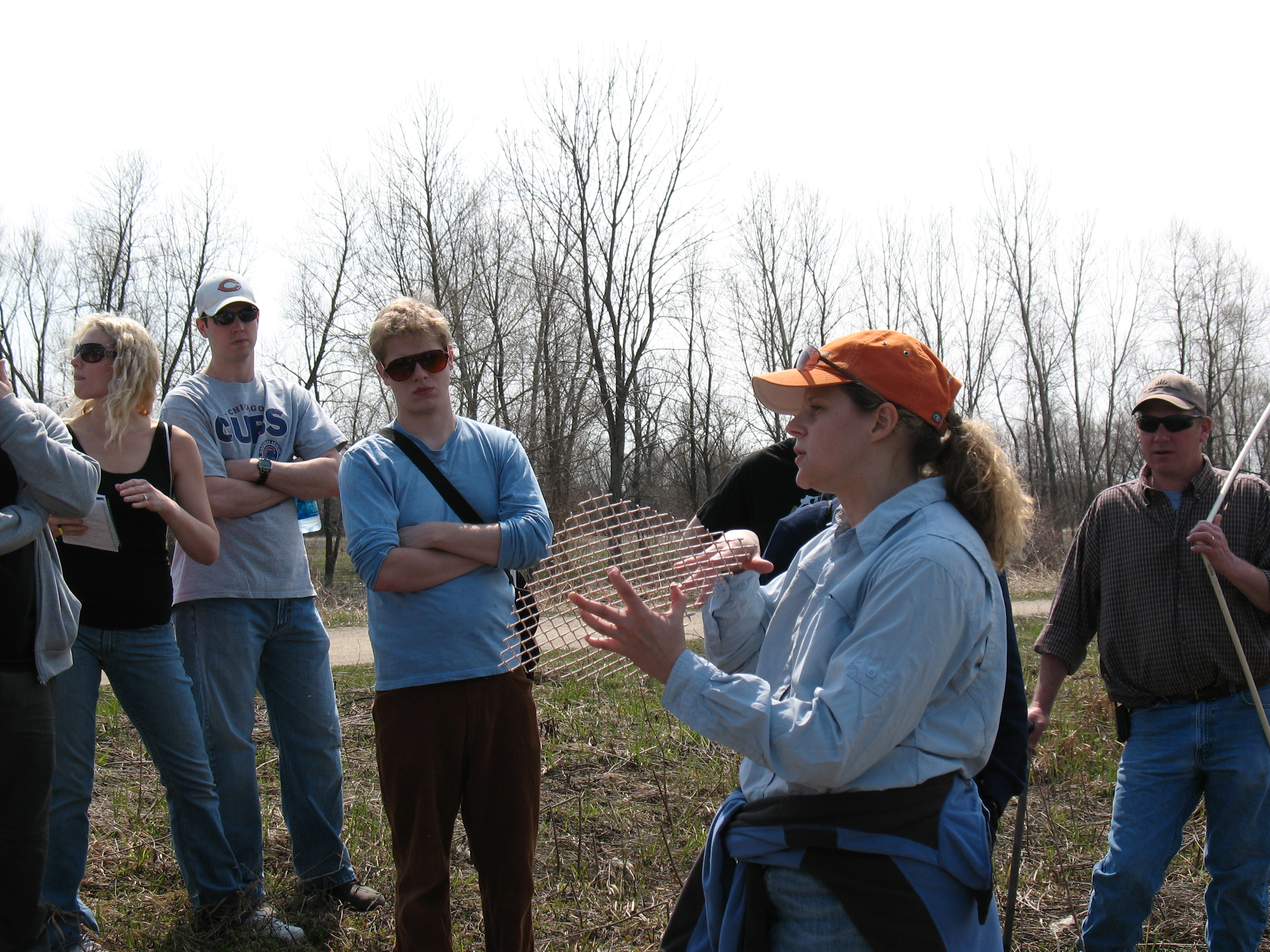
Wetlands Research Inc. ecologist Jill Kostel talks about the restoration work underway at the Des Plaines River Wetland Project, April 2009 (photo by M. Bryson)

Like to know more? Below is a preview of the kinds of topics we’ll investigate in SUST 220.

Water, the Stuff of Life

Without water there is no life. Without clean water, human and animal life is vulnerable to catastrophic disease. How, despite population growth and industrial production, can we ensure clean supplies of water for humans and wildlife? This course evaluates water quality and water sustainability issues through the analysis of local, regional, and global issues and case studies.

Consider, for example, the connections between local and regional water issues here in the Chicago area. Chicagoans have the luxury of living on the shores of the world’s greatest repository of fresh surface water, the Great Lakes, a position we regrettably abuse by withdrawing several hundred million gallons of Lake Michigan water every day simply to flush our sewage downstream to Peoria and all points south. By contrast, most communities in northeastern Illinois that lie outside the Great Lakes basin draw their water from surface streams or underground aquifers, sources that are vulnerable to over-use and pollution. According to the 2009 report “Before the Wells Run Dry” by the Chicago-based Metropolitan Planning Council and Openlands, the long-term sustainability of fresh water in Illinois requires much better conservation of these finite resources and improved long-term water supply planning.

: : For more information on local water issues, as well as sustainability events and issues within the Chicago region, be sure to check out the Sustainability Studies @ Roosevelt University Blog, which just reported on a landmark vote on June 7, 2011, by the Metropolitan Water Reclamation District to start disinfecting wastewater returned to the Chicago River.

Canoeing highly polluted Bubbly Creek, aka the South Fork of the Chicago River's South Branch (photo by L. Bryson)

A global perspective on water availability reveals far more disturbing realities. The earth is a planet defined by an abundance of water, of which almost 98 percent is salty or brackish. Just over two percent is fresh, and more than two-thirds of that water is locked up in ice sheets, glaciers, and permafrost. Thus, only a tiny fraction of the earth’s water is available to us for drinking, bathing, flushing toilets, growing crops, etc. That finite resource is imperiled by the unsustainable trends of pollution, overuse, waste, and lack of access. In developing countries, about 90 percent of sewage is dumped into rivers without any treatment. Worldwide, polluted rivers transport toxins and excess nutrients to coastal areas, where biological “dead zones” result; from 1995 to 2007, the number of such oceanic dead zones increased by 30 percent. Depending where you look, overconsumption or scarcity is the defining problem. Citizens of the US accustomed to readily available freshwater consume about 100 gallons day per household, on average; while globally, nearly two billion people lack ready access to clean water.

Key concepts and themes addressed in SUST 220 include the science and policy of ensuring a safe water supply; water conservation strategies, particularly in urban areas; wastewater treatment and  watershed management; and wetlands ecology, restoration, and management. Students will develop a thorough understanding of the water cycle and its relation to the sustainability of water systems; understand and assess the importance of water as an environmental as well as cultural resource; learn to define, measure, and sample water quality in a variety of contexts using simple yet effective field-based water chemistry sampling techniques; and evaluate contemporary water management and policy issues, particularly those affecting the waterways of the Chicago region as well as the Great Lakes ecosystem.

Sustainability in Joliet

Here in my hometown of Joliet, Illinois, one of this spring’s biggest events is happening this coming Saturday, May 21st, at the Public Library’s Black Road branch by the Rock Run Forest Preserve. It’s the GR2011 Sustainability Festival, a family-friendly celebration of nature, green technology and innovation, recycling, and environmental conservation.

Volunteers at last year's GR2010 Festival in Joliet

Based on the tremendous and somewhat unexpected success of last year’s inaugural festival, GR2011 should be even bigger and better. And with an impressive line-up of live music as well as local food vendors, the Festival is living proof that that promoting environmentalism and having fun aren’t mutually exclusive pursuits.

Even more importantly, in the year since the Will County Forest Preserve, the Joliet Public Library, Joliet Junior College, and the City of Joliet collaborated on 2010’s festival, the Joliet region has continued to take meaningful steps toward becoming a environmentally progressive and more sustainable community. That movement is part of a larger wellspring of environmental activism throughout the Chicago region, from the inner city to the outer suburbs.

Consider just a few representative examples here at home. Tonight at the Black Road Library is a free screening of the film, “Fresh,” which profiles farmers and food entrepreneurs who have developed creative approaches to sustainable agriculture. The movie is the fourth of weekly screenings leading up to the GR2011 Festival, and the film series has been a refreshing addition to the city’s cultural scene.

JJC greenhouse (photo: Steinkamp Photography / Legat Architects)

Two other key players on the local sustainability scene are JJC and USF, both of which are undertaking a variety of environmental initiatives. I visited JJC on their Earth Day celebration last month, and spoke with several students and faculty who are passionate about environmental stewardship, green design, and sustainable agriculture. The college is emerging as a regional leader in campus greening initiatives, and the faculty there are just starting to collaborate on an exciting new sustainability curriculum.

Meanwhile, USF and the recently-lauded grassroots organization Cool Joliet have broken ground on a community garden along busy Plainfield Road on the city’s near-West Side. The newly-constructed raised beds herald the forthcoming transformation of this neglected vacant lot into a productive green space.

Cool Joliet is also working on a similar garden at nearby Farragut school, which reportedly will be one of several school gardens planned in District 86. This bodes well for the 11,000 children in the district, as such gardens not only beautify school grounds, but also serve as multidisciplinary learning laboratories, points of contact with nature, and much-needed sources of fresh produce.

All these efforts show that sustainability is not just a trendy buzzword or an abstract concept. It’s a practical and fundamentally positive approach to environmental stewardship that foregrounds green entrepreneurship and social justice.

Don’t just read about it here, though. Come to the GR2011 Festival in Joliet on May 21st and see for yourself!

A version of this post, “Festival Celebrates What’s Green,” was published as my monthly op-ed column in the Joliet Herald-News on May 19th, 2011 (p14).

NU Summit on Sustainability April 1-2

I received word of this upcoming sustainability conference via email. The theme of the gathering is “Environmental Equity in the 21st Century,” and many of the events are free. Majora Carter is a major force these days in urban sustainability and social justice, having started her activist work in the Bronx.

The first annual Northwestern University Summit on Sustainability will be held April 1 & 2 on the Evanston campus. A keynote speech by Majora Carter, a MacArthur “Genius Award” Fellow, will take place on Friday, April 1st from 7 to 9 PM.  The event will continue on April 2nd, with sessions on Policymaking for Environmental Justice; Sustainable Urban Planning; Food as a Lens for Understanding Inequities; Stories of Local Transformation; and Sustainability in Corporations.

Other speakers include:
– Michael Dorsey, assistant professor of environmental studies at Dartmouth
– Mari Gallagher, principal of Mari Gallagher Research and Consulting Group
– Nia Robinson, the former Director of the Environmental Justice and Climate Change (EJCC) Initiative

This event is open to the public.  Find details at http://www.nusos.org/

Summer Internship Opportunities

I just caught wind of two very cool environmental internship opportunities for this summer — one local (Village of Glenview, IL), the other international (through Columbia University). For those of you who have time and would like to get hands-on experience in sustainability-related work experiences, this is something to check out.

(1) Ecological Restoration Intern
This summer position is with the Village of Glenview, which has an active and progressive natural resource management / environmental restoration program, headed by restoration ecologist Robyn Flakne. Dr. Flakne is a former adjunct professor of science in the College of Professional Studies, and will also be co-leading a field trip with me at the Schaumburg Park District on Sunday, April 10th. This is a terrific opportunity to learn about cutting-edge ecological restoration techniques and earn some bucks in the bargain. The application deadline is April 1st, 2011 (submission by email required).

Details about the position are available here: Natural Resources Ecological Intern – Glenview IL

(2) Summer Ecosystem Experiences for Undergraduates (SEE-U)
Applications are now being accepted for the 2011Summer Ecosystem Experiences for Undergraduates (SEE-U) program, offered by the Center for Environmental Research and Conservation (CERC) at Columbia University’s Earth Institute. SEE-U provides undergraduate students of all majors from all colleges and universities across the country with a global understanding of ecology and environmental sustainability through lectures, labs, and fieldwork carried out in unique natural settings.

– Students earn 6 academic credits in just 5 weeks. 
– No prerequisites required to enroll. 
– Fellowship funding is available through CERC.

Summer 2011 Field Sites

May 21 – June 25, 2011
The Atlantic Forest – Sao Paulo, Brazil 

May 28 – July 2, 2011
El Yunque National Forest – Puerto Rico 

July 9 – August 13, 2011
Punta Cana – Dominican Republic 

The program has a rolling admissions process. The next application review date is March 28, 2011. If you would like to learn more, please visit  www.cerc.columbia.edu/?id=see-u or contact Mr. Desmond Beirne at CERC at djb2104@columbia.edu or 212-854-0149. Students can apply online via ApplyYourself: www.cerc.columbia.edu/?id=see-u-app-process

Wild Things Conference This Saturday (March 5)

The fourth biennial Wild Things conference will take place all day tomorrow at the University of Illinois at Chicago. This day-long conference brings together the region’s best experts, hardest working professionals, most dedicated volunteers and anyone interested in nature. Technical presentations and interactive workshops explore the latest in natural areas conservation, wildlife protection and monitoring, and sustainability. The conference is organized in “tracks” designed for everyone from newcomers to experts. There is special focus on empowering citizen scientists, stewards and advocates with information, networking and good ideas.  Among the speakers scheduled are Roosevelt Professors Mike Bryson and Carl Zimring, as well as a keynote address by Aldo Leopold expert Curt Meine.

Keynote Presentation
Curt Meine
Green Fire: The Legacy of Aldo Leopold in the Chicago Region (includes a preview of a new film about Leopold)

Curt Meine will discuss the powerful role of famed conservationist Aldo Leopold in the birth and evolution of ecosystem conservation. Meine will highlight Leopold’s legacy as seen in the people, ecosystems, and history-making conservation initiatives of the Chicago area. He will also present a selection from the first full documentary film about Leopold, which is premiering this spring. Curt is a conservation biologist and writer based in Prairie du Sac, Wisconsin. A new edition of his 1988 book Aldo Leopold: His Life and Work has just been published by the University of Wisconsin Press. Curt currently serves director for conservation biology and history with the Center for Humans and Nature; senior fellow with the Aldo Leopold Foundation; and research associate with the International Crane Foundation.

For registration information, directions, and other details, see the conference overview page.

Summer Offerings in Sustainability Studies

The Sustainability Studies program at RU is pleased to unveil the summer schedule, including the debut offerings of three SUST courses.

During the May 4-week session, Professor Greg Buckley will offer SUST 390 Special Topics — Sustainability of the National Parks at both the Schaumburg campus and in a 10-day trip to Theodore Roosevelt National Park.  Enrollment for this special seminar is capped at eight students, so we urge you to look at Professor Buckley’s preview of the course and indicate soon whether you wish to participate in this unique experience.

In the session running from May 31 to August 19, we will offer three courses.

We will announce more new courses for the fall very soon, but if you are interested in taking courses this summer, please contact your RU academic advisor for registration details and consultations on financial aid options. Registration for the summer session begins March 1. If you are not currently a Roosevelt University student, we encourage you to investigate our degree options, and our course listings.  For more information, please visit  our Sustainability Studies website, call 1-877-277-5978 (1-877-APPLY RU) or email  applyRU@roosevelt.edu.

Sustainability of the National Parks: New Summer SUST Travel Course

This exciting new course, offered for the first time at Roosevelt University by Professor Gregory Buckley of the College of Professional Studies, provides a detailed look at the sustainability of America’s National Parks. This course examines the historical impetus and individuals that launched our national park system, and how the mission of the National Park Service has evolved to reflect the emerging ideals of conservation, environmentalism and sustainability.

SUST 390 will also explore historical and contemporary issues of National Park sustainability, such as the historical threats to park wildlife and ecosystems, commercial and political exploitation, and the ever-increasing stress put on the most popular parks by an escalation in the number of visitors. Readings and discussions will also examine procedures put into place by the National Park Service to make  park facilities and their operations more “green.” Field trips include a visit to a local forest preserve, as well as a 10-day trip to Theodore Roosevelt National Park in North Dakota.

For more information on Professor Buckley’s course, including required meetings at RU’s Schaumburg Campus and the travel itinerary for the North Dakota trip, see his course preview page for SUST 390 National Parks.

Midwest Real Food Summit 2011

Here’s another great opportunity to learn about sustainable food issues and systems, with a special focus on urban food production and consumption. This one’s to be held at Northwestern University in Evanston.

Midwest Real Food Summit 2011: Urban Food Systems in Development
Northwestern University, Evanston IL, Feb. 18 – 20.

Food is culture, food is community. It is what unites us, sharing a meal together. However, the system that produces and distributes and controls food in this country is flawed. The Midwest is the epicenter of our commodity food system and as students learning in midwest institutions we have the responsibility and the power to educate ourselves and those around us about the issues in the modern U.S. food system. That’s where this summit comes in!

For details and registration (students can attend for $25), see the Food Summit’s website.

Help RU Win a $250K Sustainability Grant

You and your friends can help Roosevelt University win a $250,000 grant from Pepsi that will be used to make the Schaumburg Campus an environmentally sustainable facility.

All you have to do is vote once a day during the month of January at this site: http://www.refresheverything.com/rugreenrooseveltuniversity. You can also vote on Facebook. The organization with the most votes receives the grant.

Should Roosevelt win, we plan to use the grant money in Schaumburg for the following projects:
— construction of a LEED-certified greenhouse that is powered by solar energy
— development of an organic garden to teach students how to grow native plants that will enhance the surrounding landscape
— replacement of the present asphalt in the parking lot with pervious concrete.

Roosevelt’s application is sponsored by RU Green, a student organization which was established to promote ecologically-conscious students, staff and faculty. Please help us win this major grant by voting only once a day!

Paul Matthews, Assistant Vice President, Campus Planning & Operations
Address replies to: pmatthews@roosevelt.edu