Feature 4, Feature Stories, Spring 2015

The Equality Experiment

TEXT ON WHITE

For many people the notion that a college or university could restrict admission because of one’s race, religion or gender is unthinkable. But that was the case just 70 years ago when Roosevelt University was founded. At that time, the majority of people attending colleges in the United States were white Christian men.

On the occasion of the University’s 70th anniversary, we asked University Historian Lynn Weiner to examine why the founding of Roosevelt was such an extraordinary occurrence in the history of social equality and why it was a success from the very beginning.


In nineteen forty-five, 70 years ago this year, Roosevelt College was created in a courageous effort to make higher education more democratic. It was born into a world where racial, gender and religious segregation dominated colleges and universities, in a nation where fewer than 20 percent of high school graduates went on to higher education and in a city where stores, restaurants, housing and recreation excluded African Americans.

The first student assembly at Roosevelt College

The first student assembly at Roosevelt College was held in the fall of 1945 in the Wells Street building.

College choices were limited in Chicago during the early 1940s. The only comprehensive public university was 140 miles away in Urbana-Champaign, until the University of Illinois opened a two-year campus for freshmen and sophomores on Navy Pier in 1946. Local options included professional and teacher-training colleges, junior colleges, Catholic schools and the University of Chicago and Northwestern University.

Bigotry further restricted college opportunities. Many private colleges and universities at this time – including Northwestern – imposed admissions quotas on the number of Jewish, Catholic and black students they would accept. To screen out “socially undesirable applicants,” they required photographs, personal interviews or the names of all four grandparents on applications.

The number of black enrollees at selective schools was miniscule and their applications discouraged. Princeton University, for example, would not admit black students until 1945. Public universities also discriminated by race. It was not until 1948 that the University of Arkansas admitted its first African-American student. Northwestern, which did admit up to five black students a year in the 1940s, excluded these students from on-campus housing until 1947.

Jewish students were held to quotas of between 2 and 15 percent as universities responded to what they termed the “Jewish problem.” These discriminatory admission policies, which had begun in the 1920s, persisted until the mid-1960s.

One exception was the Central YMCA College in Chicago. Opened in 1919, by 1941 it enrolled a diverse group of 2,240 men and women and identified itself as “liberal in spirit.”

By the early 1940s, however, the Y’s 16-member Board of Directors comprised mostly of local businessmen and bankers had grown uneasy with the rising numbers of “undesirable” black and Jewish students in the classrooms and hallways. They feared these students would drive away white Protestant applicants. In addition, despite the “liberal spirit” of the school, there were rigid racial restrictions in place. Black students, for instance, were expected to pay athletic fees but were not permitted to use the swimming pool, which was operated by the YMCA.

The president of the college was Edward “Jim” Sparling. A Stanford-educated psychologist, he arrived at the Y College in 1936 and found himself in increasing conflict with the YMCA over three major issues – admissions quotas, discrimination and academic freedom. When the Board told Sparling to prepare a census of the racial and religious composition of the student body, he refused, saying, “We don’t count that way.” In February of 1945 he was told to resign.

Edward James Sparling

Edward James Sparling, Roosevelt’s founding president.

President Sparling and his supporters immediately lobbied for a “friendly separation” from the YMCA and planned a new school – initially called Thomas Jefferson College – that would offer admission and equal rights to any qualified student. They sought financial backing from Marshall Field III, the Rosenwald Foundation, labor unions and progressive Chicagoans.

When efforts to interest the Y in this project failed, Sparling formally resigned on April 17, 1945, and in a walkout surely unique in American higher education, 62 faculty members resigned in his support and signed a document condemning the “illiberal and discriminatory purposes” of the Board. A student resolution soon followed, favoring separation from the Central YMCA College by a vote of 448 to 2. President Franklin Roosevelt had died on April 12 and two weeks later the new school was renamed Roosevelt College.
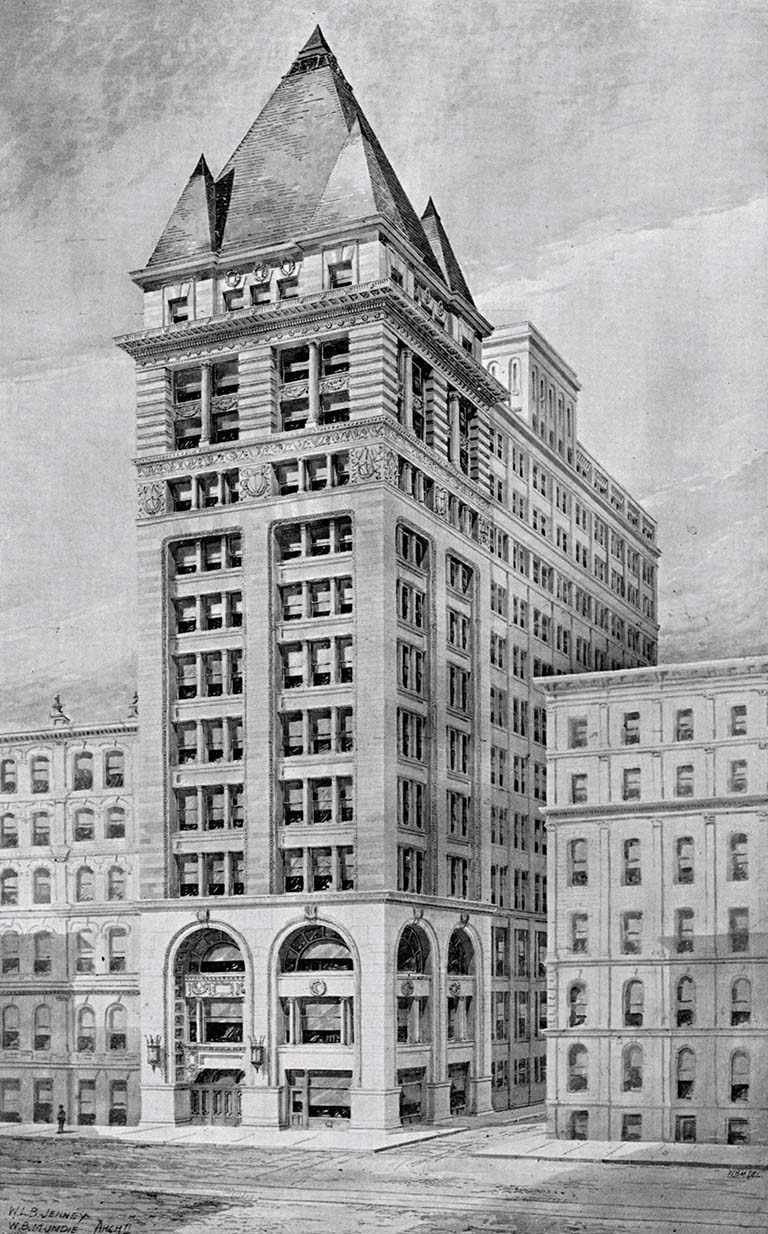
The YMCA College

The YMCA College closed soon after the faculty, staff and student body walked out in protest of discriminatory practices and established Roosevelt College.

Edwin R. Embree, a friend of FDR, head of the Rosenwald Foundation and first chair of Roosevelt’s Board of Trustees, said the new school “embodies the democratic principles to which President Roosevelt gave his life – the four freedoms in action . . . Roosevelt College of Chicago will practice no discrimination in students or faculty and no restriction of class or party line in its teaching or research.”

The College now had a mission, a name, a faculty and students, but no money, classrooms, labs or library. The new Board of Trustees, which included African-American chemist Percy Julian, was undoubtedly one of the first racially integrated college boards. It took the trustees until mid-July to acquire a home, an 11-story office building on Wells Street, and a lease on a second building on Wabash Avenue for a music school.
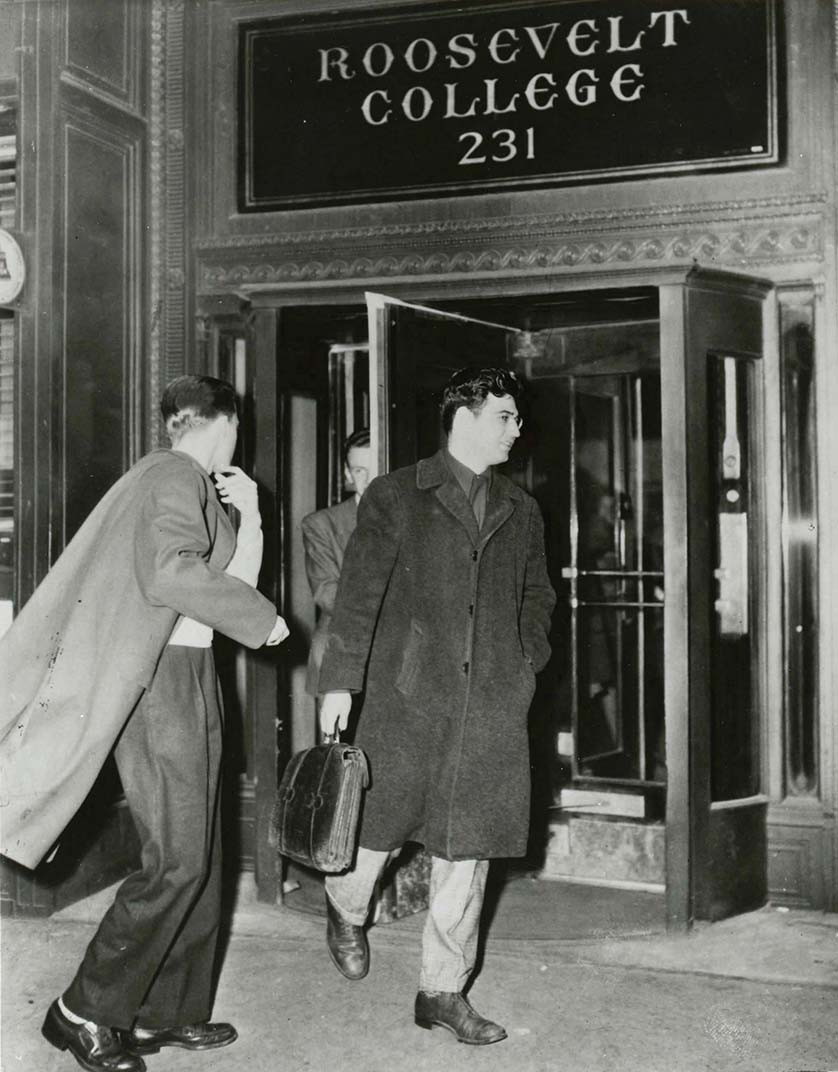
The first Roosevelt campus

The first Roosevelt campus was a hastily renovated office building sitting by the el tracks on Wells Street, and quickly proved too small for the numbers of students seeking admission.

The Board then had two months to raise money, remodel offices into classrooms, studios and labs, and plan for fall classes. They bought chairs from Standard Oil, lab equipment from Illinois Technical College, and books, desks and blackboards from a variety of sources. Faculty and students pushed carts piled high with books and supplies through city streets to set up the new campus and worked alongside painters and carpenters to ready the classrooms for the fall semester.
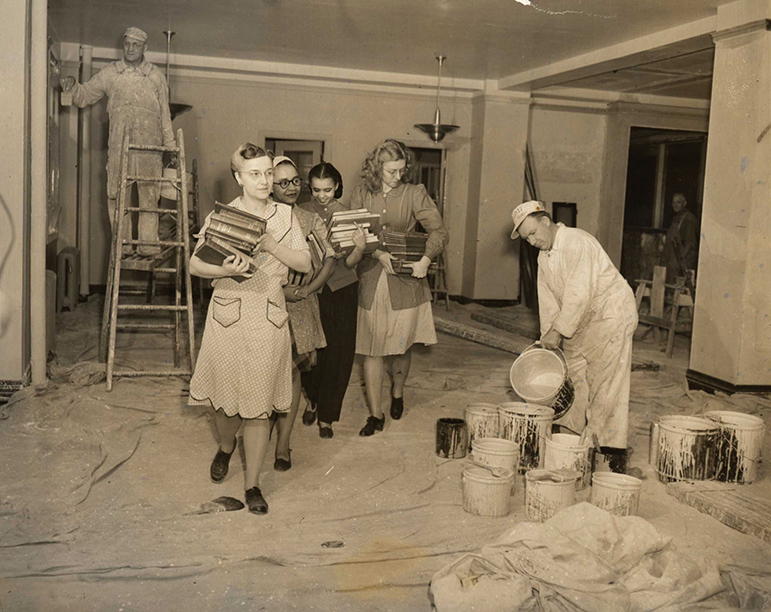
Founding librarian Marjorie Keenleyside

Founding librarian Marjorie Keenleyside (foreground) with help from students and staff established the first Roosevelt library in the fall of 1945.
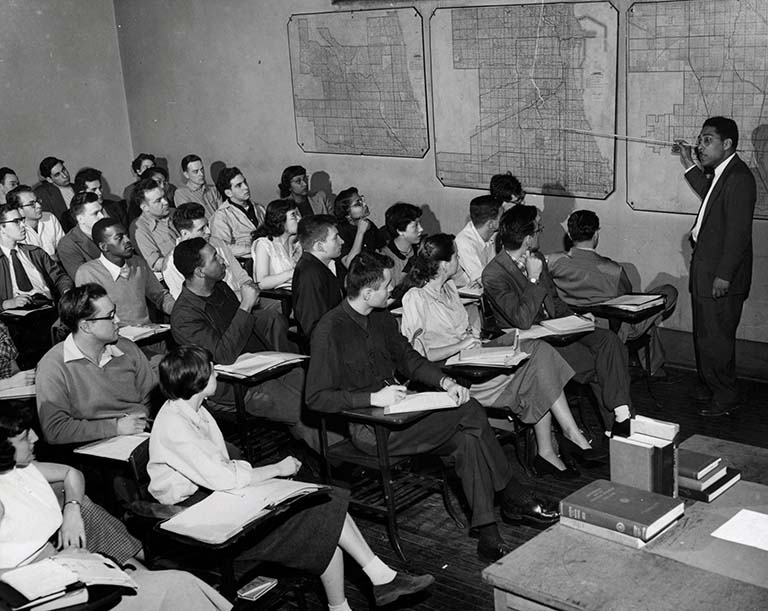
Roosevelt students studied with an outstanding faculty, including the sociologist St. Clair Drake (standing), who co-authored Black Metropolis, the classic study of race and urban lif

Roosevelt students studied with an outstanding faculty, including the sociologist St. Clair Drake (standing), who co-authored Black Metropolis, the classic study of race and urban life.

At the same time, Roosevelt College leaders were busy creating one of the most diverse faculties in the United States. In an era when most American professors were white male Protestants, Roosevelt hired men, women, African Americans, Jews, European refugees, Catholics and teachers from India, China and Latin America. Founding faculty included political scientist Tarini Prasad Sinha, sociologist Rose Hum Lee, economist Abba Lerner, philosopher Estelle De Lacey, language professor Dalai Brenes, sociologist St. Clair Drake, chemist Edward Chandler and many more.

The faculty grew to 71 full-time and 90 part-time professors by 1946. An additional 1,000 professors from around the country sent applications hoping to work at this pioneering college, even if it meant a cut in pay.

Eleanor Roosevelt

Eleanor Roosevelt, a staunch friend of the college from the start, celebrated the opening of Roosevelt College with President Edward James Sparling and 1,000 supporters at the Stevens Hotel in Chicago. Her declaration that the new school would “provide educational opportunities for persons of both sexes and of various races on equal terms” was radical for its time.

Approximately 1,200 students began classes on Sept. 24, 1945. They were even more diverse than the faculty – and were described by one newspaper as “Chinese, Japanese, Negroes, Levantines, Jews, Catholics and Down East Yankees.” The next year, realizing the first campus was too small to accommodate the number of students seeking admission, Roosevelt acquired Chicago’s famed Auditorium Building on Michigan Avenue. Five thousand students, from military veterans to new high school graduates, registered for classes in the fall of 1947.
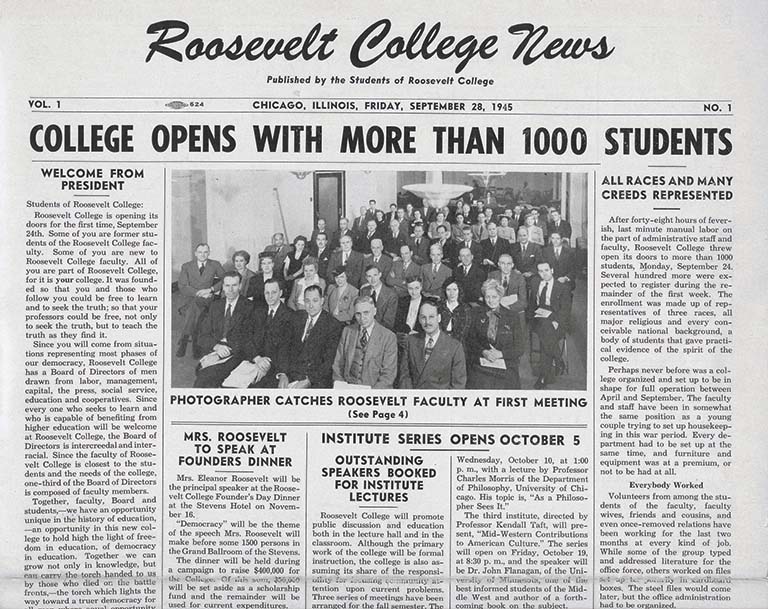
 The first issue of the student newspaper.

The first issue of the student newspaper featured a front-page story on Roosevelt’s opening.

And so a new college began. Magazine and newspaper reporters flocked to the classrooms and marveled at Chicago’s “equality lab.” In November of 1945 Eleanor Roosevelt, chair of Roosevelt’s Advisory Board, dedicated the college “to the enlightenment of the human spirit.” A remarkable act of courage by a college president, staff, faculty and students in the spring of 1945 had created, as one journalist wrote, nothing less than “a model of democracy in higher education.”
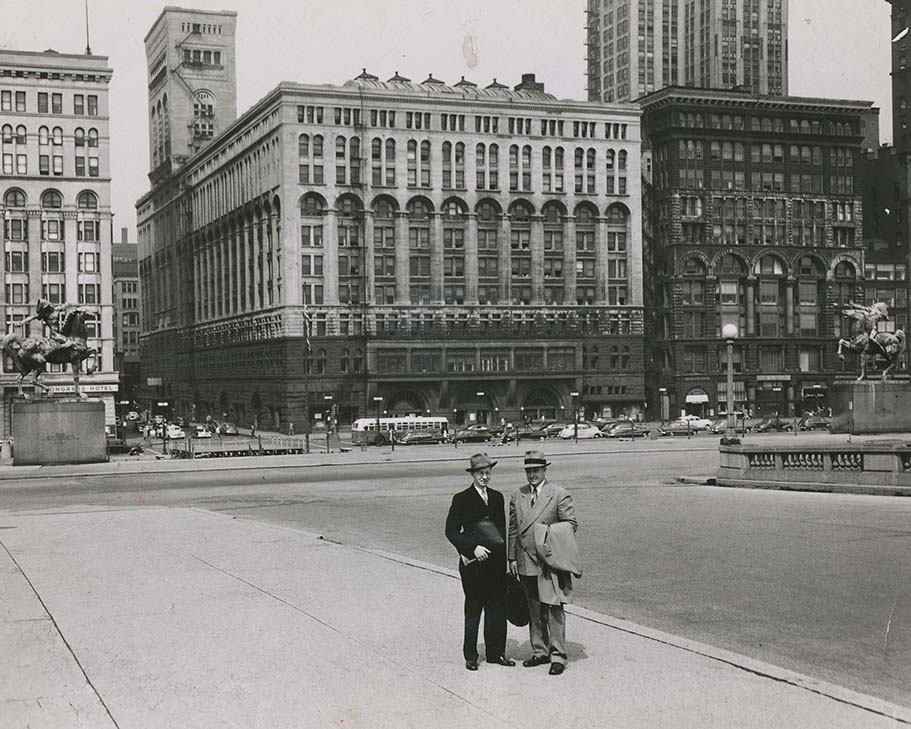
Roosevelt purchased the dilapidated Auditorium Building in 1946 and immediately began the long process of renovating the building into an 18-story college campus.

Roosevelt purchased the dilapidated Auditorium Building in 1946 and immediately began the long process of renovating the building into an 18-story college campus.

Standard
Alumni News, Feature 4, Feature Stories, Spring 2015

Seth Boustead Wants Us All to Hear the New Classics

Seth

Whether he’s talking about composers on his internationally syndicated radio show or meeting with them in China, Chicago and points in between, Seth Boustead’s message is this: Classical music is not dead.

Set aside then, at least for now, classics by centuries-old icons like Beethoven, Bach, Mozart and Tchaikovsky. Boustead, a Roosevelt alumnus with bachelor’s and master’s degrees in Music Composition from Roosevelt’s Chicago College of Performing Arts (CCPA) in 2000 and 2002, believes classical music’s golden era is happening right now.

“Seth Boustead is a leading voice for today’s classical music,” said Henry Fogel, CCPA dean. “In addition to being a fine composer, he is one of the best promoters of new music, which is a unique talent to have and an important niche to fill.”

Known for his energy, casual attire and innovative ideas regarding ways new music can be spread more widely, the 42-year-old arts leader and composer seeks, more than anything, to change negative perceptions. That means not giving credence to complaints that today’s classical music is too atonal, just noise, hard to follow, academic, difficult to relate to and so on.

“Seth went out and created his own career, and that’s a powerful example for anyone coming out of music school.”
Linda Berna, director of CCPA’s Music Conservatory

“It used to hurt me when I heard those things,” said Boustead, who is president of Access Contemporary Music (ACM), an organization he started as a Roosevelt student. “Now I’m bold, just taking the ball and running in a lot of directions.” Many directions, indeed. Boustead has his hand in numerous projects relating to today’s classical music.

Featuring the latest in modern classical music, Boustead’s “Relevant Tones,” a weekly radio show based at WFMT in Chicago, reaches a quarter-million listeners in 188 markets, including New Zealand, Canada, the Philippines and dozens of U.S. cities.

“It seemed like a risk at first,” said Jesse McQuarters, a WFMT producer who met Boustead in 2007 when he was performing one of Boustead’s compositions for double bass. A few days later, Boustead called McQuarters with a proposal for a new show. “Nobody was asking for a new-music program,” said McQuarters, who pitched the idea to the station anyway, as Boustead was so enthusiastic and enigmatic. “It’s gone far beyond what we ever anticipated,” added McQuarters of the 3-year-old program which was syndicated last year. “That’s part of Seth’s genius: He’s such an advocate for living composers and new music that he’s been able to get listeners to financially support the show.”

Another of Boustead’s ideas is the Composer Alive series, which streams a winning piece of music in installments on the ACM website. In its ninth season, Composer Alive has engaged lovers of new classical music in learning the craft of composing. Winning compositions have come to ACM from Poland, Brazil, New York, Canada, Japan, Mexico, Paris, Ireland and China.

“There are organizations you join just because you’re a composer,” said Alyson Berger, a cellist and ACM board member. “Most of them don’t help composers get their music out. That’s what makes this unique.” One way ACM does this is by commissioning composers to write pieces for significant spaces that are open to the public for tours.

“Too often, people think new classical music is weird, but Seth has succeeded in breaking down the barrier,” said Lynn Osmond, president of the Chicago Architectural Foundation’s Open House Chicago. In 2014, the event attracted thousands to Chicago locations where new pieces were played, including the Old Women’s Lounge at Union Station and Tip Top Tap at the Allerton Hotel. “The music certainly brought the spaces to life,” said Osmond, who said she hopes the concept continues to flourish. In fact it has, as Boustead is commissioning composers to write music for spaces at Open House Milwaukee and Open House Helsinki.

The idea also inspired Tim Corpus, a 2010 Roosevelt percussion performance graduate and composer to write “Letters from Home,” a piece capturing the mumbling voices of waiting passengers. It premiered at Union Station and also was featured in a CNN Money segment about ACM, a 2014 nominee for a Chicago Innovation Award.

“Composers can be awkward people who tend to want to be off somewhere by themselves, but Seth’s not like that. He’s approachable, engaging and empowering,” said Corpus, who is currently writing three pieces for the New American Timpani project that will premiere in spring 2016 at Roosevelt.

Also promising for ACM has been The Sound of Silent Film Festival, a Boustead creation pairing new scores with modern silent films. Started in Chicago in 2005, the concept recently debuted in New York, San Francisco and Austin, Texas. “You can do these kinds of films set to new music in any country in the world,” said Boustead, who has been composing classical music for much of his adult life.

SOSF_logo

Boustead, unlike many aspiring composers, never pursued a PhD. “This is not your typical music student who wants to be a member of an orchestra or a college professor,” said Linda Berna, director of CCPA’s Music Conservatory. “Seth went out and created his own career, and that’s a powerful example for anyone coming out of music school today.”

Anything but conventional, Boustead left the University of Missouri with 12 credits remaining for a bachelor’s degree in Music Composition. He moved to Chicago on a lark at 21 years of age to play piano for Chicago’s Annoyance Theatre, performing off-the-cuff sing-alongs nightly for unruly audiences. He also answered phones at a call center and worked alongside CCPA students at the Carl Fischer Music Store, formerly on South Wabash Avenue, where he got the idea to finish his bachelor’s in Music Composition at Roosevelt.

“You can ask students in class any time, ‘How many of you have ideas for new music compositions?’ Most if not all of their hands will go up,” said Stacy Garrop, a Roosevelt music composition professor whose first student was Boustead. “But to succeed, you have to figure out how to promote your ideas – and Seth has done that,” added Garrop. “He’s definitely one of our best success stories.”

Boustead always has had a flair for promotion, going back to his time at Roosevelt when he attracted nearly 100 people to his graduate recital by using flyers of his face photo-shopped atop a bust of Beethoven with the headline: “Come Explore the Works of Boustead, Boustead and Boustead.”

“He was funny and smart and I remember us hitting it off quickly,” said Roosevelt alumna Laura Koepele-Tenges (MM, ’97), a former flutist and lover of new classical music who met Boustead while she was a CCPA administrator. “One day we were kicking around ideas. I remember saying ‘Wouldn’t it be great if new music was played more often?’ and Seth saying ‘We’re living in an exciting time. Why is this music being held back?’”

The two joined together in 2000 and formed the first rendition of ACM, performing in churches, gymnasiums, coffee shops and any venue that would have them for free. Then Boustead dreamed up Weekly Readings, a series that brought musicians out regularly to record new music. “It was a ludicrous idea really, and I didn’t think it would go anywhere,” said Boustead, who wrote up and sent out press releases calling for new scores.

Access Contemporary Music

Access Contemporary Music runs the fourth largest music school in Chicago and plans are being made to open storefront music schools in cities nationwide.

He received more than 100 submissions and a write-up in Chamber Music Magazine, which credited him with “breaking a new trail.” The recordings were posted on the ACM website, streaming music clips before Sound Cloud or iTunes existed.

Boustead is planning for ACM’s expansion nationwide, not through performances, but with storefront music schools that attract passersby to sign up after they see lessons-in-progress in the schools’ storefront windows.

“He (Boustead) knows that if we’re going to make it we can’t just be a performing ensemble,” said Randall West, an ACM board member with a 2009 master’s in Music Composition from Roosevelt. In West’s words, “There’s always something rolling at ACM,” which now has four Chicago spaces and also is the city’s fourth-largest music school. “There’s this synergy as a result of all these things happening and it’s inspired Seth to broaden the reach further.”

That includes Boustead’s work as a composer. In fall 2014, he and fellow Roosevelt music composition and saxophone performance graduate Amos Gillespie (MM, ’05) released “1,001 Afternoons in Chicago,” a CD with music and narratives on the writings of late Chicago journalist Ben Hecht. It caught the attention of Chicago Tribune critic Rick Kogan.

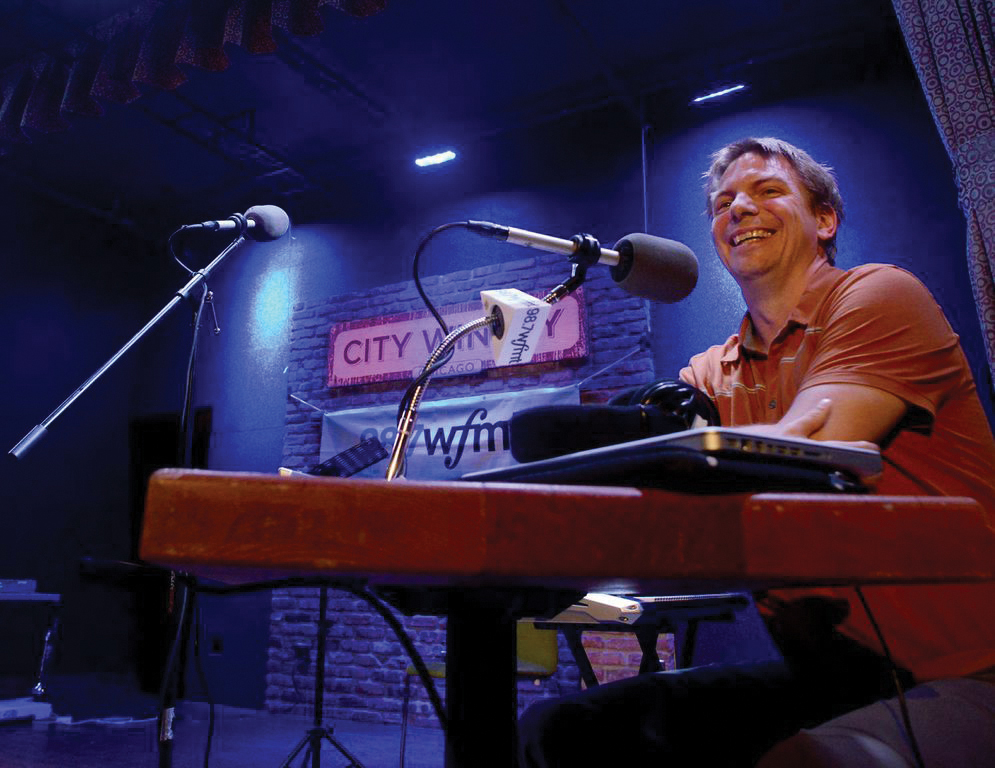
Seth Boustead is host of "Relevant Tones"

Seth Boustead is host of “Relevant Tones”, a weekly syndicated radio show about new classical music that reaches a quarter-million listeners around the globe.

“Seth’s inventive championing of the work of Ben Hecht is a remarkable thing, bringing back to life in words and music one of the great writers of the 20th Century,” said Kogan, who has had Boustead as a guest on his radio show. “Seth has some terrific work under his belt and a bright future ahead.”

The future according to Boustead means new classical music must continue to thrive. “I keep telling everyone this: ‘If I get run over by a truck tomorrow, I want you to see that modern classical music continues as a living, breathing part of our planet. Promise me, you’ll keep the movement rolling.’”

Listen In

Relevant Tones is a weekly exploration of the most fascinating time in classical music: right now. From up-and-coming firebrands to established artists, this program celebrates the dynamic and diverse musical creations of modern-day composers from around the world.

» Saturdays at 5 p.m. CST, 98.7 WFMT-Chicago

Access Contemporary Music strives to present classical music as a thriving, global art form in the 21st century and beyond by fostering the creation and appreciation of new works by living composers and bringing those works to new and diverse audiences through collaborative projects, innovative commissions and dynamic public performances of the highest artistic quality.

»Learn more: http://www.acmusic.org

SethBoustead.com

»Latest tracks: http://sethboustead.com/works

[soundcloud url=”https://api.soundcloud.com/users/5592480″]

Standard
Balance Illustration
Faculty Essay, Feature 3, Feature Stories, Spring 2015, Uncategorized

Faculty Essay: What is social justice?

Susan Torres-Harding

Susan Torres-Harding is an associate professor in the Department of Psychology. Her research interests include understanding the impact of sociocultural factors on physical and psychological health and assessing the development of social justice attitudes and social activism. She earned her PhD in Clinical Child Psychology from DePaul University in 2001.

Social justice has always been an important value to me and a foundation for my career aspirations. Therefore, in 2006, I was pleased to join the faculty at Roosevelt University, a university founded on inclusivity and one with a strong focus on social justice and social action. I quickly realized that this was a friendly “home” where I could continue to discuss the impact of societal inequalities and discrimination in health care, my own area of research.

At the same time, I was intrigued by the reactions of friends and colleagues when I told them that I was now at Roosevelt. Invariably, I would meet people who had been at Roosevelt in those early years, and they would tell me stories about what a special place Roosevelt is. They described Roosevelt as a school where people of all races came together—a college unlike others. The pictures hanging on the walls of the Auditorium Building from those early years are visual reminders of this truly unique integration of people from diverse racial groups at a time when racial segregation was the norm. Today Roosevelt continues to be ethnically and racially diverse, but the world has changed since Roosevelt came into being in 1945. In addition to racial injustice, which regrettably remains prevalent in our society, we now truly confront other forms of discrimination based on gender, sexual orientation, social class and disability status.

As a Roosevelt psychology professor, I often talked in my classes about social justice as a key value for the Roosevelt community, but I found students grappled with the meaning of social justice. What is social justice? Whom is it for? Many students talked about social justice as if it were a high-minded ideal, unrealistic or impractical to do in real life. While we often discussed the need to use our knowledge and skills to work for a more fair and just society, I wondered if students had become overwhelmed with the amount of injustice in society and whether they believed they could actually make a difference in the world.

This led me to ask myself, what do students think social justice is all about? More importantly, I wanted to know what I could do to empower them to take action and strive to make a difference while at Roosevelt and after.

Social Justice Infographic? Illustration

In response to these questions, I started a series of studies to investigate how students understood social justice and how, if at all, they were learning about our social justice message and integrating it into their own lives. What did all of this talk of social justice mean to the students? And, how could we, as educators, facilitate the goals of students who had the sincere desire to promote social justice, but who also had the notion that it was too hard, impractical, unrealistic or idealistic? As an educator, I had a personal stake in these questions. I wanted to know if integrating social justice concerns into my classes was actually making a difference in how students viewed themselves, their communities, and their own personal and professional actions. In other words, were we living up to the Roosevelt University mission of educating “socially conscious citizens”? Does talking about social justice make a difference, or is it all a lot of feel-good talk that is disconnected from reality?

Students Define Social Justice

To begin answering some of these questions, my research team and I embarked on a study to first understand how students defined social justice. In textbooks, researchers and educators define social justice as “involving the recognition of the existence of social injustices based upon being a member of a non-dominant or marginalized social group.” These marginalized social groups can include people who live in poverty, women, people who are LGBTQ, people who are disabled, people from racial and cultural minority groups, and people who have severe mental illness or have a substance abuse disorder. Researchers also defined social justice as “a value or desire to increase access of power, privileges and socioeconomic resources to people from socially marginalized groups.”

But is this how students thought about social justice? I believed it unlikely that most students would think about social justice in such abstract terms. So we conducted a study with Roosevelt students simply asking how they defined social justice. We found that students were relatively consistent in their definitions. They tended to describe social justice as addressing injustices in equality and promoting opportunity, rights, fairness and acceptance of everyone, including people from diverse backgrounds. Interestingly, a significant proportion (44 percent) of the students said they engaged in some activity that promoted social justice.

Additionally, we asked students to describe what they were actually doing to promote social justice. In most academic papers, social activism is defined as political activism: marching in protests, attending rallies, writing legislators or voting in order to promote policy or legal changes.

They tended to describe social justice as addressing injustices in equality and promoting opportunity, rights, fairness and acceptance of everyone, including people from diverse backgrounds.

Interestingly, there was a tremendous range of responses to our question. In addition to political activism, we identified many different categories of social justice activities, including conducting social-justice-related research, being a member of or volunteering for an organization that focused on social activism, seeking out educational opportunities to learn more about social justice, engaging in advocacy on behalf of people from disadvantaged or marginalized groups, and talking to family and friends about social justice.

What was most impressive to me was the creativity displayed by students as they sought to promote social justice, as well as the diversity of issues addressed by their actions. Many students reported participating in marches, protests and other direct social actions for economic or racial change. One participant was working to promote social justice by acting in a short film that aimed to foster acceptance of LGBTQ youth during the coming out process. Some students were using a social justice approach when providing clinical services to children with developmental disabilities. A few reported that they were engaged in youth mentoring or were working on behalf of youth within the juvenile justice system. Others were working to promote racial justice, women’s empowerment and awareness around diversity-related justice. Still others described being LGBTQ allies or serving as advocates for women who have endured domestic and sexual violence. We also had students who volunteered at community or religious organizations to help individuals around issues of poverty and food security.

A significant number of students indicated that they spoke with family or friends about these issues. I think that these kinds of actions are more quiet forms of activism. Discussing issues of social justice with significant others might have the impact of changing attitudes or gaining support from them. In turn, this might ultimately increase awareness of social issues and might influence others to take action in some way in their own lives.

Many of the students’ efforts involved using resources available at Roosevelt University. These included engaging in social-justice related research, attending lectures, being part of student groups and organizations that promoted social justice such as RU PROUD (a lesbian, gay, bisexual, transgender, questioning and ally organization) and Students for a Sensible Drug Policy, engaging in social justice as part of their professional clinical training and volunteering as part of service learning. Although less than half of the students we surveyed reported engaging in activism, those who were active appeared to take advantage of the resources and opportunities available at Roosevelt, and many sought to integrate these experiences with their academic studies.

social justice infographic

Connecting With The Mission

The second study that my research team and I conducted focused on the role of the University mission in promoting positive attitudes toward social justice. I wanted to understand whether students who felt more involved at the University and agreed with its mission were in fact more likely to engage in social activism. Interestingly, I found that students who reported having a high sense of community—that is, feeling as if they belonged to the “Roosevelt family”—said they valued the social justice mission more.

Students who respected the social justice mission were much more likely to state that they intended to work for social justice in the future and felt that they possessed the skills to effect positive change. These students were also more likely to report having engaged in social activism, talk about social justice issues with family and friends and personally identify as social activists. It seems that Roosevelt’s social justice mission influenced students by impacting both positive attitudes toward social justice and facilitating the integration of social justice concerns into their personal and professional lives. Feeling a part of the Roosevelt community mattered because it allowed them to share in this core community value.

Balance Illustration

Thus, the mission and values of Roosevelt University are having an impact on our students’ actions. We are currently conducting additional studies where we hope to follow undergraduate students over time to see how their ideas and views of social justice might change as they move from freshman to senior year. We are also interviewing student activists to learn from their unique experiences, motivations and perceptions of their own work.

Indeed, it has been a pleasure to be able to assess and document the amazingly diverse and creative activism that is going on at Roosevelt. In addition to the examples listed above, Roosevelt students have participated in walk-outs and rallies in Grant Park, lobbied at the state capital, made videos to help educate others about traditionally marginalized groups, conducted interventions to promote health and wellness in our communities, and organized programs that give our students and people in the community a voice. We have so much to learn from our students!

An important part of social justice education is to trust that students are able to evaluate the information we provide and use it in a way that is valid, realistic and relevant to their own lives. Because students are able to come up with so many unique and creative ways to address injustices in their interpersonal and professional lives, professors should not provide answers, but rather should pose questions to help students recognize the real challenges in our society. We can encourage them to critically evaluate their own views and the views of others and provide them with a range of interventions and interpersonal skills that they can then use to confront a range of social problems and issues in their own ways. We also need to recognize that this is hard, risky work.

An important part of social justice education is to trust that students are able to evaluate the information we provide and use it in a way that is valid, realistic and relevant to their own lives.

Working for social justice is, by its nature, “radical” because it focuses on changing the status quo, challenging existing policies and can involve breaking rules. As educators, it is important that we not only talk about social justice but provide students with the skills they need to take action and be effective. Promoting favorable attitudes and teaching interpersonal intervention and activism skills will have a positive impact on students and help them fulfill the Roosevelt mission of creating “socially conscious citizens” who change the world.

Contact Susan Torres-Harding at storresharding@roosevelt.edu

Standard