Alumni News, Fall 2015, Sidebar Story

Buzzworthy journalism grads make headlines

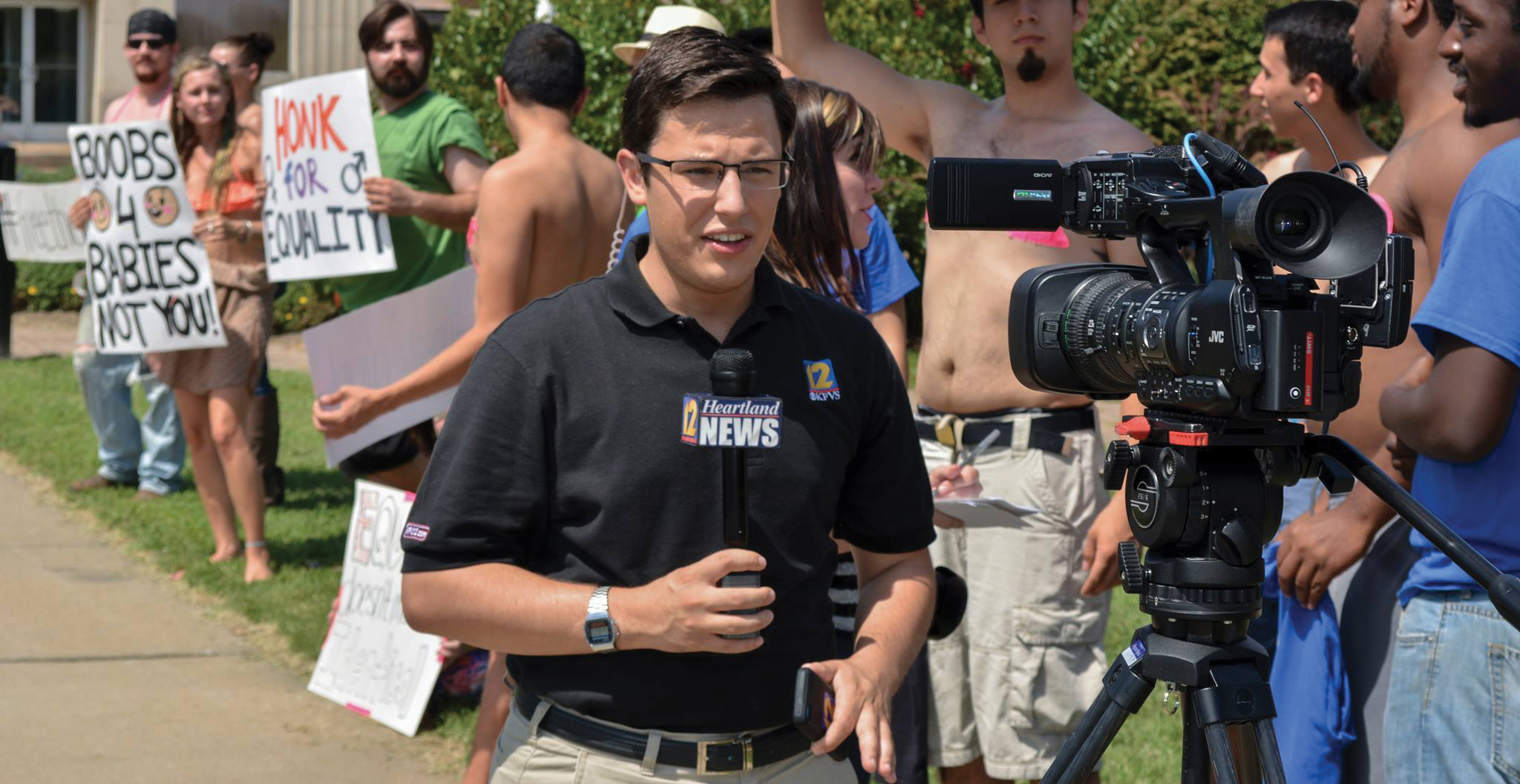
I have my Roosevelt journalism professors to thank for preparing me well for this experience,” says Giacomo Luca (above), an award-winning journalist who is currently reporting for CBS/Fox affiliate KFVS-TV in Cape Girardeau, Mo.

“I have my Roosevelt journalism professors to thank for preparing me well for this experience,” says Giacomo Luca (above), an award-winning journalist who is currently reporting for CBS/Fox affiliate KFVS-TV in Cape Girardeau, Mo.

From writing for daily newspapers to anchoring television news programs, alumni from Roosevelt University’s Journalism Program are realizing dreams as successful members of the media.

“Many of our journalism graduates are doing great things,” said Marian Azzaro, chair of the Department of Communication at Roosevelt. “One of the keys to our program is that it positions students to be prepared for the rapidly changing field of journalism by providing instruction in different media, from newspapers to video to Internet reporting.”

Started four decades ago, the Roosevelt journalism experience includes opportunities for learning at The Torch student newspaper, The Blaze student radio station and most recently The Fire, which is doing video news segments and is the newest student journalism format. “We’re teaching students to write and report for all kinds of journalistic media; these are skills that are useful and needed for success,” Azzaro said.

Jennifer (Berry) Hawes, a 1993 journalism graduate, brought positive attention to Roosevelt’s program as a member of a reporting team for The Post and Courier, a daily newspaper in Charleston, S.C., that won the Pulitzer Prize in April for Public Service for a five-part series on domestic violence.

She credits Roosevelt Associate Professor of Journalism Linda Jones with opening her eyes to the storytelling craft of journalism. “She instilled the importance of storytelling in me,” Hawes said of Jones, “and that’s what I’m really known for today.”

Roosevelt journalism alumnus Aaron Lee recently landed a job with ESPN in Chicago, getting a foot in the door toward one day achieving his ultimate goal of becoming an ESPN anchorman.

Lee, who also learned the importance of storytelling as a journalism undergraduate at Roosevelt, credits Roosevelt Journalism Professor John Fountain with inspiring him to tell his story of battling Crohn’s Disease and coming to terms with his mother’s untimely death.

“I remember having a professor who once told me ‘The sky’s the limit on where you can go’ and I feel that way about Aaron,” Fountain said recently.

Keeping that advice in mind, Lee covered the NFL Draft in Chicago as a freelance sports reporter and shortly after landed a job with ESPN Chicago. “This is going to be a stepping stone for me,” said Lee, who began work this fall on a master’s degree. “I’m getting to meet a lot of people at the network and they know I have aspirations to go a lot further.”

Giacomo Luca, who was working as an anchorman for a small TV station in Lima, Ohio, before graduating from Roosevelt in May 2014, already has moved up as an on-air reporter for a larger TV station that broadcasts out of Cape Girardeau, Mo.

As a reporter for a CBS affiliate station out of Cape Girardeau, which has the 81st largest TV market in the country, Luca goes live nightly, covering news from approximately 50 rural counties in four Midwest states.

“I broke into a top 100 market the month after I graduated from college and I have my Roosevelt journalism professors to thank for preparing me well for this experience,” said Luca. “I’ve been able to do my dream job every day and I couldn’t be happier.”

Standard
Alumni News, Fall 2015, Feature 4, Feature Stories

Signing Off

Roosevelt alumnus Rick Nieman (BA, ’87) reminisces about his career and being one of Holland’s most influential television journalists.

Roosevelt alumnus Rick Nieman (BA, ’87) reminisces about his career and being one of Holland’s most influential television journalists.

When Rick Nieman stepped down this spring as anchor of RTL News in Amsterdam after 19 years in front of the camera, he was surprised at the tributes he received.

“I got many emails and even old-fashioned post cards from viewers who said they were sad to see me go,” he said. “You don’t think about it when doing your job, but apparently you become part of people’s lives. And when they tell you how much of a part, it’s humbling. A Bosnian War refugee, for instance, thanked me for ‘teaching’ her Dutch. She learned the language, she said, by watching our broadcasts.”

Until his retirement, Nieman, 50, was widely recognized as Holland’s most watched and most influential television journalist. His 7:30 p.m. broadcasts on RTL were seen by 1.5 million viewers every day in a country of 17 million inhabitants. For comparison, NBC Nightly News is watched by about 8.5 million people, but the United States has a population of 318 million.

As those statistics show, news, especially international news, is very popular in the Netherlands and Nieman, who is fluent in Dutch and English and also speaks German, Italian and French, regularly interviewed world leaders when they came to Holland. Over the years, he has talked with Madeleine Albright, the Dalai Lama, Hillary Clinton, Laura Bush, Bill Clinton and Condoleezza Rice, among many others.

Learning From the Best

Nieman’s path to being a “news presenter” began in 1983 when he came to Roosevelt as an American Cultural Exchange student. Unlike many of his colleagues who wanted to study at a large state university, his objective was to go to a university in a large city where he could learn journalism from practicing professionals.

“I had a wonderful experience at Roosevelt,” he said. “The professors were either former or current practicing journalists with a lot of experience. They gave us very practical assignments. I remember one semester my beat was the Cook County Court system and I had to write a background story and a feature story about it every week. What I learned there, I have used daily ever since. I am really incredibly grateful for my time at Roosevelt.”

Interviewing Madeleine Albright

Secretary of State Madeleine Albright was interviewed a number of times by Rick Nieman. On this occasion in 2003, she was promoting her first book Madame Secretary.

One person Nieman particularly respected is Charles-Gene McDaniel, who headed Roosevelt’s journalism program from 1979 until 1995. A former Associated Press writer, McDaniel was a first-rate writer and teacher who, after he retired, visited Nieman in Amsterdam. “Professor McDaniel instilled in us a tremendous feeling of fairness,” he said. “He was very much into the ABCs of journalism – accuracy, brevity and clarity. We had to get the facts straight. He was not very kind if you did sloppy work.”

During his four years at Roosevelt, Nieman lived in the Herman Crown Center residence hall and was active in school activities. He was editor of Roosevelt’s student newspaper, The Torch and was a member of Roosevelt’s soccer team that was ranked 16th nationally in the NAIA and beat the University of Notre Dame. “We had a Serbian coach and nobody on the team was actually born in the U.S.,” he recalled. “We had Iraqis, Iranians, Haitians, Yugoslavians and just one Dutchman, me. Truth be told, I was substitute and didn’t play much, but I loved being on that team.”

“I had a wonderful experience at Roosevelt.”

After graduating from Roosevelt, Nieman received a scholarship to earn a master’s degree from the University of Southern California (USC) where he studied international relations and journalism. He then joined a small business news organization that was acquired by CNN shortly after he was hired. All of a sudden at the age of 25, he was an on-air reporter for CNN in London specializing in financial news.

“It’s a bad anecdote about our society and being a television reporter,” Nieman said, “but an instructor at USC once told me: ‘You’re young, you’re blond, you speak reasonably well, you’re made for television. You should be a TV reporter.’ I was insulted at the time, but she was probably right.”

In 1991 he decided to move back to Holland and accepted a position as a reporter with RTL News. The station is part of RTL Group, Europe’s leading entertainment network with interests in 55 television channels around the world. After serving as a general assignment reporter, the Roosevelt alumnus was selected as RTL’s anchor in 1996 and he held that position until May when he decided to leave in order “to write more, travel and work on other journalistic projects.”

Politics, American Style

To glean ideas for his newscasts, Nieman regularly watched American television. “Of all the countries in Europe and the United Kingdom, we’re the most Anglo-American focused,” he said. “Germany is our biggest trading partner, but the Dutch don’t speak German all that well. They speak English and they’re very focused on the U.S. I read the New York Times every day and already did stories about the 2016 U.S. Presidential election even though the Iowa caucuses are still many months away.”

 Clifford Sobel, the U.S. ambassador to the Netherlands, met with Nieman in 2005 in Margraten, where more than 8,000 U.S. servicemen who were killed in WWII are buried.


Clifford Sobel, the U.S. ambassador to the Netherlands, met with Nieman in 2005 in Margraten, where more than 8,000 U.S. servicemen who were killed in WWII are buried.

However, it was elections in the Netherlands that helped make Nieman so well known. Like George Stephanopoulos or Bob Schieffer in the United States, he moderated debates with all the major candidates and then anchored the election results and provided analysis on what the results meant for the parties and country. Every major political leader in the Netherlands has been grilled by Nieman on such topics as the future of the Dutch economy and the effects of budget cuts on Dutch citizens.

When they come to Amsterdam, international leaders frequently visit RTL news and Nieman was often the reporter who interviewed them. His most memorable interview, however, occurred in a hotel room in Luxemburg where he was attending the European Union–United States Ministerial Summit in 2005.

He was the first person to talk with Secretary of State Condoleezza Rice following a major announcement by North Korea. He began the interview by saying: “Ms. Secretary, North Korea just announced for the first time publicly this morning that it has nuclear weapons. What is your reaction to this?” Rice replied that the North Koreans were “only deepening their isolation in the international community” and “there needs to be no nuclear weapons on the Korean peninsula in order to maintain stability in the region.”

When Nieman opened the hotel door after the interview, there were 30 journalists from around the world waiting to ask him what she said. “Our timing was very fortunate,” he recalled. “Our interview was picked up by CNN and other stations and there was a front page article in the New York Times the next morning.”

Nieman also has interviewed President Bill Clinton a number of times as well as former Secretary of State Colin Powell, whom he quizzed about the use of Dutch troops in Iraq as part of the military coalition during the Iraq War.

Rick Nieman, a Roosevelt alum and well-known journalist in Holland, interviewed President Bill Clinton when he visited Rotterdam in 2007 to talk about the Clinton Global Initiative.

Rick Nieman, a Roosevelt alum and well-known journalist in Holland, interviewed President Bill Clinton when he visited Rotterdam in 2007 to talk about the Clinton Global Initiative.

And during a TV interview in 2013 to discuss their upcoming royal inauguration, Crown Prince Willem-Alexander of the Netherlands and his wife Princess Máxima surprised the nation by telling Nieman that citizens can address them “any way they see fit.” “People in the street call me Máxima. At the end of the day, it’s not that important to be called princess or queen. The important thing is the title we represent,” Máxima said.

Nieman describes his interview style as being tough, but fair. “If people don’t want to answer a question, I gently try to say you didn’t answer the question and give it another shot. But after I’ve asked it three times, I say, ‘I understand you don’t want to answer, let’s move on to the next one.’”

In addition to anchoring and interviewing, Nieman is an accomplished author, whose book Always Viareggio was published in Spring 2015 to favorable reviews. It tells the story of four high school and college friends who make an annual motorcycle trip to Viareggio, Italy. One critic wrote that Always Viareggio “might move you to think about your own life and friendships.”

Nieman is married to Sacha de Boer, a former news anchor on a competing network. De Boer is now a professional photographer who shoots for National Geographic among other publications.

As to the future, Nieman said he received a number of offers the moment he announced his departure. One of those was hosting a Sunday-morning news show on another network, which he began doing this fall. Odds are his legion of news viewers are tuning in.

book rbg

Always Viareggio
Rick Nieman’s first novel, Altijd Viareggio, came out in May and tells the story of a group of friends who every year make a trip to the Italian seaside village of Viareggio by motorcycle. Nieman, a motorcycle enthusiast himself, said the book describes how friendships change as people grow older.


Standard
Fall 2015, Feature 4, Feature Stories

Getting down to business

Ali Profile

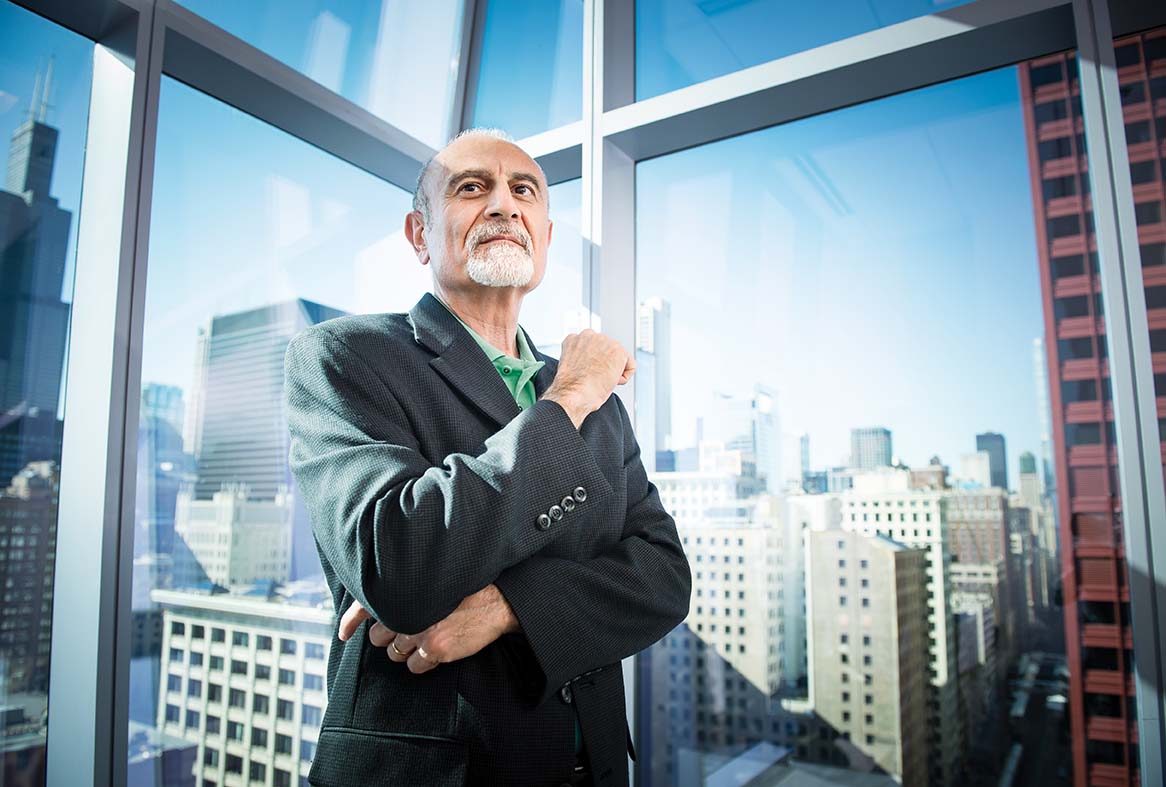
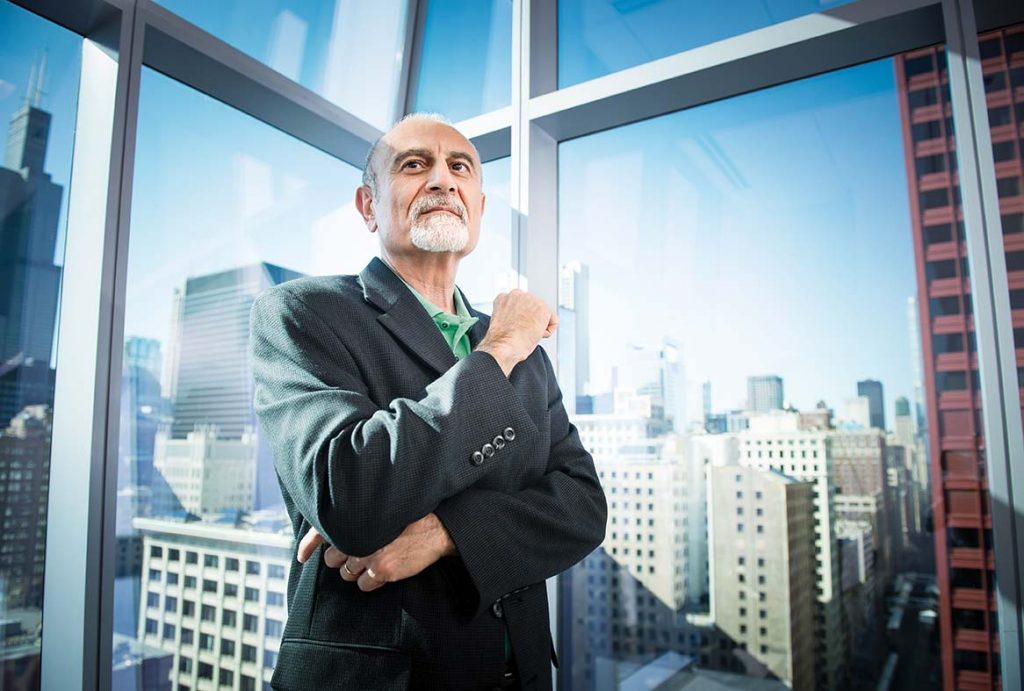
Ali Malekzadeh has the leadership skills, higher education experience, business expertise and personality Roosevelt’s trustees sought in a new president.

“What would you be doing if you weren’t in higher education?”

The question seemed to surprise him, and Ali Malekzadeh, Roosevelt University’s new president, paused and looked around his office before answering. “I never thought of that before,” he replied. “Education is my business. I understand it and have loved every minute of it.”

From the time he was a second grader, Malekzadeh, a native of Iran, wanted to be an educator, and true to his dreams, his entire 33-year career to date has been in education as a university professor and administrator. He’s even married to a professor, Dr. Afsaneh Nahavandi, chair of the Department of Leadership Studies at the University of San Diego.

Malekzadeh, who asks everyone to call him “Ali,” joined Roosevelt on July 1 as the University’s sixth president, succeeding Chuck Middleton who retired after 12 years as president. “The sky is the limit at Roosevelt,” said the former dean of business at Kansas State University, just a short time into his first presidency. “This is a great University with a noble history and outstanding faculty, staff, students and alumni. Our legacy will be to build on those attributes and create an even greater University.”

“This is a great University with a noble history and outstanding faculty, staff, students and alumni. Our legacy will be to build on those attributes and create an even greater University.”
President Ali Malekzadeh

Colleagues who have worked with him in the past have no doubt that his leadership skills, higher education experience and personality will enable him to be a successful president.

“Very few times in your life do you meet someone with a sense of optimism, fairness, and a forward looking and compelling vision, along with a strategy for achieving that vision. I was fortunate to have met that person – Ali Malekzadeh,” said Anand S. Desai, a former associate dean at Kansas State and now dean of the School of Business at Wichita State University.

“When I’m in a difficult meeting or conversation, I ask myself ‘what would Ali do?’” said Raghu Tadepalli, dean of the School of Business at Elon University in Elon, N.C. “And since it’s been six years since we worked together at Xavier University in Cincinnati, that’s the biggest compliment I can pay someone.”

Malekzadeh, 60, first started thinking about becoming a university president six months before the Roosevelt position opened. “I liked being a dean and being a university president was not a lifetime ambition of mine,” Malekzadeh said. Kansas State President Kirk Schulz, a friend and mentor, helped change his mind. He encouraged Malekzadeh to consider becoming a president as his next career move.
Ali 1

So when Witt/Kieffer, Roosevelt’s search firm, contacted him about the presidency, he agreed to an initial interview. “The more I looked into Roosevelt, the more I liked it,” he said. “I was really impressed with the University’s social justice mission and thought the job might be a good fit for me.” It turned out that the feeling was mutual. Malekzadeh impressed every constituency he met during the interview process. In March, the Presidential Search Committee, chaired by trustee and now Board Chair Patricia Harris, recommended his appointment to the Board of Trustees and he was unanimously elected president on March 26.

“During his conversations with the committee,” Harris said, “it became clear that Ali’s collegial disposition, strategic insights and natural affinity for the Roosevelt community made him the resounding choice to serve as Roosevelt’s next president.”

“I have worked in administration at four universities, both public and private, and believe the main responsibility of a leader is to provide an environment where everyone can succeed,” Malekzadeh said. “Organizations are about people and everyone comes to work to be successful. If there’s a problem, we will work to try and solve it.”

Ann Marie Tracey, professor of business law and ethics at Xavier University where Malekzadeh was business dean from 2003 to 2011, said he is “an extraordinary leader.” “I remember going to a community event with him after he’d only been in town for a few weeks and thought I would be introducing him to people. But he already knew everybody,” she said.

Tadepalli said Malekzadeh is able to get along with everyone, from CEOs to custodians. “He is always upbeat, looks on the positive side, is unfailingly courteous and is strategic. Working with him was one of the most professionally satisfying periods of my life.”

The Makings of a President

While many people comment on his energy and enthusiasm, Malekzadeh does much of his thinking and planning while jogging every morning along Chicago’s lakefront, a continuation of his life long interest in fitness and sports. A snow skier, he lifts weights to stay in shape and is a fourth-level black belt in Tae Kwon Do. He was captain of his high school basketball team and a varsity soccer goalie in college.

Fundraising has long been one of Malekzadeh’s strengths. He secured funds for a new business college location at St. Cloud State University in Minnesota, helped raise $30 million for a new business school building at Xavier and raised over $40 million for a new $55 million College of Business facility at Kansas State.

“Ali understands the dynamics of fundraising,” said University of Montana Foundation President and CEO Shane Giese, who worked with Malekzadeh at Kansas State, raising funds for programs, faculty, students and facilities. “He personally drove the vision of building a new business building at K-State, from securing internal support, to developing the concept, to scoping the project with architects and contractors, to fundraising for the effort.”

Malekzadeh’s initial experiences in university administration and faculty leadership were at Arizona State University West in Phoenix where from 1987 to 1998 he helped develop the brand new campus. He helped hire the business faculty and created the Office of Graduate Studies. Since he was first appointed a dean and throughout his career, Malekzadeh has been a strong advocate for faculty and staff development, providing professors and university staff with opportunities to advance their careers.

“Ali changed my life,” said Desai of Wichita State. “In the four years I was at Kansas State with him, he gave me opportunities to grow and develop my skills as an academic leader. He showed me that if you dream it and work hard, you can make it happen.”

Malekzadeh attributes his can-do spirit to his mother and his skills in negotiation to his father, a successful attorney. At one time, Malekzadeh said his dad was requested to be counsel for both parties in a legal dispute between a university in Tehran and the city of Tehran. During a break in the judicial proceedings, he brought both sides together and resolved the issue. Years later, Malekzadeh had a similar experience. While at St. Cloud State, both the labor union and the administration named him as their investigative officer.

“The main responsibility of a leader is to provide an environment where everyone can succeed.”
President Ali Malekzadeh

Malekzadeh’s life in the United States began in 1969 when he was invited to spend the summer in Denver with an American family. “When we landed at Stapleton Airport in Denver, I looked up and it was just like Tehran,” he said. “Fourteen thousand feet high mountains, four seasons and very similar weather. I said, ‘Wow, this is it. This is where I want to go to college. I can even continue skiing here.’ So, I spent the summer there and applied to only one university, the University of Denver.”

After earning bachelor’s and master’s degrees in business administration from Denver, Malekzadeh and his wife (Malekzadeh and Nahavandi met in grade school and married in Tehran in 1977) went to the University of Utah to earn doctoral degrees in business. Then in January of 1979 after the Islamic Revolution, Malekzadeh and Nahavandi were unable to return to Iran.

Malekzadeh describes the ordeal this way: “It’s like you were born and raised in Illinois and then go to school in Massachusetts. All of a sudden, somebody says, ‘By the way, Illinois won’t let you in anymore.’ They take your passport, punch a hole in your face and give the worthless passport back.”

After the revolution, Malekzadeh and Nahavandi immediately decided to make the United States their home. They completed their doctorates and were granted asylum, allowing them to teach at Northeastern University in Boston. Shortly later, they became U.S. citizens and their two daughters were born and raised in America. Malekzadeh’s contributions to America were recognized on July 4 when the Carnegie Corporation of New York honored him and 37 other “great immigrants” from more than 30 countries with a full-page ad in the New York Times.

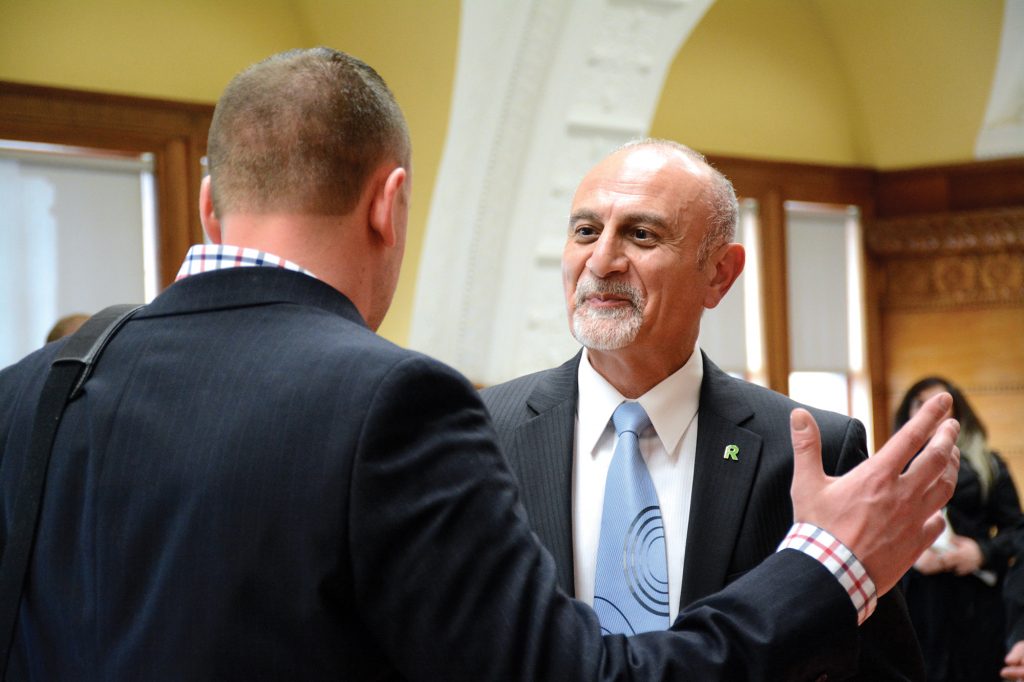
During his first weeks at Roosevelt, President Ali Malekzadeh has been busy participating in University life: trying on Roosevelt gear, meeting parents of students and joining in activities with students.

Although Malekzadeh is still forming his agenda for Roosevelt, one area he will emphasize is alumni participation. He will be reaching out to graduates and encouraging them to become more involved in the life of Roosevelt students by being mentors, providing internships and supporting scholarships. “We want alumni to be so proud of their alma mater that they call us and say ‘how can we help you?’”

The mentoring program will be based on successful programs he implemented at Kansas State and Xavier. At Kansas State more than 560 undergraduate students had executive mentors, while at Xavier more than 500 people volunteered to advise students with their careers. This helped improve the college’s job placement rate to 98 percent.

“Ali is a strong believer in getting students hands-on experience with internships,” Giese said. “He enjoys the process of watching students mature in their work and their outlook on what they want to do with their lives.”

For someone whose business has always been education, it won’t take Roosevelt’s new president long to capitalize on the University’s opportunities and build on its legacy. “We’re here to educate people and provide an open environment where absolutely everybody can thrive and succeed and achieve the American Dream. I think that’s what Roosevelt has been and always will be about,” he said.

Standard