


Seventy is, for me, a kind of magical number. Not that there haven’t been others that fascinated me earlier in life. Thirteen, 18, 21, “33 and four months” and 50 come to mind.
These were seasons of my life that in retrospect were important milestones for me and thus for those around me.
Seventy, however, is special in this galaxy of numbers because this is the year that both I and Roosevelt University begin our eighth decade. Of course, institutions of higher education at 70 are really not all that old. But people are, despite our best efforts sometimes to pretend otherwise.
As we turn the page on 70 years, we reflect on where we have been and speculate just a wee bit on where we might be going.
I thought about this last summer when I met several sets of grandparents of this year’s freshman class and discovered that they were my juniors, though not by that much! Makes you wonder what students in the elevator with whom I talk constantly think of all of us who are beyond 35 or so.
This spring we are celebrating the University’s 70th birthday. It comes at a truly momentous period of our history. As we turn the page on 70 years, we reflect on where we have been and speculate just a wee bit on where we might be going.
Lynn Weiner, formerly dean of the College of Arts and Sciences and a really smart and insightful historian of contemporary America after World War II, has been digging deeply for the past couple of years into that history. The first fruits of her work have gelled into the book of pictures and commentary (available from the Office of Alumni Relations) that highlight some of the key moments.
Taken together they record the evolving life of the institution through many challenges, most of them unimaginable before they occurred.
In each case, large and small, it was the resiliency of our people—faculty members, administrators and staff, and especially our students—that saw us through. I think we always emerged from whatever challenges we faced, no matter how intense and intractable they may have seemed at the time, in better shape than we went in.
Lynn meets with me every couple of weeks and she has taught me much about this history.
Turns out that there are notions about it that we Rooseveltians carry about in our head that are more myth than reality. And there are others that are spot on about what transpired—and more significantly, why.
But it’s difficult to recapture the nuances of those moments in pictures and brief commentary associated with each, so we await the arrival of the full book to think about them in more subtle, nuanced ways.
There were other moments in every decade that required bold action so that Roosevelt did not become a prisoner of its past and so that it could resolutely engage its future.
Taking a longer view, however, points out a fundamental common feature of all these periods of our collective past. It is this: Burnham’s admonition to make no little plans regularly animated leaders of the University, especially when they were faced with big challenges.
For instance, the foundation itself was as bold as it was foolhardy, at least on paper. And bravo to President Edward Sparling for sticking to his guns and not permitting the replacement of the Auditorium Theatre with a garage for employees to park their cars in or for expanded residential or classroom space. It took a fight, but he was right.
There were other moments in every decade that required bold action so that Roosevelt did not become a prisoner of its past and so that it could resolutely engage its future. I’ll leave it to Lynn and others to fill in the details of that broad historical thesis.
For now, I am content to ponder the immutability of transitions—personal and institutional—as not only defining moments in life but as essential ones if we are to continue to grow throughout our lives and if our institutions are to prosper over long periods of time.
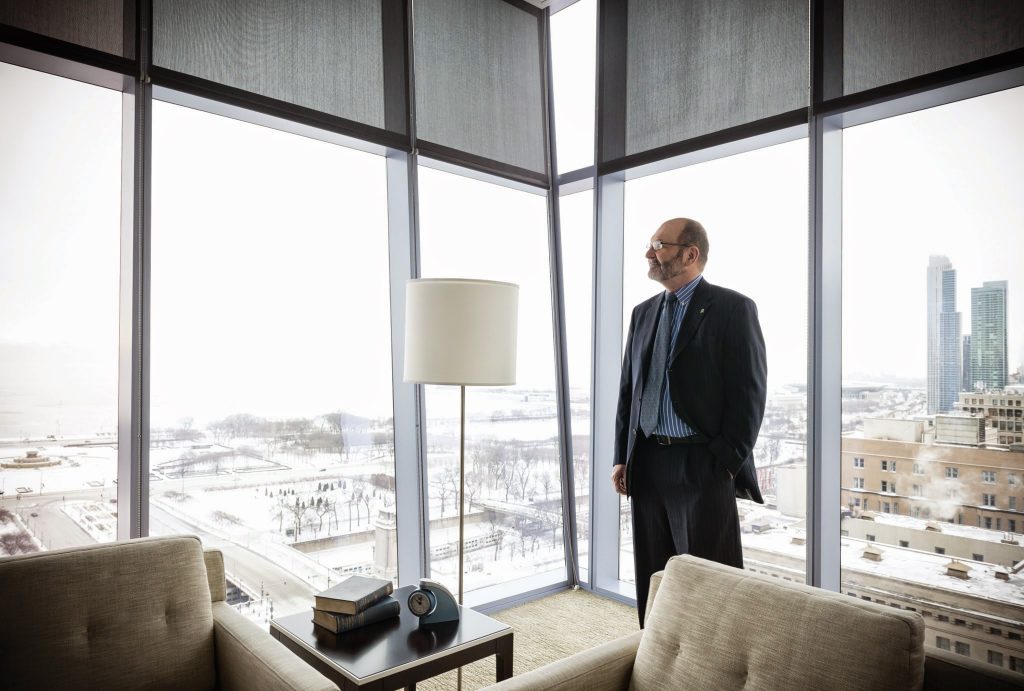
It takes a special skill to be able to look backward and understand as much as humanly possible about where we have been. It takes the ability to dream about how the future can be both tethered in that past and yet change sufficiently to promote a stronger and enduring future.
The mists of the past cover up much of the drama. The mists of the future are totally impenetrable. So we do the best that we can in time present. Always have.
This is essentially the work we have been engaged in for the first decade and a half of the 21st century. We ponder our past and celebrate its successes while simultaneously appreciating its problematic moments. And we imagine how, in this kaleidoscopic world in which we live, we can build upon these successes in ways that shape the transitions into the future that we must promote if we are to continue that tradition of resiliency that underpins and defines our history.
Stewardship of Roosevelt University, as with service here in all other capacities, is a very special privilege. It requires attention to the past and especially to the values that have informed every moment of it from 1945 to 2015. And it presents opportunities, if you can just discern them from among the many possibilities that permeate our environment, for greater and more enduring successes in the future.

To the alumni, friends and especially the faculty, administrators and staff, and most especially our students who have traveled with me in this journey, I give thanks at this moment of transition in my life for the privilege of having walked this way with you for a brief period of time in Roosevelt’s ongoing story.
Chuck Middleton welcomes your comments. Email him at cmiddleton@roosevelt.edu.

