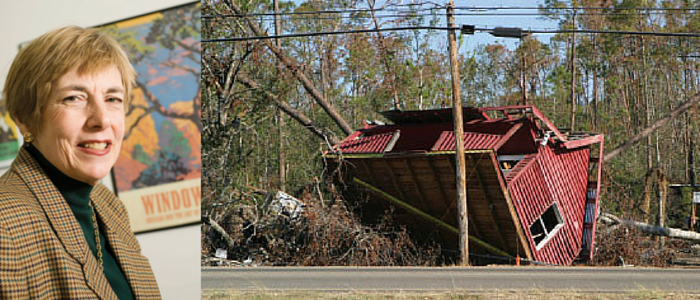
Feature Image: RU Adminstrator Lends A Hand In Louisana
Sidebar Story, Spring 2006

[Spring 2006] RU Administrator Lends A Hand In Louisana

Editor’s note: This week, we’re marking the 10-year anniversary of Hurricane Katrina with a pair of posts about how the Roosevelt community pitched in to help after the tragedy.
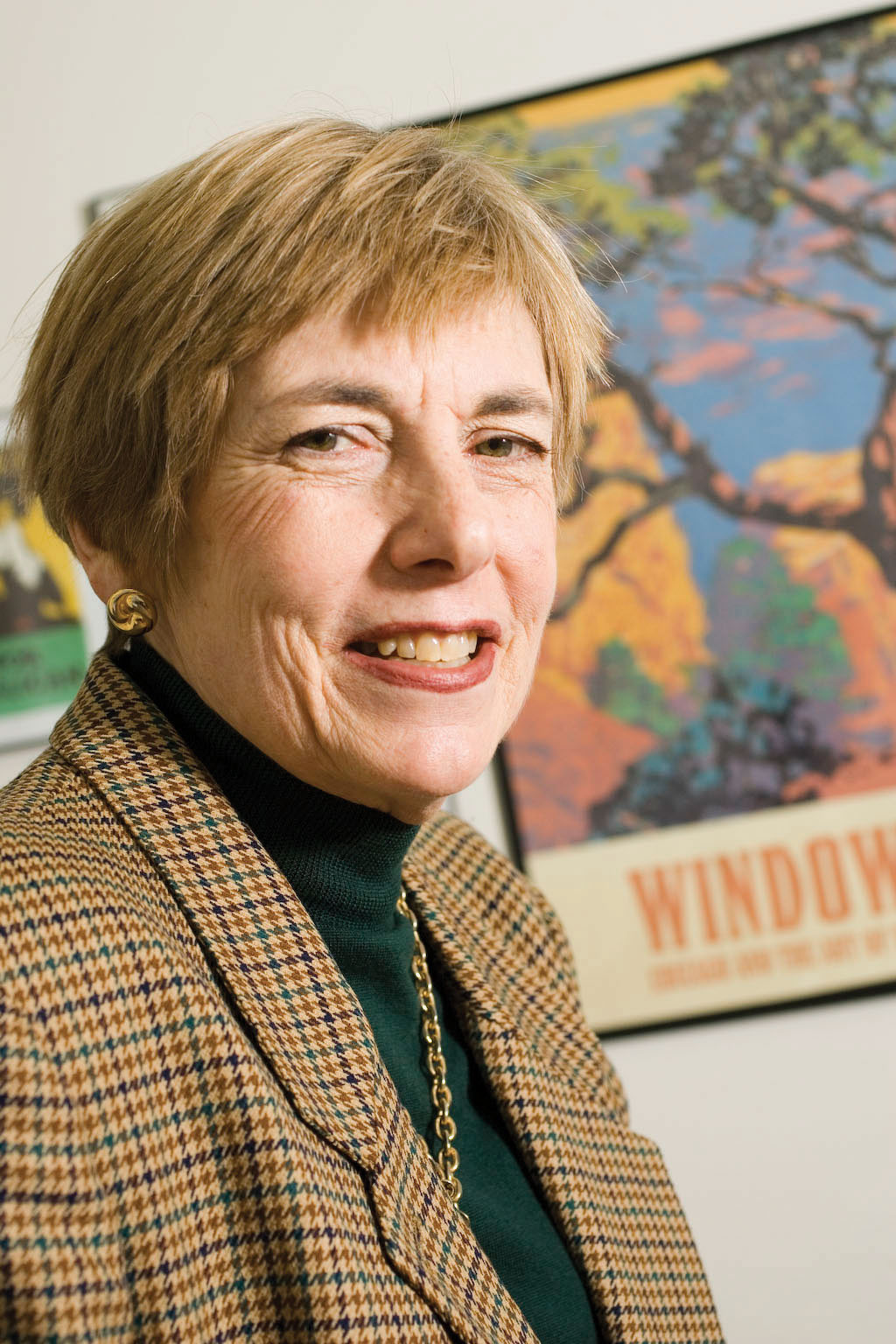
Connie Goddard

Connie Goddard, director of field placements and partnerships in the College of Education, volunteered during the winter break in storm-ravaged Louisiana.

Last September, a few weeks after Hurricane Katrina devastated New Orleans, my colleague Andy Carter, who is a Louisiana native and an assistant professor of mathematics education at Roosevelt, spoke at a University town hall meeting on how we could respond to the disaster.

Soon after, two other College of Education colleagues, Judy Gouwens and Sheila Coffin (see accompanying story), organized work trips with students to Bay Saint Louis, Miss., an area hard hit by Katrina. Then, sometime in mid-October I phoned Carter, asking him for information on an organization he had suggested we could help.

Thus began my involvement with the Southern Mutual Help Association (SMHA), a group based in New Iberia, La., and its Rural Recovery Task Force, which was established right after Hurricane Rita wreaked damage on parts of Texas and southwestern Louisiana, including parishes near New Iberia. I spent a week during the recent winter break helping SMHA’s cleanup efforts, and one of the things I learned is how a hurricane travels: its winds circle counterclockwise, picking up the ocean’s water on its western, downward thrust, then dumping water on its eastward side as the winds surge upward. In the area we worked, the waters rose from a few inches to waist-deep in less than an hour.
katrina_04

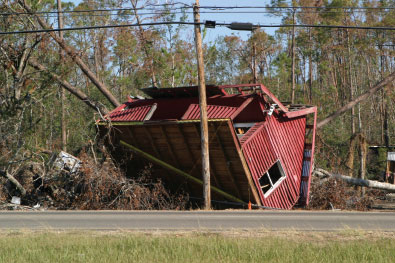
Many homes were toppled in Bay Saint Louis, Miss., which was near the eye of the Hurricane Katrina storm path.

“If you have to be in a hurricane,” noted one longtime resident, “you want to be on its west side, because it gets less flooding.” His house was one of a half-dozen the crew I worked with readied for restoration. We’d been directed there, in southern Vermillion Parish a few miles from the gulf, by SMHA, which, since the hurricane hit, has been organizing volunteer groups to first survey and then begin repairing damage, particularly to homes.

Signs of this project’s ecumenical nature were as abundant as the flood waters and the hardy outlook of the people devastated by them. SMHA, established by Catholic nuns to help sharecroppers emerge from dependence and poverty during the 1960s, had housed Unitarians from rural Vermont and Jews from suburban Boston in a Methodist church dining hall converted to sleeping quarters with bunk beds constructed by Canadian Mennonites. Many of our tools and cleaning supplies were provided by members of the Church of Latter-Day Saints.

Our project was to pull, peel and pry wallboard, cupboards, linoleum and appliances away from the structural elements of a half dozen modest homes. For four days, two dozen of us wielded crowbars, sledgehammers and saws to get the job done. Along the way, homeowners affected by the disaster worked with us, while others, including a physically disabled man, could offer little more than moral support. One woman told us it would have taken a month or more to do the job on her own.

Service like this not only continues the tradition of social justice that Roosevelt lays claim to; it helped us, too, as we developed skills we did not know we had.
We also enjoyed ourselves—Acadians are famed for food and good times—and had several invitations to dinner, but we departed knowing there was much left to do. Service like this not only continues the tradition of social justice that Roosevelt lays claim to; it helped us, too, as we developed skills we did not know we had.

Standard
Featured Image - Roosevelt Reaches Out
Feature 4, Feature Stories, Spring 2006

[Spring 2006] Roosevelt Reaches Out: Community Helps Katrina Victims Start Over

Editor’s note: This week, we’re marking the 10-year anniversary of Hurricane Katrina with a pair of posts about how the Roosevelt community pitched in to help after the tragedy. 

katrina_05

The photo above was taken by Sheila Coffin, assistant dean in the College of Education. Subsequent photos were shot by Michelle Navarre (MA, ‘01), adjunct instructor in the College of Education and winner of a Golden Apple Award for Teaching and Excellence. The two made separate trips with College of Education volunteers in October 2005 to help a storm-ravaged school district in Bay Saint Louis, Miss., get back on its feet after Hurricane Katrina.

Eleanor Roosevelt once said, “It’s better to light a candle than to curse the darkness.”

In a sense, that’s what the Roosevelt University community did after Hurricane Katrina ravaged the Gulf Coast in late August.

Buoyed by President Chuck Middleton’s call for action shortly after the hurricane struck, Roosevelt faculty members, students, administrators and staff opened their hearts and their pocketbooks in an attempt to help.

Some of the community’s outpouring of support consisted simply of donations made to organizations like the United Way and the American Red Cross, in addition to the University’s own Hurricane Katrina Community Relief Fund.

Among the many individuals and groups that gave generously, Roosevelt’s Office of Student Activities as well as the University’s Administrative Assembly and its Office and Professional Employees International Union Local 391 held fundraising events on behalf of Roosevelt students from affected areas.

More than $3,000 was raised for the benefit of the affected students.  In addition, the University hosted and financially assisted 22 students who attended Roosevelt during the fall 2005 semester after being displaced from their Gulf Coast universities.

Other gestures of help from the Roosevelt community came in the form of volunteerism at devastated sites along the Gulf Coast.

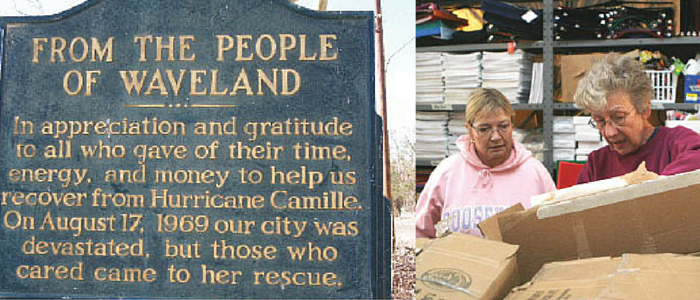
LEFT: Judith Gouwens (left), assistant professor of elementary education, and Kay Covode, a librarian from the Bay Saint Louis-Waveland School District, sort through supplies in a makeshift storage facility. RIGHT: One of the only landmarks standing after the 2005 storm had destroyed much of Waveland, Miss., was a sign commemorating those who helped with recovery during a hurricane in 1969.

No matter how large or small the effort, however, the Roosevelt community lived up to its long-held tradition and mission of social justice in ways that would have made both Franklin and Eleanor Roosevelt proud.

“We encouraged offices, departments, clubs and organizations throughout the University to select a project and work on it as a unit,” said Roosevelt University Provost Pamela Reid, who called town hall meetings at the Chicago and Schaumburg campuses to discuss ways community members could get involved.

Answering Reid’s call, members of the College of Education organized one of the more interesting relief efforts by partnering with a devastated school district in Bay Saint Louis, Miss., located on the Gulf Coast near the eye of the storm.

“We saw people who were still living in tents and met a teacher who was living with her husband and two kids in their car,” said Judith Gouwens, an assistant professor of elementary education who made a trip with students to Bay Saint Louis in October.

“Virtually everyone was homeless and everything near the coast was flattened,” said Gouwens, who, because of the experience, has begun to do research, including interviewing school superintendents along the Gulf Coast, for a groundbreaking study and publication on how schools respond to natural disasters.

Three students and an adjunct instructor joined Gouwens on what was to be the first of two trips to the Bay Saint Louis-Waveland School District, where first clean up and later rebuilding were—and are—needed for school children taking courses in makeshift facilities.

“I chose to be included in the trip because I felt I needed to do more than just donate money,” said Veronica Baez, a graduate elementary education major who was shocked to see school buildings reduced to rubble and to find classrooms filled knee-deep with debris.

“What amazed me most was that I expected the people down there to be devastated, and they weren’t. They were strong and trying to do what they could to get back to normal,” Baez added.

The second trip to Bay Saint Louis, also in October, was led by Sheila Coffin, the assistant dean of the College of Education.

“It was the kind of trip where you worked hard physically trying to create space in the Quonset huts so they could serve as the school district’s administrative offices,” said Coffin, who was joined by two College of Education students in helping to move things to a new location in order to make room.

“The devastation is so overwhelming that it’s difficult to comprehend how people continue to live each day amidst the debris,” she added. “Viewing the devastated areas shocks one’s entire sensorial system. The sights and smells are so unbelievable. You have to admire the resilience of people who have lost everything and are so willing to rebuild their lives.”

Stacey Oliver, an undergraduate majoring in early childhood education, was one of the students who accompanied Coffin.

“It was nice to see the outpouring of compassion and great to see how the community came together to help one another out.”

“It was nice to see the outpouring of compassion and great to see how the community came together to help one another out,” said Oliver, who hopes to be part of a future volunteer trip to the Bay Saint Louis area.

Standard