Alumni News, Feature 4, Feature Stories, Spring 2015

Rewriting History

Darlene Clark Hine

Alumna Darlene Clark Hine is a pioneering scholar in the field of African-American women’s history and a recipient of the prestigious National Humanities Medal.

When she was a sophomore in high school, Darlene Clark Hine envisioned herself wearing a white coat in a laboratory, examining microbes and essentially having little to do with human beings.

“That was my dream. That’s what I thought I’d be doing for all of my life,” she said. “But after my freshman year at Roosevelt University, I changed my major from biology to history and my life took a whole new direction.” That direction led all the way to the White House, where last summer she received a National Humanities Medal from President Obama for her groundbreaking studies on African-Americans, especially accomplishments of African-American women.

“Darlene is an architect in the field of African American women’s history, the co-author of the most widely used textbook in African-American history and the leading scholar in the United States of the black professional class,” said Martha Biondi, chair of the Department of African-American Studies and Hine’s colleague at Northwestern University, where Hine is the Board of Trustees Professor of African-American Studies and Professor of History. “She’s an intellectual leader, yet at the same time, she is a down-to-earth, warm, generous and thoughtful person,” Biondi said.

In a conference room at Northwestern (her office being too filled with books and papers to meet comfortably), Hine recalled that she was admitted to Roosevelt University on a scholarship, having been valedictorian at Chicago’s Crane High School. Her freshman year was 1964 and the Civil Rights Movement was at its peak. “As a biology student, all I knew was that this talk about racial inferiority made absolutely no sense to me, because as every scientist knows there’s only one race and that’s the human race. The color of your skin is neither good nor bad.”
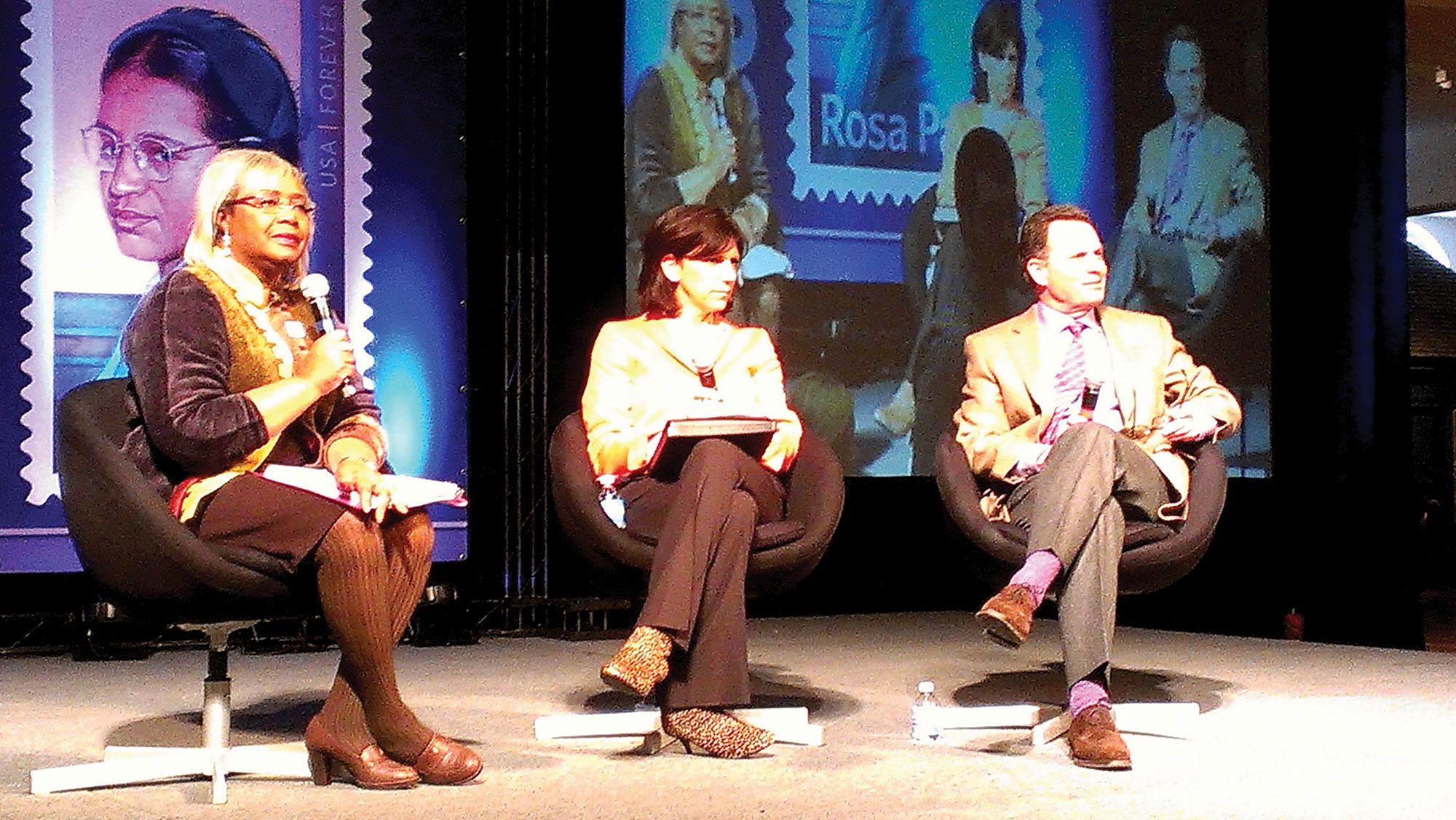
Darlene Clark Hine moderating a panel

On Feb. 3, 2013, at the Henry Ford Museum in Michigan, Roosevelt alumna Darlene Clark Hine moderated a panel celebrating the 100th birthday of civil rights activist Rosa Parks and unveiled a stamp in her honor.

The Roosevelt student concluded that hatred and turmoil must have something to do with history so she switched her major to history. Laughing, she said, “I wanted to write a lot of books, explain this to people and have everyone behave better.”

At Roosevelt, Hine observed history in the making, listening to Black Panthers Mark Clark and Fred Hampton when they spoke on the second floor of the University.

She took classes from some of the University’s most distinguished faculty members, including Charles Hamilton, author of Black Power, and Lorenzo Turner, chairman of the African Studies Program and author of Africanisms in the Gullah Dialect. Roosevelt “was a mecca for me,” she said. “I didn’t know enough to participate in the conversations and I didn’t become politically active, but I soaked it all in.”

Darlene ClarK Hine and Randal Jelks,

Darlene Clark Hine, who taught at Michigan State University for 17 years, meets with former student Randal Jelks, who is now a professor at the University of Kansas.

Throughout her career, Hine always has stressed the importance of her Roosevelt education and she talked about it again in December when she was Roosevelt’s fall semester Commencement speaker and the recipient of an honorary Doctor of Social Justice degree. Her address to graduates described the “precious intellectual gifts” she received as a Roosevelt student.

“When my students learn that Dr. Hine was an undergraduate student at Roosevelt like them, they become all the more inspired,” said Erik Gellman, associate professor of history at Roosevelt who was mentored by Hine when he was a doctoral student at Northwestern. “Her textbook, The African-American Odyssey, always receives high praise from students in my African-American history courses for its fascinating telling of the central and rich history of African-Americans in America.”

“I had entered a universe that I never knew existed. And that was the beginning of my commitment to telling the truth, to lifting the veil, to shattering the silence about black women in American history.”

After graduating from Roosevelt in 1968, Hine went to Kent State University to further her studies with August Meier, one of the nation’s foremost authorities on race and black history and a former Roosevelt professor. But her time there was marred on May 4, 1970, when members of the Ohio National Guard shot students who were protesting the Vietnam War. Hine was the only black student to witness the confrontation. “I was a historian in training and thought I should be there to observe things,” she said. “The shootings were so profoundly disturbing that I basically retreated to the library and didn’t come out for decades.”

Hine’s first job after receiving her PhD from Kent State was at South Carolina State College in Orangeburg, where she taught for three years before returning to the Midwest to teach at Purdue University from 1974 until 1987. At that time, there were only a handful of black women history professors in the United States and she was the only tenured African American female professor in the entire state of Indiana.

Her career took an important turn in 1980, when Shirley Herd, an Indianapolis schoolteacher and president of the city’s chapter of the National Council of Negro Women, persuaded Hine to write a history of black women in Indiana. From that point on, much of Hine’s research has focused on African American women. “At that time, no one thought black women were worth studying,” Hine explained. “I had entered a universe that I never knew existed. And that was the beginning of my commitment to telling the truth, to lifting the veil, to shattering the silence about black women in American history.”

President Barack Obama presented Hine with a 2013 National Humanities Award at the White House on July 28, 2014.

President Barack Obama presented Hine with a 2013 National Humanities Award at the White House on July 28, 2014.

Aldon Morris, professor of Sociology and African-American Studies at Northwestern, said Hine is a groundbreaking historian because she demonstrated for the first time that experiences by black women could no longer be subsumed under the history of black men or that of white women. “Her meticulous scholarship has focused a bright historical light on black women, showing they have been crucial actors on the stage of history throughout the life of the nation,” he said.

Hine’s first major book on African-American women, a 1989 study of black nurses called Black Women in White: Racial Conflict and Cooperation in the Nursing Profession, 1890-1950, won numerous awards and professional acclaim. Originally intended to be a history of blacks in the medical profession, Hine changed her focus when she came across a 1924 study on black nursing schools and hospitals while doing research at the Rockefeller Archive Center in Pocantico Hills, N.Y.

A tribute to the first three generations of black nurses, the book highlights nurse Mabel K. Staupers, who helped break down color barriers in nursing at a time when segregation was entrenched in the country and military. “In the 1940s, Staupers took it upon herself to lead a struggle to desegregate the armed forces medical corps and destroy a quota system that permitted very few black women nurses to serve,” Hine said.

The Northwestern professor loves nothing more than rolling up her sleeves and digging through old documents in the archives of libraries and philanthropic organizations. “Almost by surprise, you’ll come across a name, a code, that will lead you to something else and that will lead to something else and before long you can begin to craft a narrative. But it can take weeks or months of investigating,” she said with a smile. That research has led to more than a dozen books on race, class and gender, including The African-American Odyssey and The History of Black Women in America.

In addition to being a nationally recognized scholar, Hine has a reputation in the higher education community for being an outstanding mentor to students pursuing doctoral degrees. During her career, she has trained 35 PhD students, helping to produce a new generation of pioneering historians. “Darlene is encouraging to the uninitiated and a tough-as-nails demanding teacher when she prepares future scholars,” said Morris, her Northwestern colleague.

Christopher Reed, professor of history emeritus at Roosevelt who has known Hine for four decades, said that even when Hine joined Northwestern in 2004 after spending 17 years at Michigan State University, she continued to train her former students. “That was an unusual gesture within the academy and one that ensured continuity for her doctoral students,” he said.

Hine, who taught at Roosevelt in 1996 as the Harold Washington Distinguished Professor of History, has also been a leader in national organizations. She was the first African-American woman president of the Southern Historical Association and the second African-American woman president of the Organization of American Historians, which honored her service by establishing the Darlene Clark Hine Award, given annually to the author of the best book in African-American women’s and gender history.

Hine said “the defining moment in my career and in my life” was receiving the National Humanities Medal from President Obama. Her citation proclaimed: “Darlene Clark Hine, historian, for enriching our understanding of the African American experience. Through prolific scholarship and leadership, Dr. Hine has examined race, class and gender and shown how the struggles and successes of African American women shaped the nation we share today.” Months after receiving the award she is still overwhelmed. “When they first contacted me, I thought they were asking for a letter of recommendation for somebody else,” she said.

Hine won’t tell where she keeps the medal and she refuses to wear it. She has, however, received plenty of comments about the honor from friends. Her favorite is: “You deserve this medal because everybody messed up our history and you got it right.”

Publications by Darlene Clark Hine


Black Victory: The Rise and Fall of the White Primary in Texas
University of Missouri Press, New 2003 Edition

Black Women in White: Racial Conflict and Cooperation in the Nursing Profession, 1890-1950
Indiana University Press, 1989

Hine Sight: Black Women and the Re-Construction of American History
Indiana University Press, 1996

Black Europe and the African Diaspora
(Co-editor with Trica Danielle Keaton and Stephen Small)
University of Illinois Press, 2009

Beyond Bondage: Free Women of Color in the America
(Co-editor with David Barry Gaspar)
Indiana University Press, 1996

The Harvard Guide to African-American History, Vol. I
(Co-editor with Evelyn Brooks Higginbotham and Leon F. Litwack)
Harvard University Press, 2001

A Question of Manhood: A Reader in U.S. Black Men’s History
and Masculinity Vol. I and II

(Co-editor with Ernestine Jenkins)
Indiana University Press, 1999

“We Specialize in the Wholly Impossible” a Reader in Black
Women’s History

(Co-editor with Wilma King and Linda Reed)
Carlson Publishing, 1995

Black Women in America, Historical Encyclopedia Vol. I, II and III
(Co-editor with Elsa Barkley Brown)
Oxford University Press, 2005

The African-American Odyssey
(Co-author with William C. Hine and
Stanley Harrold)
5th Edition, Pearson Education, 2011

Standard
Feature 4, Feature Stories, Spring 2015

The Equality Experiment

TEXT ON WHITE

For many people the notion that a college or university could restrict admission because of one’s race, religion or gender is unthinkable. But that was the case just 70 years ago when Roosevelt University was founded. At that time, the majority of people attending colleges in the United States were white Christian men.

On the occasion of the University’s 70th anniversary, we asked University Historian Lynn Weiner to examine why the founding of Roosevelt was such an extraordinary occurrence in the history of social equality and why it was a success from the very beginning.


In nineteen forty-five, 70 years ago this year, Roosevelt College was created in a courageous effort to make higher education more democratic. It was born into a world where racial, gender and religious segregation dominated colleges and universities, in a nation where fewer than 20 percent of high school graduates went on to higher education and in a city where stores, restaurants, housing and recreation excluded African Americans.

The first student assembly at Roosevelt College

The first student assembly at Roosevelt College was held in the fall of 1945 in the Wells Street building.

College choices were limited in Chicago during the early 1940s. The only comprehensive public university was 140 miles away in Urbana-Champaign, until the University of Illinois opened a two-year campus for freshmen and sophomores on Navy Pier in 1946. Local options included professional and teacher-training colleges, junior colleges, Catholic schools and the University of Chicago and Northwestern University.

Bigotry further restricted college opportunities. Many private colleges and universities at this time – including Northwestern – imposed admissions quotas on the number of Jewish, Catholic and black students they would accept. To screen out “socially undesirable applicants,” they required photographs, personal interviews or the names of all four grandparents on applications.

The number of black enrollees at selective schools was miniscule and their applications discouraged. Princeton University, for example, would not admit black students until 1945. Public universities also discriminated by race. It was not until 1948 that the University of Arkansas admitted its first African-American student. Northwestern, which did admit up to five black students a year in the 1940s, excluded these students from on-campus housing until 1947.

Jewish students were held to quotas of between 2 and 15 percent as universities responded to what they termed the “Jewish problem.” These discriminatory admission policies, which had begun in the 1920s, persisted until the mid-1960s.

One exception was the Central YMCA College in Chicago. Opened in 1919, by 1941 it enrolled a diverse group of 2,240 men and women and identified itself as “liberal in spirit.”

By the early 1940s, however, the Y’s 16-member Board of Directors comprised mostly of local businessmen and bankers had grown uneasy with the rising numbers of “undesirable” black and Jewish students in the classrooms and hallways. They feared these students would drive away white Protestant applicants. In addition, despite the “liberal spirit” of the school, there were rigid racial restrictions in place. Black students, for instance, were expected to pay athletic fees but were not permitted to use the swimming pool, which was operated by the YMCA.

The president of the college was Edward “Jim” Sparling. A Stanford-educated psychologist, he arrived at the Y College in 1936 and found himself in increasing conflict with the YMCA over three major issues – admissions quotas, discrimination and academic freedom. When the Board told Sparling to prepare a census of the racial and religious composition of the student body, he refused, saying, “We don’t count that way.” In February of 1945 he was told to resign.

Edward James Sparling

Edward James Sparling, Roosevelt’s founding president.

President Sparling and his supporters immediately lobbied for a “friendly separation” from the YMCA and planned a new school – initially called Thomas Jefferson College – that would offer admission and equal rights to any qualified student. They sought financial backing from Marshall Field III, the Rosenwald Foundation, labor unions and progressive Chicagoans.

When efforts to interest the Y in this project failed, Sparling formally resigned on April 17, 1945, and in a walkout surely unique in American higher education, 62 faculty members resigned in his support and signed a document condemning the “illiberal and discriminatory purposes” of the Board. A student resolution soon followed, favoring separation from the Central YMCA College by a vote of 448 to 2. President Franklin Roosevelt had died on April 12 and two weeks later the new school was renamed Roosevelt College.

The YMCA College

The YMCA College closed soon after the faculty, staff and student body walked out in protest of discriminatory practices and established Roosevelt College.

Edwin R. Embree, a friend of FDR, head of the Rosenwald Foundation and first chair of Roosevelt’s Board of Trustees, said the new school “embodies the democratic principles to which President Roosevelt gave his life – the four freedoms in action . . . Roosevelt College of Chicago will practice no discrimination in students or faculty and no restriction of class or party line in its teaching or research.”

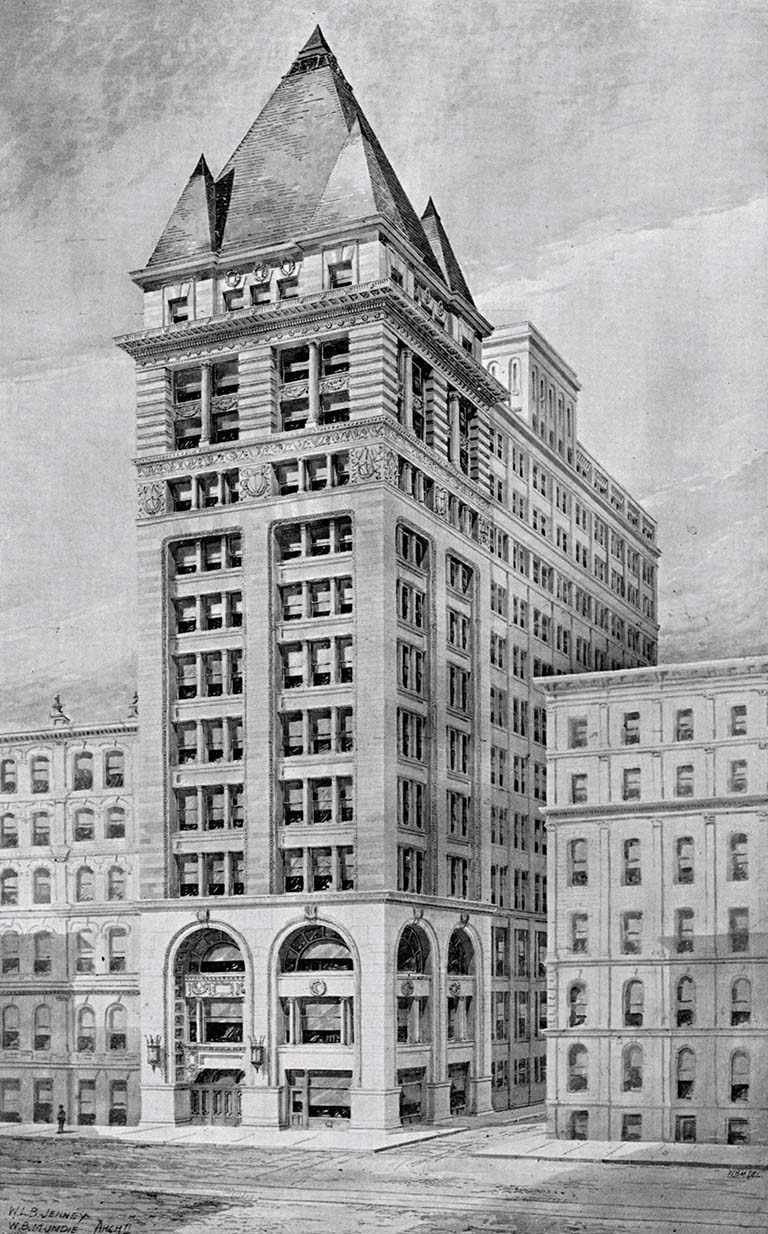
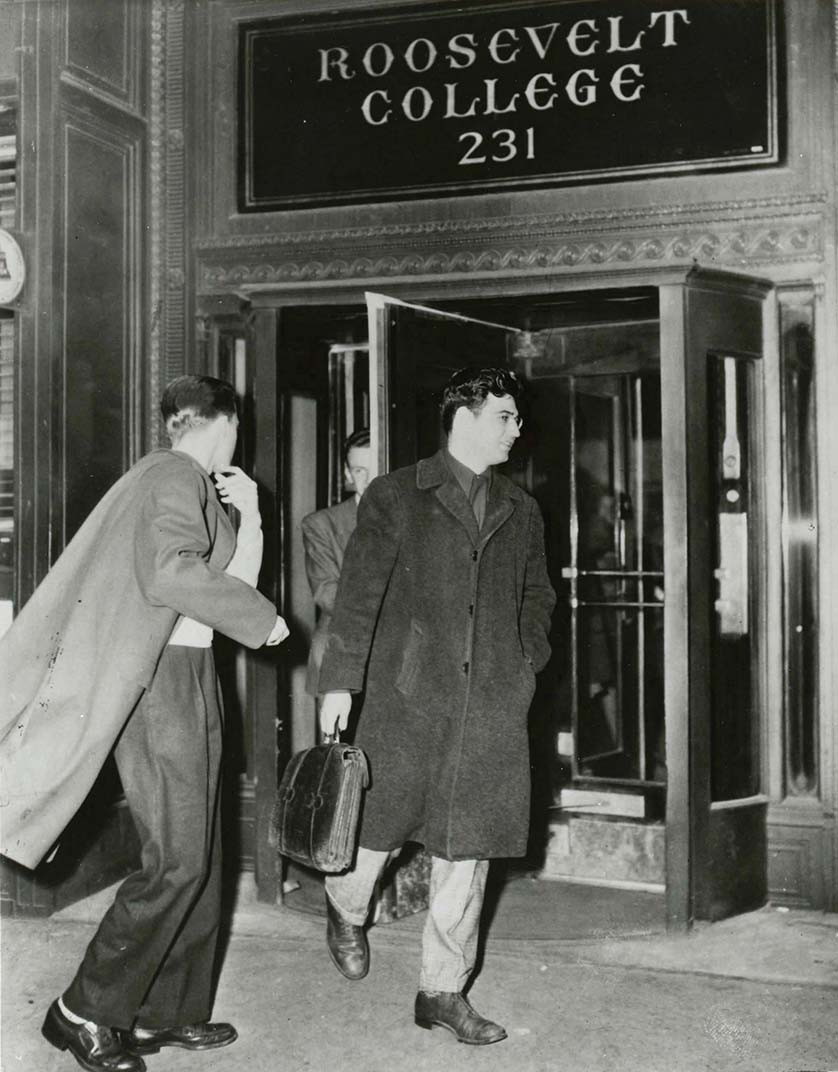
The College now had a mission, a name, a faculty and students, but no money, classrooms, labs or library. The new Board of Trustees, which included African-American chemist Percy Julian, was undoubtedly one of the first racially integrated college boards. It took the trustees until mid-July to acquire a home, an 11-story office building on Wells Street, and a lease on a second building on Wabash Avenue for a music school.

The first Roosevelt campus

The first Roosevelt campus was a hastily renovated office building sitting by the el tracks on Wells Street, and quickly proved too small for the numbers of students seeking admission.

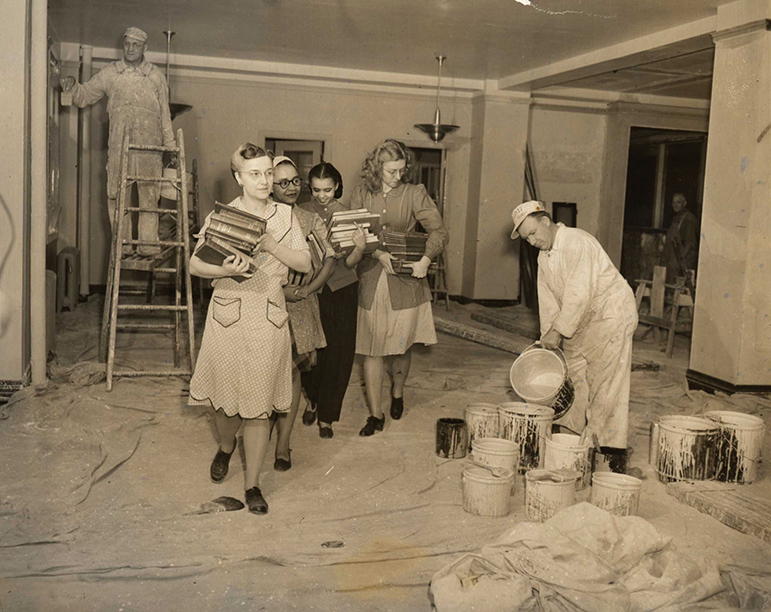
The Board then had two months to raise money, remodel offices into classrooms, studios and labs, and plan for fall classes. They bought chairs from Standard Oil, lab equipment from Illinois Technical College, and books, desks and blackboards from a variety of sources. Faculty and students pushed carts piled high with books and supplies through city streets to set up the new campus and worked alongside painters and carpenters to ready the classrooms for the fall semester.

Founding librarian Marjorie Keenleyside

Founding librarian Marjorie Keenleyside (foreground) with help from students and staff established the first Roosevelt library in the fall of 1945.

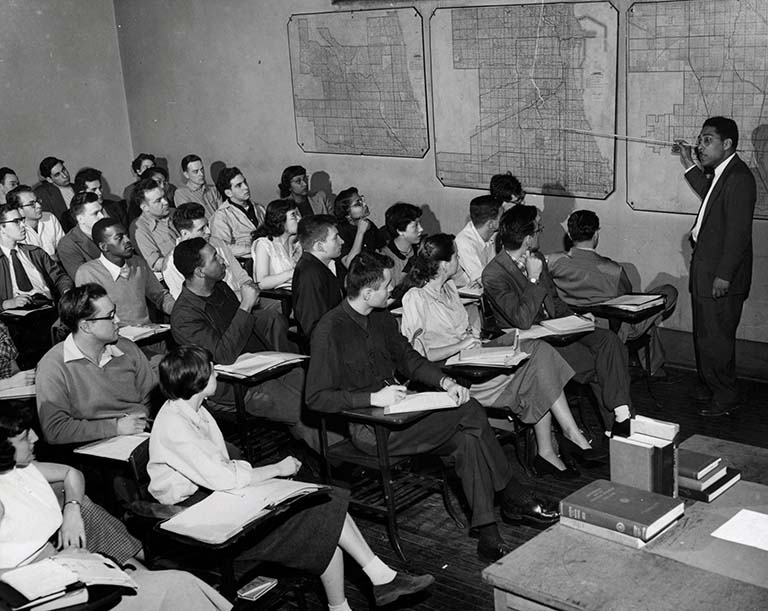
Roosevelt students studied with an outstanding faculty, including the sociologist St. Clair Drake (standing), who co-authored Black Metropolis, the classic study of race and urban lif

Roosevelt students studied with an outstanding faculty, including the sociologist St. Clair Drake (standing), who co-authored Black Metropolis, the classic study of race and urban life.

At the same time, Roosevelt College leaders were busy creating one of the most diverse faculties in the United States. In an era when most American professors were white male Protestants, Roosevelt hired men, women, African Americans, Jews, European refugees, Catholics and teachers from India, China and Latin America. Founding faculty included political scientist Tarini Prasad Sinha, sociologist Rose Hum Lee, economist Abba Lerner, philosopher Estelle De Lacey, language professor Dalai Brenes, sociologist St. Clair Drake, chemist Edward Chandler and many more.

The faculty grew to 71 full-time and 90 part-time professors by 1946. An additional 1,000 professors from around the country sent applications hoping to work at this pioneering college, even if it meant a cut in pay.

Eleanor Roosevelt

Eleanor Roosevelt, a staunch friend of the college from the start, celebrated the opening of Roosevelt College with President Edward James Sparling and 1,000 supporters at the Stevens Hotel in Chicago. Her declaration that the new school would “provide educational opportunities for persons of both sexes and of various races on equal terms” was radical for its time.

Approximately 1,200 students began classes on Sept. 24, 1945. They were even more diverse than the faculty – and were described by one newspaper as “Chinese, Japanese, Negroes, Levantines, Jews, Catholics and Down East Yankees.” The next year, realizing the first campus was too small to accommodate the number of students seeking admission, Roosevelt acquired Chicago’s famed Auditorium Building on Michigan Avenue. Five thousand students, from military veterans to new high school graduates, registered for classes in the fall of 1947.

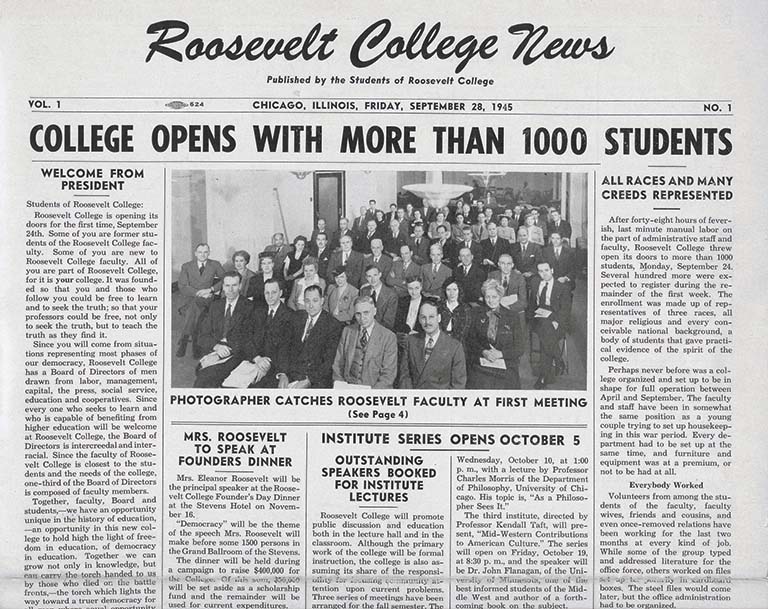
 The first issue of the student newspaper.

The first issue of the student newspaper featured a front-page story on Roosevelt’s opening.

And so a new college began. Magazine and newspaper reporters flocked to the classrooms and marveled at Chicago’s “equality lab.” In November of 1945 Eleanor Roosevelt, chair of Roosevelt’s Advisory Board, dedicated the college “to the enlightenment of the human spirit.” A remarkable act of courage by a college president, staff, faculty and students in the spring of 1945 had created, as one journalist wrote, nothing less than “a model of democracy in higher education.”

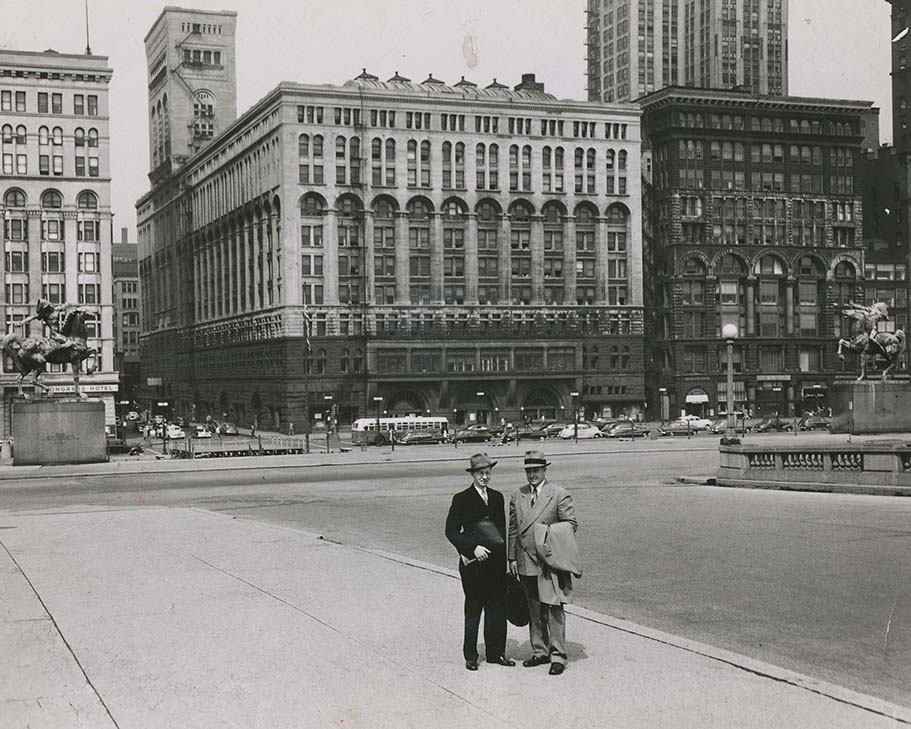
Roosevelt purchased the dilapidated Auditorium Building in 1946 and immediately began the long process of renovating the building into an 18-story college campus.

Roosevelt purchased the dilapidated Auditorium Building in 1946 and immediately began the long process of renovating the building into an 18-story college campus.

Standard
Alumni News, Feature 4, Feature Stories, Spring 2015

Seth Boustead Wants Us All to Hear the New Classics

Seth

Whether he’s talking about composers on his internationally syndicated radio show or meeting with them in China, Chicago and points in between, Seth Boustead’s message is this: Classical music is not dead.

Set aside then, at least for now, classics by centuries-old icons like Beethoven, Bach, Mozart and Tchaikovsky. Boustead, a Roosevelt alumnus with bachelor’s and master’s degrees in Music Composition from Roosevelt’s Chicago College of Performing Arts (CCPA) in 2000 and 2002, believes classical music’s golden era is happening right now.

“Seth Boustead is a leading voice for today’s classical music,” said Henry Fogel, CCPA dean. “In addition to being a fine composer, he is one of the best promoters of new music, which is a unique talent to have and an important niche to fill.”

Known for his energy, casual attire and innovative ideas regarding ways new music can be spread more widely, the 42-year-old arts leader and composer seeks, more than anything, to change negative perceptions. That means not giving credence to complaints that today’s classical music is too atonal, just noise, hard to follow, academic, difficult to relate to and so on.

“Seth went out and created his own career, and that’s a powerful example for anyone coming out of music school.”
Linda Berna, director of CCPA’s Music Conservatory

“It used to hurt me when I heard those things,” said Boustead, who is president of Access Contemporary Music (ACM), an organization he started as a Roosevelt student. “Now I’m bold, just taking the ball and running in a lot of directions.” Many directions, indeed. Boustead has his hand in numerous projects relating to today’s classical music.

Featuring the latest in modern classical music, Boustead’s “Relevant Tones,” a weekly radio show based at WFMT in Chicago, reaches a quarter-million listeners in 188 markets, including New Zealand, Canada, the Philippines and dozens of U.S. cities.

“It seemed like a risk at first,” said Jesse McQuarters, a WFMT producer who met Boustead in 2007 when he was performing one of Boustead’s compositions for double bass. A few days later, Boustead called McQuarters with a proposal for a new show. “Nobody was asking for a new-music program,” said McQuarters, who pitched the idea to the station anyway, as Boustead was so enthusiastic and enigmatic. “It’s gone far beyond what we ever anticipated,” added McQuarters of the 3-year-old program which was syndicated last year. “That’s part of Seth’s genius: He’s such an advocate for living composers and new music that he’s been able to get listeners to financially support the show.”

Another of Boustead’s ideas is the Composer Alive series, which streams a winning piece of music in installments on the ACM website. In its ninth season, Composer Alive has engaged lovers of new classical music in learning the craft of composing. Winning compositions have come to ACM from Poland, Brazil, New York, Canada, Japan, Mexico, Paris, Ireland and China.

“There are organizations you join just because you’re a composer,” said Alyson Berger, a cellist and ACM board member. “Most of them don’t help composers get their music out. That’s what makes this unique.” One way ACM does this is by commissioning composers to write pieces for significant spaces that are open to the public for tours.

“Too often, people think new classical music is weird, but Seth has succeeded in breaking down the barrier,” said Lynn Osmond, president of the Chicago Architectural Foundation’s Open House Chicago. In 2014, the event attracted thousands to Chicago locations where new pieces were played, including the Old Women’s Lounge at Union Station and Tip Top Tap at the Allerton Hotel. “The music certainly brought the spaces to life,” said Osmond, who said she hopes the concept continues to flourish. In fact it has, as Boustead is commissioning composers to write music for spaces at Open House Milwaukee and Open House Helsinki.

The idea also inspired Tim Corpus, a 2010 Roosevelt percussion performance graduate and composer to write “Letters from Home,” a piece capturing the mumbling voices of waiting passengers. It premiered at Union Station and also was featured in a CNN Money segment about ACM, a 2014 nominee for a Chicago Innovation Award.

“Composers can be awkward people who tend to want to be off somewhere by themselves, but Seth’s not like that. He’s approachable, engaging and empowering,” said Corpus, who is currently writing three pieces for the New American Timpani project that will premiere in spring 2016 at Roosevelt.

Also promising for ACM has been The Sound of Silent Film Festival, a Boustead creation pairing new scores with modern silent films. Started in Chicago in 2005, the concept recently debuted in New York, San Francisco and Austin, Texas. “You can do these kinds of films set to new music in any country in the world,” said Boustead, who has been composing classical music for much of his adult life.

SOSF_logo

Boustead, unlike many aspiring composers, never pursued a PhD. “This is not your typical music student who wants to be a member of an orchestra or a college professor,” said Linda Berna, director of CCPA’s Music Conservatory. “Seth went out and created his own career, and that’s a powerful example for anyone coming out of music school today.”

Anything but conventional, Boustead left the University of Missouri with 12 credits remaining for a bachelor’s degree in Music Composition. He moved to Chicago on a lark at 21 years of age to play piano for Chicago’s Annoyance Theatre, performing off-the-cuff sing-alongs nightly for unruly audiences. He also answered phones at a call center and worked alongside CCPA students at the Carl Fischer Music Store, formerly on South Wabash Avenue, where he got the idea to finish his bachelor’s in Music Composition at Roosevelt.

“You can ask students in class any time, ‘How many of you have ideas for new music compositions?’ Most if not all of their hands will go up,” said Stacy Garrop, a Roosevelt music composition professor whose first student was Boustead. “But to succeed, you have to figure out how to promote your ideas – and Seth has done that,” added Garrop. “He’s definitely one of our best success stories.”

Boustead always has had a flair for promotion, going back to his time at Roosevelt when he attracted nearly 100 people to his graduate recital by using flyers of his face photo-shopped atop a bust of Beethoven with the headline: “Come Explore the Works of Boustead, Boustead and Boustead.”

“He was funny and smart and I remember us hitting it off quickly,” said Roosevelt alumna Laura Koepele-Tenges (MM, ’97), a former flutist and lover of new classical music who met Boustead while she was a CCPA administrator. “One day we were kicking around ideas. I remember saying ‘Wouldn’t it be great if new music was played more often?’ and Seth saying ‘We’re living in an exciting time. Why is this music being held back?’”

The two joined together in 2000 and formed the first rendition of ACM, performing in churches, gymnasiums, coffee shops and any venue that would have them for free. Then Boustead dreamed up Weekly Readings, a series that brought musicians out regularly to record new music. “It was a ludicrous idea really, and I didn’t think it would go anywhere,” said Boustead, who wrote up and sent out press releases calling for new scores.

Access Contemporary Music

Access Contemporary Music runs the fourth largest music school in Chicago and plans are being made to open storefront music schools in cities nationwide.

He received more than 100 submissions and a write-up in Chamber Music Magazine, which credited him with “breaking a new trail.” The recordings were posted on the ACM website, streaming music clips before Sound Cloud or iTunes existed.

Boustead is planning for ACM’s expansion nationwide, not through performances, but with storefront music schools that attract passersby to sign up after they see lessons-in-progress in the schools’ storefront windows.

“He (Boustead) knows that if we’re going to make it we can’t just be a performing ensemble,” said Randall West, an ACM board member with a 2009 master’s in Music Composition from Roosevelt. In West’s words, “There’s always something rolling at ACM,” which now has four Chicago spaces and also is the city’s fourth-largest music school. “There’s this synergy as a result of all these things happening and it’s inspired Seth to broaden the reach further.”

That includes Boustead’s work as a composer. In fall 2014, he and fellow Roosevelt music composition and saxophone performance graduate Amos Gillespie (MM, ’05) released “1,001 Afternoons in Chicago,” a CD with music and narratives on the writings of late Chicago journalist Ben Hecht. It caught the attention of Chicago Tribune critic Rick Kogan.

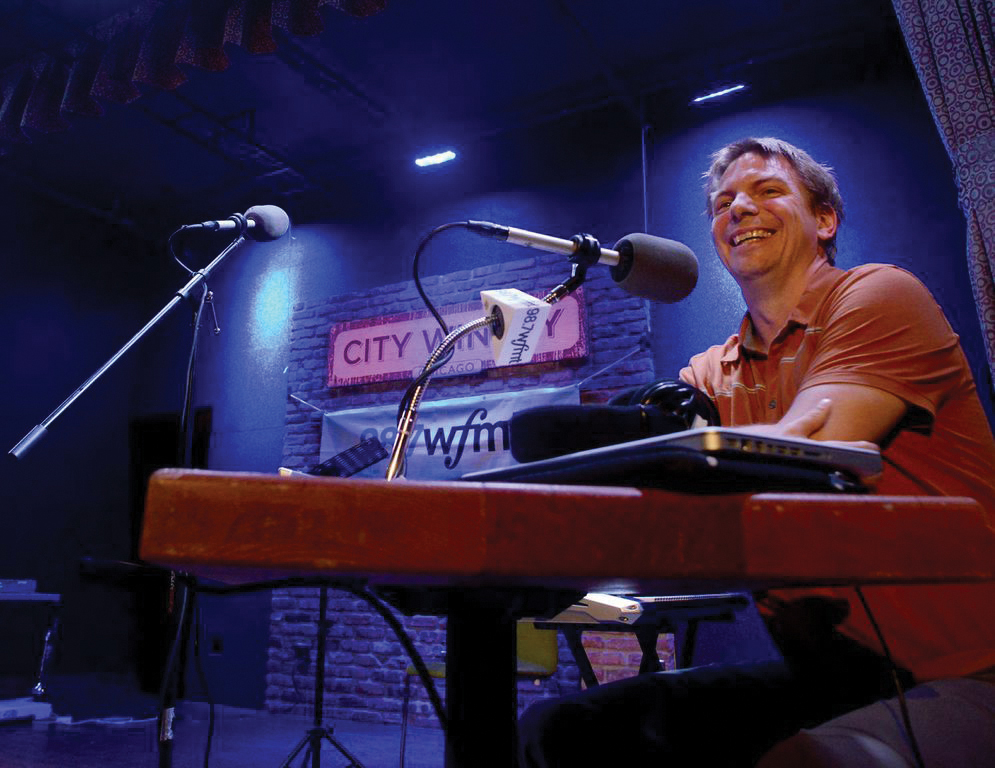
Seth Boustead is host of "Relevant Tones"

Seth Boustead is host of “Relevant Tones”, a weekly syndicated radio show about new classical music that reaches a quarter-million listeners around the globe.

“Seth’s inventive championing of the work of Ben Hecht is a remarkable thing, bringing back to life in words and music one of the great writers of the 20th Century,” said Kogan, who has had Boustead as a guest on his radio show. “Seth has some terrific work under his belt and a bright future ahead.”

The future according to Boustead means new classical music must continue to thrive. “I keep telling everyone this: ‘If I get run over by a truck tomorrow, I want you to see that modern classical music continues as a living, breathing part of our planet. Promise me, you’ll keep the movement rolling.’”

Listen In

Relevant Tones is a weekly exploration of the most fascinating time in classical music: right now. From up-and-coming firebrands to established artists, this program celebrates the dynamic and diverse musical creations of modern-day composers from around the world.

» Saturdays at 5 p.m. CST, 98.7 WFMT-Chicago

Access Contemporary Music strives to present classical music as a thriving, global art form in the 21st century and beyond by fostering the creation and appreciation of new works by living composers and bringing those works to new and diverse audiences through collaborative projects, innovative commissions and dynamic public performances of the highest artistic quality.

»Learn more: http://www.acmusic.org

SethBoustead.com

»Latest tracks: http://sethboustead.com/works

[soundcloud url=”https://api.soundcloud.com/users/5592480″]

Standard