Fall 2016, Feature 4, Feature Stories

Justice Comes Full Circle — The Mansfield Institute Takes On Restorative Justice

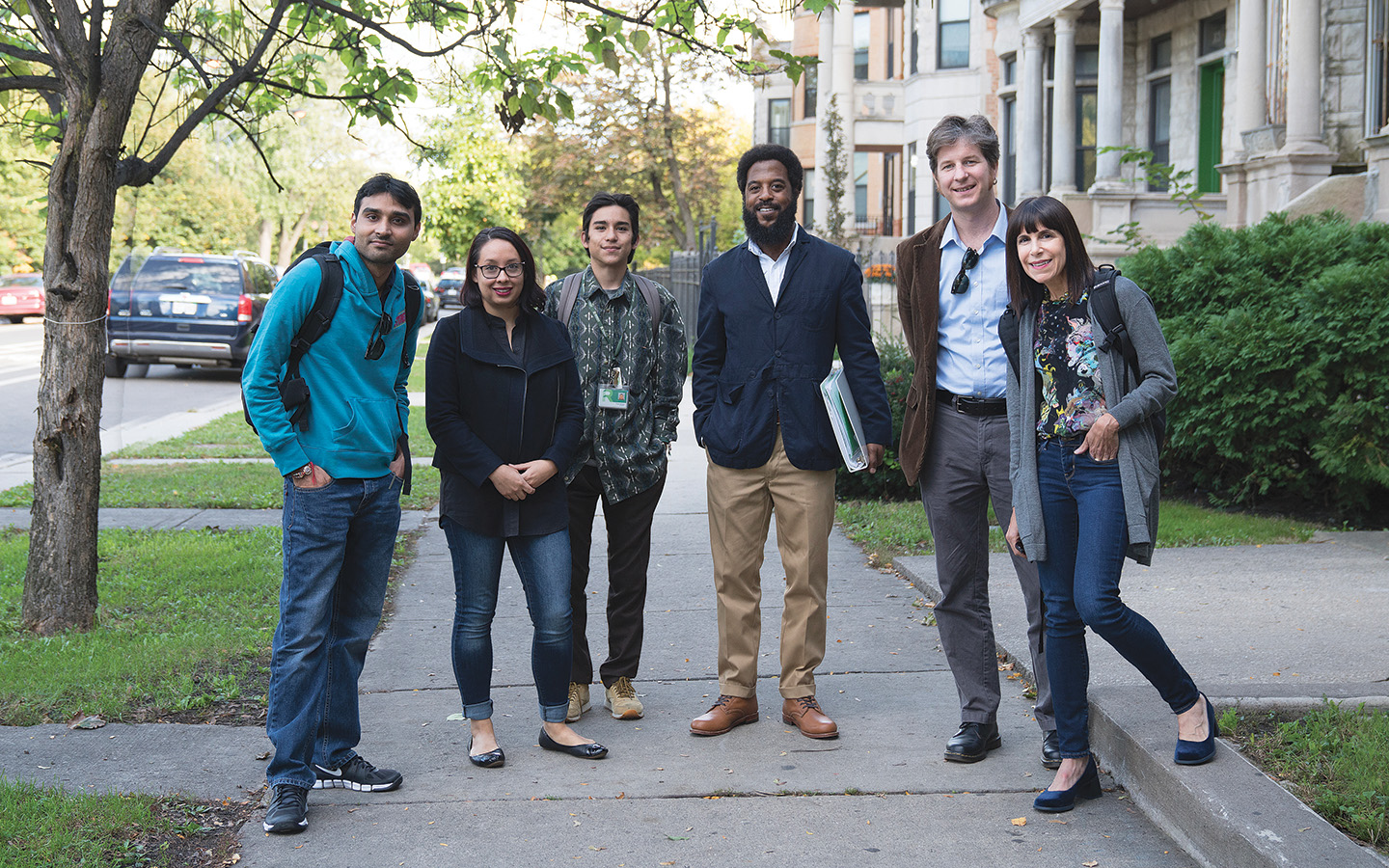
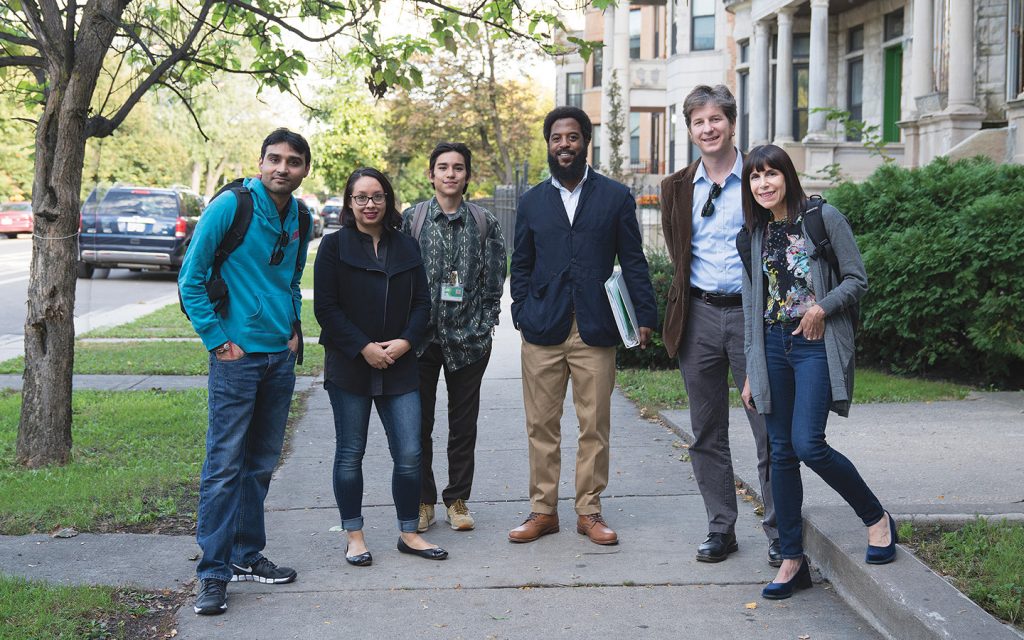
Left, in Chicago’s North Lawndale: Roosevelt accounting student Bajesh Punjwani, Mansfield’s Lyly Harrington, Roosevelt sociology students Edgar Moreno and Shanti Brown, Roosevelt professor Edward Green and Mansfield’s Nancy Michaels.

Left, in Chicago’s North Lawndale: Roosevelt accounting student Bajesh Punjwani, Mansfield’s Lyly Harrington, Roosevelt sociology students Edgar Moreno and Shanti Brown, Roosevelt professor Edward Green and Mansfield’s Nancy Michaels.

A shift in thinking about how we deal with conflict, crime and violence is taking place in Chicago and beyond, and Roosevelt University’s Mansfield Institute for Social Justice and Transformation has a major stake in it.

Founded in 1999 as the University’s social justice arm, Mansfield got its start planning social-justice lectures that frequently have drawn hundreds of people to campus. Today, the organization is leading frank discussions, often called circles, on ways to fix our broken criminal justice system.

“We don’t get to know one another the way we used to,” said Heather Dalmage, director of the Mansfield Institute, which, since 2010, has been working to rescue vulnerable youths from the grasp of gangs, drugs, crime and prison. “We’ve got to be able to think together about how to create needed social changes. Otherwise, we’ll never be able to get at the root of what’s causing these problems.”

“We’ve got to be able to think together about how to create needed social change.”
Heather Dalmage Director, Mansfield Institute for Social Justice and Transformation

Now being tried with young people around the nation as a way to nip conflicts before they turn violent or criminal, this approach is called restorative justice, and it’s picking up steam from Chicago to London, and Colorado to West Virginia.

“We’ve been stuck in a cycle of punishment: black and brown young people getting in trouble at school and suspended, then being arrested in school and in their communities, unnecessarily criminalized and sent down the path to prison,” said Nancy Michaels (BA, ’07; MA, ’10), associate director of the Mansfield Institute.

“People all over are realizing that this way of doing things isn’t working. It’s damaging lives and communities, and we have to find alternative solutions,” she said.

Restorative justice has roots in indigenous cultures that for years have used circle practices to build relationships and strong communities. Building on these traditions, modern-day founder, Mennonite and American criminologist Howard Zehr, who in 1990 wrote Changing Lenses: A New Focus for Crime and Justice, encourages us to move toward building communities and away from building a world of punishment. For example, when wrongdoing or crime occurs , he encourages us to ask “Who was hurt?” and “What are their needs?” instead of “What laws have been broken?” and “What do the offender(s) deserve?”

“Our goal is to shift the way we think about and do justice,” said Michaels, who has been leading the development of restorative justice thinking and practices in schools, the criminal justice system, throughout Chicago and at Roosevelt University. “It’s about changing hearts and minds, and building public and political will that results in policy change. While this has been a slow process, we are certainly beginning to see a shift,” she said.
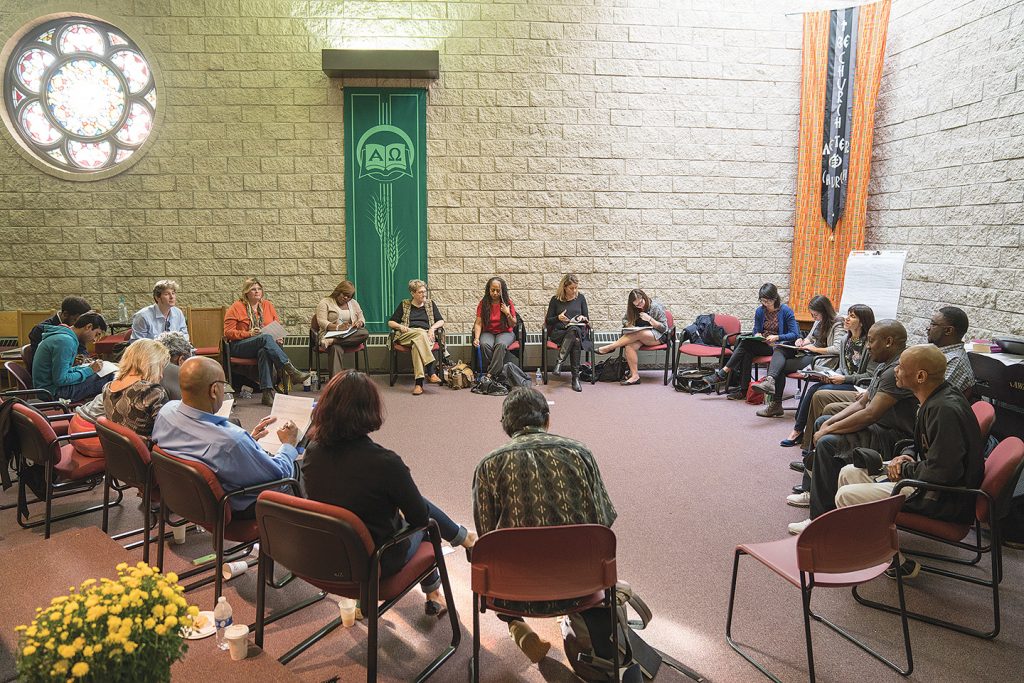
Court Planning

Court planning sessions include circle discussions.

There is a national buzz today, like never before, about the value of restorative justice: It’s been highlighted extensively recently as having potential to heal rifts and mend troubled lives by the New York Times Magazine, Wall Street Journal and USA Today; It’s also been piloted, primarily as an alternative to school suspensions, in places like New York City, Denver and Oakland, Calif.

“We’re at a point where we don’t have to spread the word quite as much on what restorative justice is all about,” said Sara Balgoyen, president of the Illinois Balanced and Restorative Justice Project. “Clearly, the Mansfield Institute is one of the players who has helped move the cause forward.”

Among steps taken, the Mansfield Institute has brought together under one umbrella called “The Embrace RJ in Schools Collaborative” more than 40 grassroots groups in Chicagoland that subscribe to implementing restorative justice in all schools.

Led by Michaels, the group crafted guidelines for using restorative justice practices, including circles, in the Chicago Public Schools, and also has been active in teacher and principal training.

“We’re moving toward a system-wide, restorative-justice school district,” said Jean Klasovsky, a restorative practices specialist at CPS, “and Embrace RJ helped us put together the framework.”

Now Mansfield is on the verge of impacting lives and policy as one of the advisers for the nation’s first Restorative Justice Community Court, opening in Chicago in 2017. The expertise and leadership of Michaels and the Mansfield Institute have been pivotal to the creation of this court.

In fact, Cook County Circuit Court Judge Colleen Sheehan, a 16-year veteran who has seen young people repeatedly cycling through her courtroom, emphatically stated, “We are entering unchartered waters with this innovative project, and I can tell you right now that there would be no court without Nancy and the Mansfield Institute.”
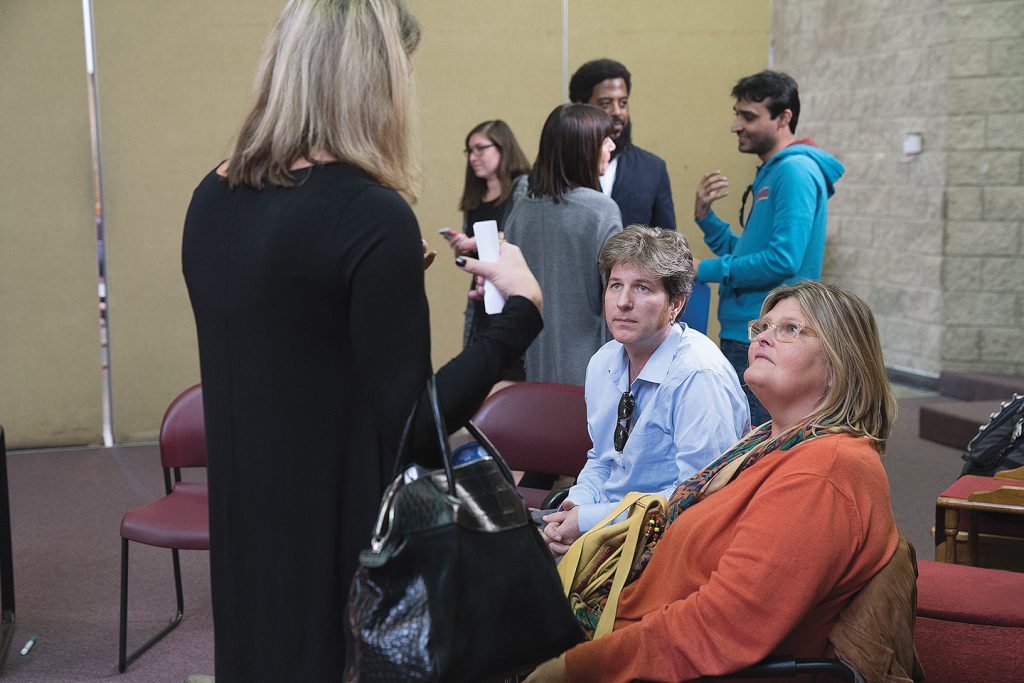
Roosevelt Assistant Professor of Criminal Justice Edward Green and Cook County Circuit Court Judge Colleen Sheehan.

Roosevelt Assistant Professor of Criminal Justice Edward Green and Cook County Circuit Court Judge Colleen Sheehan.

Sheehan worked closely with Michaels and Cook County Circuit Court administrator Michelle Day to develop a plan for the court that will be housed in Chicago’s west-side North Lawndale neighborhood where 70 percent of male residents have felony convictions.

The pilot court, which could become a model, will be for 18 to 26-year olds accused of nonviolent misdemeanors and first-time felonies committed in North Lawndale.

“We are entering unchartered waters with this innovative project, and I can tell you right now that there would be no court without Nancy Michaels and the Mansfield Institute.”
Judge Colleen Sheehan

They would be asked to voluntarily participate in circles/conferences with their victims, and the goal would be to: give them a better understanding of harm caused so they accept responsibility; award restitution repairing harm done to victims and the community; and provide resources, such as mental health or drug treatment and job training, that can put offenders on a positive track.

“This is huge. It’s a project that has international significance,” said Elizabeth Clarke, president of the Illinois Juvenile Justice Initiative, which recently put the Mansfield Institute on an international restorative justice delegation visiting England last spring. “We are giving the community ownership of the court and allowing them to deal with these cases as they see fit, and that’s something that’s not been done before,” she said.

The Mansfield Institute will evaluate the court’s effectiveness with help from approximately 20 Roosevelt students who will be surveying North Lawndale residents.

“I’m interested in this project because it’s near my home and I’ve seen the damage that’s been done with young people who have been convicted of crimes and can’t find work,” said Emmanuel Corde, a sociology student who will survey in North Lawndale as part of a Research Methods class. “I want to support our future and change the world we live in.”

The court project is but one example of the Mansfield Institute’s social justice work, according to Roosevelt University Trustee Meme Hopmayer, whose Albert and Anne Mansfield Foundation created and has financially supported the Institute.
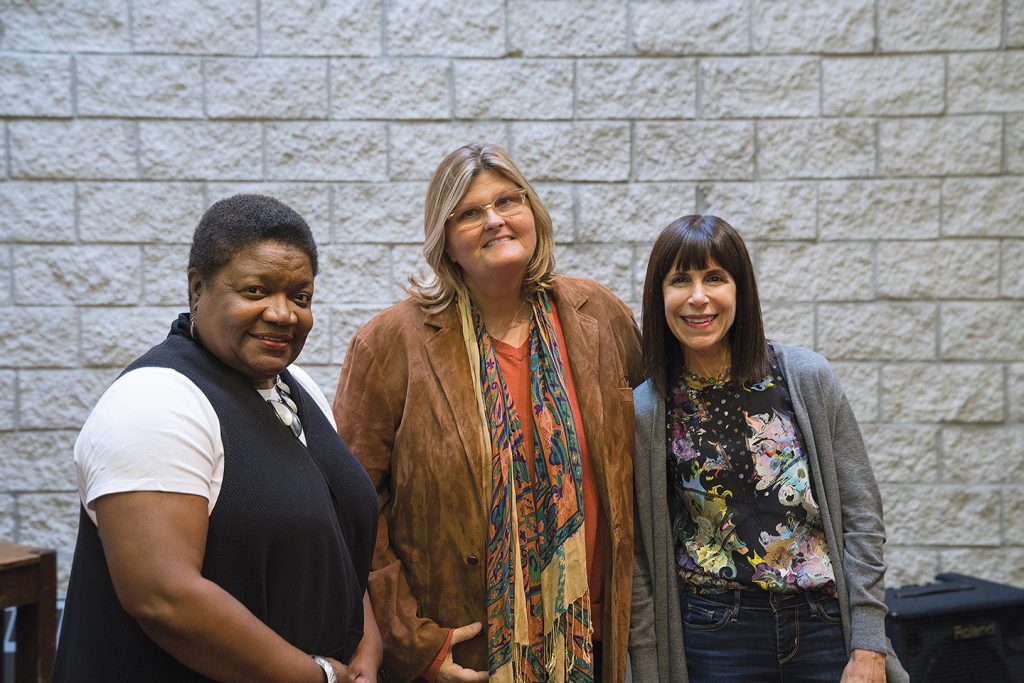
Restorative justice court planners include Cook County Circuit Court Administrator Michelle Day, Judge Colleen Sheehan and Roosevelt’s Nancy Michaels.

Restorative justice court planners include Cook County Circuit Court Administrator Michelle Day, Judge Colleen Sheehan and Roosevelt’s Nancy Michaels.

“I’m proud of what’s been accomplished with this project, and I particularly love that Roosevelt has engaged students in going out, learning about and contributing to the work,” she said.

Looking forward, the Mansfield Institute wants to encourage neighborhood connections that can help transform Chicago into a restorative justice city.

“Our goal is to shift the way we think about and do justice.”
Nancy Michaels Associate Director, Mansfield Institute for Social Justice and Transformation

“We’ve talked quite a bit about it, using circles of healing to create positive values that we can live by – block to block, police to community, city hall to downtown and its neighborhoods,” said the Rev. David Kelly, executive director of the Precious Blood Ministry of Reconciliation. “Roosevelt has been active in this, and is one of our partners in our campaign,” he said.

Now in its 17th year, the Mansfield Institute also is aiming to make Roosevelt a restorative justice university. “If not at Roosevelt, then where?” asked Dalmage.

So What is a Restorative Justice University?

Above: Roosevelt sociology student Edgar Moreno and Mansfield’s Lyly Harrington.] It can be a place where research, teaching, training and technical assistance for all kinds of restorative justice projects are housed, such as at Skidmore College in New York, which has its own Restorative Justice Project.

Above: Roosevelt sociology student Edgar Moreno and Mansfield’s Lyly Harrington.

It can be a place where research, teaching, training and technical assistance for all kinds of restorative justice projects are housed, such as at Skidmore College in New York, which has its own Restorative Justice Project.

It can be a center for learning through webinars and videos, which the University of Minnesota’s Center for Restorative Justice and Peacemaking widely offers.

And it is a university that is steeped in the values and practices of restorative justice.

Use of restorative justice circles and peer conferences can be specific to student conduct proceedings, which the University of Denver advocates when cases involving student conduct are being resolved; or the use of circles can have a simple aim of relationship building, which is to put ALL people in a community, no matter rank or stature, on track to share values, uniting them to work together toward positive change.

“These were strangers I hardly knew,” said Roosevelt student Elizabeth “Lizzie” Sharp, who remembers being moved as she sat in circle during Mansfield’s Social Justice Summer Institute where students shared personal reflections on what’s wrong with and how to fix the criminal justice system.

“Once people started opening up, it became easier to share,” said Sharp, who believes a restorative justice university should be about building bridges. “There was this connection that all of us felt in that circle, and to this day, most of us are still in contact. We’ve become friends and activists working together.”

Roosevelt President Ali Malekzadeh had a similar experience when he joined a Mansfield-led circle seeking healing after the fall 2015 release of a video showing Chicago police shooting teen Laquan McDonald.

“There was a lot of pain being expressed, and I was just as angry and sad as everyone in the room,” said Malekzadeh, who remembers several students being uneasy about violence in their own neighborhoods, including police showing up with guns drawn.

“It was important for me to learn what some of our students are going through, and to know that they have a safe place at Roosevelt where they can go to heal,” he said.

“All of us in that room wanted to get beyond the shooting,” he added. “There was a bond and a commitment there to work together for something better.”

That is exactly the kind of spirit that the Mansfield Institute hopes to further ignite as it moves forward in transforming Roosevelt into Illinois’s first restorative justice university.

Among goals will be to: develop university-wide values, policies and procedures; create safe spaces for discussion of difficult topics and to address student concerns or conflicts; provide training for community members, including Roosevelt’s new eight-member student conduct board; and include restorative justice practices as part of coursework in applicable areas, such as for those studying to become counselors or teachers, said Nancy Michaels, associate director of the Mansfield Institute.

“Restorative justice is aligned with our social justice mission,” said Michaels, “and as a result, a restorative justice university will be that much easier to achieve.”

Standard
Faculty Essay, Fall 2016, Feature 4, Feature Stories

Human Resource: Strategies for Landing a Job and Moving Up the Ladder

rufall16_pg52_1

Over the years, I’ve often been asked for advice about career management. In addition to being a professor of management and human resource management at Roosevelt University, I’ve served as board chair for senior executive appointments, evaluated the effectiveness of boards of directors, conducted professional searches and redesigned organizational structures to reflect strategic and other changes.

So I’ve observed a lot and along the way developed creative ways to address a variety of organizational challenges. In this essay, I would like to share my insights on strategies for obtaining a job and moving up the professional ladder.

More than a million people graduate from college each year and it often takes three to nine months to find a job commensurate with the graduate’s college degree. The time may be even greater for international students and professionals. That’s because many new graduates must deal with professional exams and licensure –such as in actuarial science, allied health, accounting and education fields.

Most students start looking for their first job after they graduate, but I believe they need to start earlier —when they’re still in school. There is no perfect time to begin the job search, except this: the sooner the better.

Unlike many people in earlier generations who worked for one employer their entire life, today the average college graduate’s first job is unlikely to be his or her last. In fact, college graduates and professionals these days may have six to eight employers over a 40-year career span with people moving on average every four to five years. So, when selecting an employer, choosing one for lifetime employment should not be among the most important selection criteria.

I realize that some people are wondering whether they should invest the time and money needed to complete a college degree. Completing a bachelor’s degree is extremely important and has strong positive results on career success. Consistently, data from the U.S. Census Bureau shows that over a 40-year working span, the average college graduate earns approximately $1 million more than someone with only a high school diploma.

A master’s degree is also worth the time and money it takes. It’s the highest degree for practicing managers, whereas the doctorate is for people who want to focus more on research or be accredited in such fields as pharmacy or educational administration. For example, a master’s degree in business (i.e., an MBA, MSHRM, MSA, MSRE) and in other disciplines puts the graduate on a whole different level across his or her entire working career with richer opportunities on all fronts, work and life. It also hugely changes his/her potential influence on the world. So the answer is Yes! Bachelor’s and graduate degrees are worth the time, effort and money.

rufall16_pg54_1

People often ask me about whether they should take on this or that job with little or no thought of first establishing a career plan. A job is not a career. A career involves vision, planning and jobs that may include a series of horizontal and vertical moves.

I often think that if people apply for the job they really want, rather than doing mass emails and postings of their resumes, recruiters could fill positions more quickly and accurately. This reminds me of a board that I chaired to select the mayor of a relatively large municipality. The most attractive candidate only applied for one job. He was highly focused and knew exactly what he wanted. That resonated with me and he gained our recommendation. This might not work for all people. The principle is to focus your career efforts with a vision and career plan.

Employers tend to hire and promote based on knowledge, skills, abilities and personal characteristics. Of course, career advancements also are the result of doing your job well. It’s not a matter of being a perfectionist; rather, it’s a matter of good to excellent performance on what the organization values. Lacking the right talent can be painful for an organization. Thus, you and any candidate are more likely to land a role when you match and present your skills and experiences according to the organization’s needs.

Aligning your plans to your manager’s goals under the company’s values and goals will be important to success. If you were in the elevator with the president of your company and were asked, you should be able to deliver a 30- to 60- second pitch on how your work contributes to the bottom line. This shows that you are aware of your company’s needs and how your work contributes to addressing those needs in tangible ways.

Personal characteristics such as dependability, loyalty, trustworthiness, honesty and integrity go a long way. A former store manager recently mentioned that her company valued her and promoted her because they could trust her. Because of those traits, she was chosen to manage the entire store, including its human and physical capital and the risk management function.

Another conversation with a manager in the telecommunications industry brought to light the importance of having a breadth of work experiences. In some industries people are looked at more favorably and experience career advancements based on working in various departments of the organization. Doing this attests to your ability to get along with people, build positive relationships and be a team player.

“A job is not a career. A career involves vision, planning and jobs that may include a series of horizontal and vertical moves.”
Carolyn Wiley, Professor of Management and Human Resource Management

In addition, horizontal career moves allow you to develop new skills. This will make you a more attractive candidate for other desirable jobs within and outside the organization. You’ll learn more about your company and build a broader internal network. For example, in one global firm a cohort of entry level consultants was engaged in a rotation program, giving them an opportunity to work in various practices and hopefully after the rotations to return to the practice of their choice. These types of horizontal career moves are helpful at the beginning of your career and also can be extremely beneficial at other career levels.

Career advancement sometimes requires difficult decisions such as moving to different locations in this country and abroad. Being willing and ready to move to a different location will have an impact on family and other personal relationships. The truth is that you will rarely find all your career advancements in your present role. Advancing to significantly higher levels will often require a move.

But keep in mind that life is more complex these days. It’s good to be flexible and willing to change locations. This is not convenient; but it will enlarge your network. Personally, having led and worked with people on at least four continents has broadened my prospective and respect for others and made me more confident in future work experiences.

As you ascend up the career ladder, you’re gauged more and more on your personal characteristics. At the higher levels of a career about 90 percent or more of the people have a college degree. Therefore, the differentiators become the personal characteristics.

A window into your personal characteristics are your networks. I don’t mean the number of people you’ve connected with on the internet. I mean the number and quality of your relationships with others. It’s important to respect others, consider their views, keep tempers in check and be tactful in verbal and written communication, especially e-mails!

I, like many people, have had great bosses and not so great ones. I recall an incident when a particular boss asked for my feedback. His response to me was great, indicating that he would take my ideas under consideration and he did. He was a good example of a leader who listens to others and acts on their unbiased perspectives. His actions became a model for my management style.

In my teaching and advising students, I emphasize the things I’ve mentioned here. I also advise students to be members of their professional societies that may include marketing, finance, IT, HR or real estate. Most fields (education, law, health services, etc.) also have professional organizations. In all of my classes, students are encouraged to network with professionals in their fields. Your networks are a rich source for discovering new opportunities.

Currently I advise Roosevelt’s student chapter of the Society for Human Resource Management which is open to all majors and has earned local and national recognition. It encourages students to fulfill volunteer roles at the national conferences, sit in on committees and board meetings, attend leadership conferences, participate in case competitions, and stay up to date with the profession. My students also engage in experiential learning through simulations, games, conferences, case studies, pro-bono consulting and other extra-curricular activities.

These are all important, but as students begin their job search, I urge them above all to be prepared for any opportunity. Over 50 percent of college graduates land positions that are not directly related to their field of study. I always encourage students to be flexible and consider other opportunities that may use their skills and aptitudes.

I can think of at least one graduate student who wanted a job in HR, but was offered the head of operations role instead. She accepted the opportunity. While you need to plan your careers, you also must be open and flexible for unexpected opportunities that come your way.

In my own personal life, I have been an entrepreneur, manager, consultant and professor. I have found all these jobs rewarding. What’s my best advice for your career journey? Remain flexible, plan and be alert to the vision and path that ultimately leads to your satisfaction and happiness and helps you advance your goals in life.


Carolyn Wiley is professor of management and human resource management in the Heller College of Business and formerly the associate provost for Academic Program Review at Roosevelt University. She was a European principal and senior consultant for a global consultancy and member of its performance and talent management global team and functioned as a chief human resource officer for an organization. She has held management faculty posts in the United States, France and Ireland. She is currently president-elect for the Midwest Academy of Management. A recipient of both teaching and research recognitions and awards, she earned a PhD from the University of California, Los Angeles and has over 50 publications in journals and book chapters. Her speaking engagements have spanned the globe including Russia, Japan, Africa, Czech Republic, the United Kingdom, France, Spain and the United States. Her research areas include corporate governance, diversity, ethics, professional certification, impression management, DNA of the best companies and corporate responsibility.

For further information, feel free to email cwiley@roosevelt.edu.

Standard
Fall 2016, Feature 4, Feature Stories

Who You Gonna Call? — The Haunting of the Auditorium Theatre

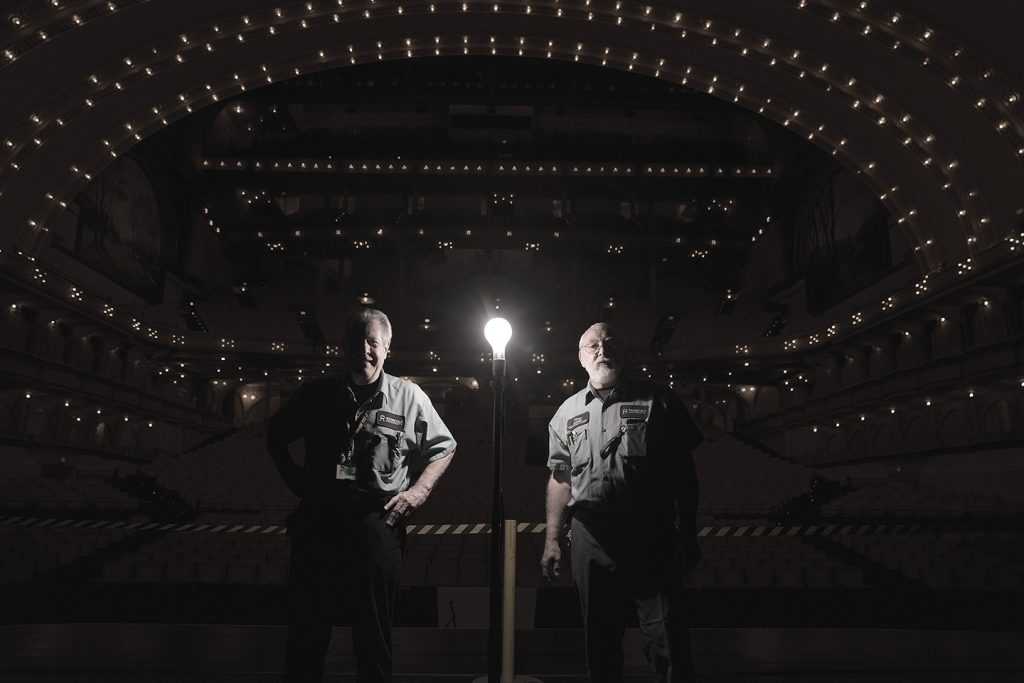
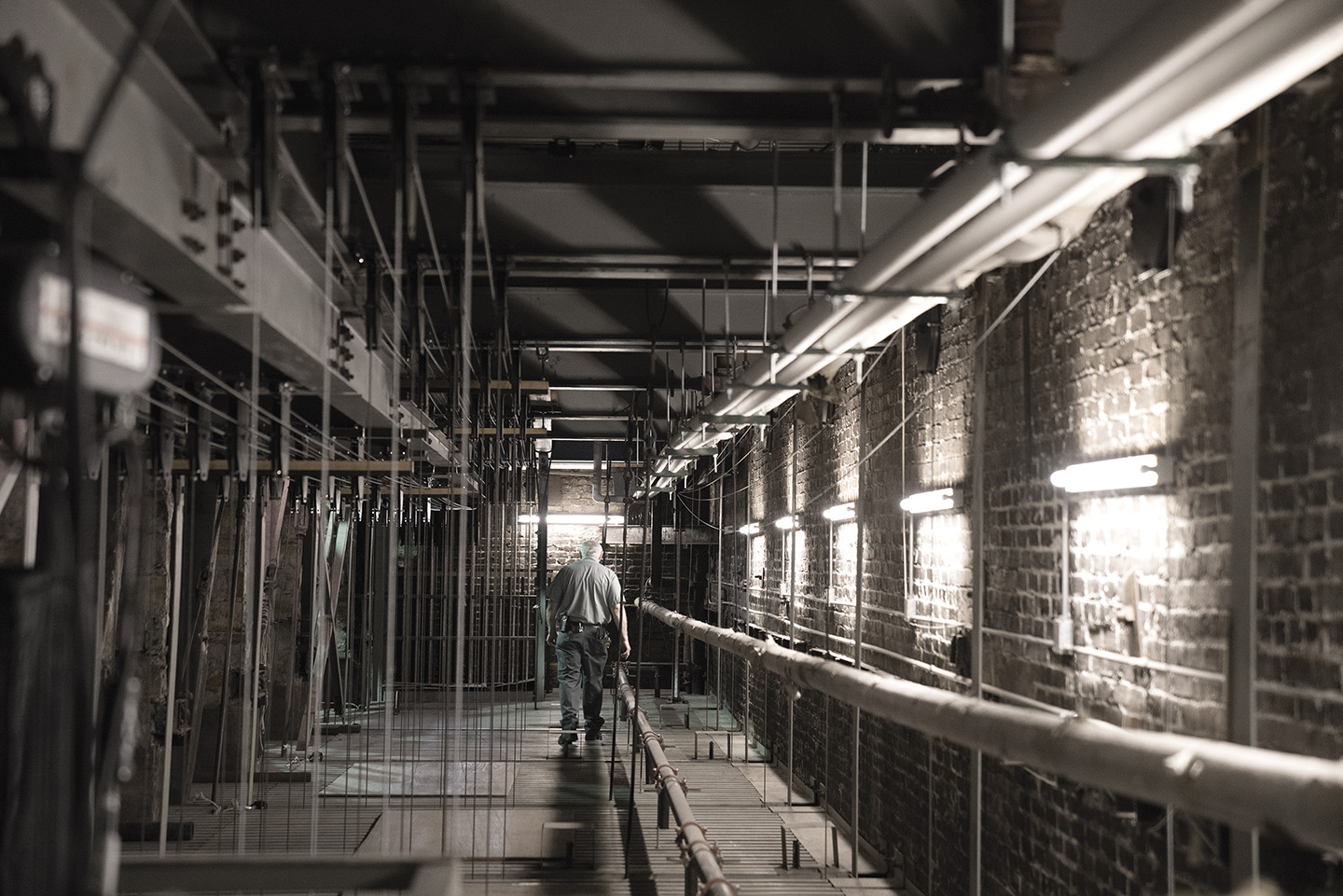
Roosevelt engineers Nick Ahrens (left) and Tony Bugajsky

Roosevelt engineers Nick Ahrens (left) and Tony Bugajsky.

In a humid and oppressive August evening in Chicago, some 20 tourists from around the world gathered around tour guide Andy for his weekly “ghost walk” around the South Loop. At the Congress Hotel –considered one of the most haunted places in the city — we learn about Karel Langer, a young boy tossed out of a 12th floor hotel window in 1939, whose ghost is legendary. And we were told about Shadow Man, who killed himself the night before his wedding in 1900, and reportedly still occasionally roams the lobby, where the piano sometimes . . . plays by itself.

Address site of an antique postcard, isolated on white. (with clipping path) The old postcard has an aged yellow color and the tekst post card, communication and address are printed in english and french but can be easily cloned away. The card is unwritten blank.

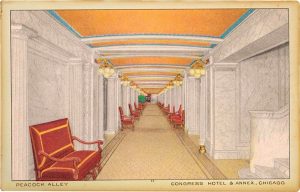
Peacock Alley between the Congress Hotel and Auditorium Building

But what about the Auditorium Building and Theatre, just across the street? The ghost tour speculates about a “presence” felt near Peacock Alley, the underground marble tunnel linking the Congress and Auditorium hotels at the turn of the century that was walled up in 1911. Is the Auditorium Building, opened in 1889 as a stately hotel and world famous Theatre and now home to Roosevelt University, haunted?

To find out, we asked staff members who work the night shift and Roosevelt alumni.

The Auditorium Theatre

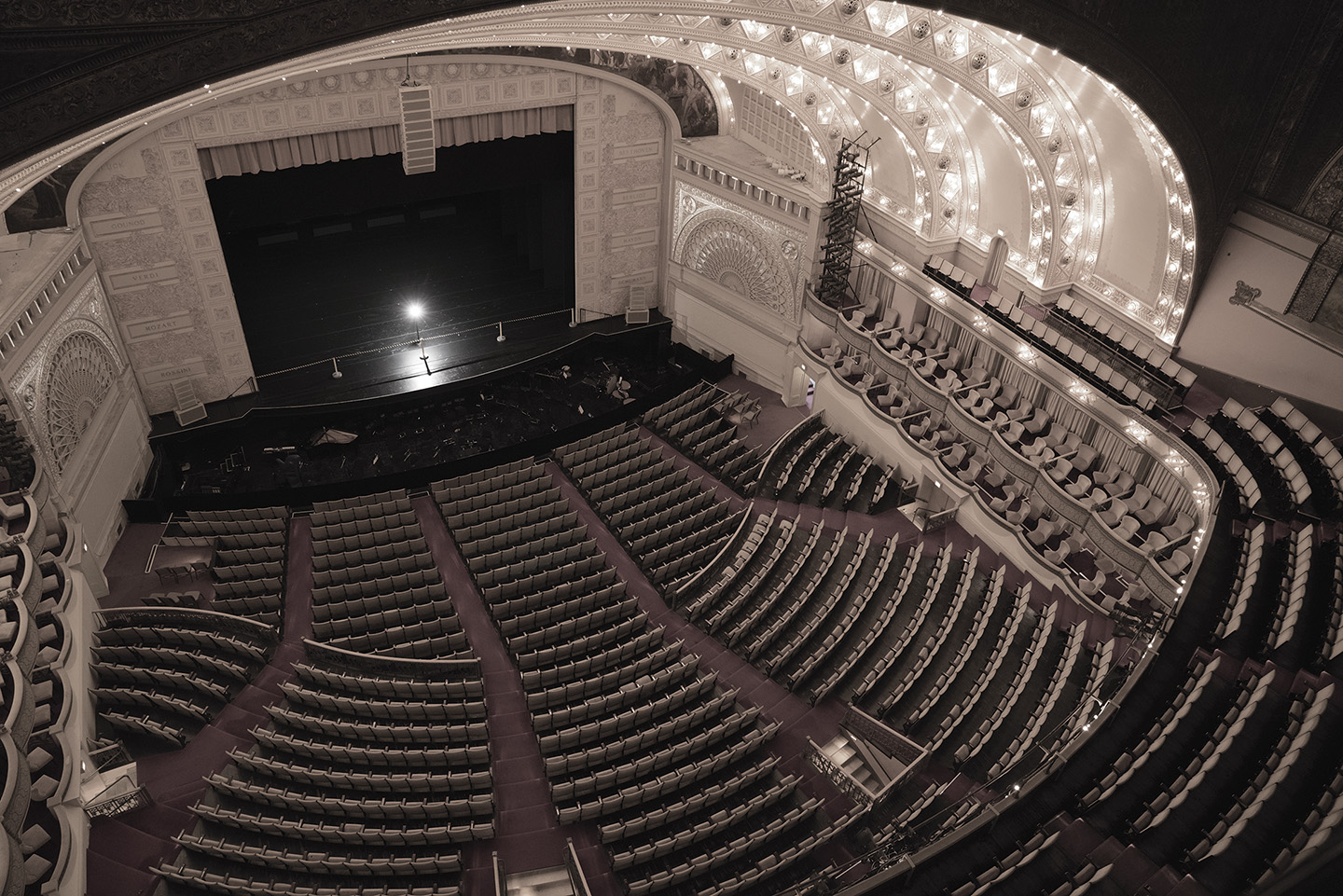
The Theatre is a magnificent space with 4,200 seats, four balconies, a deep stage and an ornate lobby. The after-hours lighting is dim and the space cavernous and full of shadows and dark corners.

Nick Ahrens, an engineer whose job includes checking the fire safety mechanisms at night, reports experiencing numerous episodes of a “presence” in the Theatre. These include muffled conversations and laughter, mysterious footsteps and doors banging shut when no one is there.

rufall16_pg48_1

One time, at 2 a.m., he entered the stage and looked out into the seats, admiring the architecture. To his surprise he saw a man sitting toward the back of the Theatre. He squinted, called out “What are you doing here?” and approached the spectral figure. “But he was gone by the time I got close,” Ahrens said. “He was there and then he wasn’t. When I told my colleagues about the experience some admitted they had also seen people in the audience seats who quickly vanished.”

“Thousands of people have passed through these halls over the years. Our ghosts aren’t threatening or menacing, just odd. They no longer bother me. I just think – there they are again!”
Nick Ahrens, Roosevelt Building Engineer

When Ahrens began his job in 2003, there was an engineer who said he had seen strange things and refused to enter the Theatre alone at night. He asked to be reassigned to another shift. But the ghostly experiences don’t bother Ahrens. “It’s obvious there is something there,” he said. “Thousands of people have passed through these halls over the years. Our ghosts aren’t threatening or menacing, just odd. They no longer bother me. I just think – there they are again!”

The Theatre has also startled campus safety officer Clara Christmas, who reported that while working the midnight shift some 10 years ago, “I thought I heard voices in the Theatre – as if there were a performance at two in the morning.” But the stage was empty and after that time “I changed my mind about visiting certain places at night!” she said.

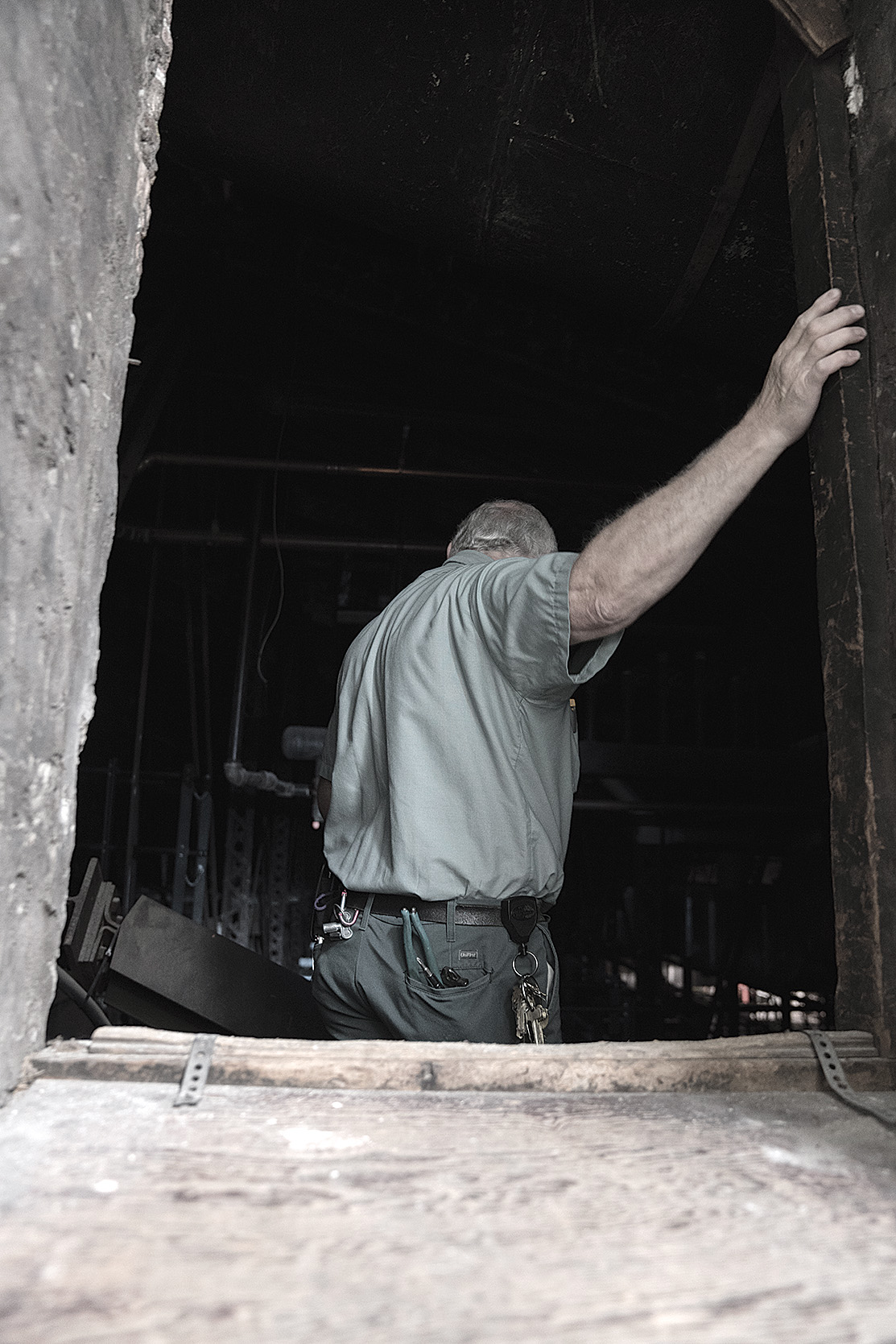
Engineer Tony Bugajsky walks high above the Theatre stage

Engineer Tony Bugajsky walks high above the Theatre stage.

Stephen Sell, director of production and facilities at the Theatre, said that several people have reported seeing a ghostly man on “the jump,” a catwalk 40 feet above the stage. A TV crew visited about five years ago and claimed to see a male ghost in the lobby and another entity with a scarf on the catwalk. “At two in the morning my step quickens,” he said, “but I personally have never seen or heard or felt anything.”

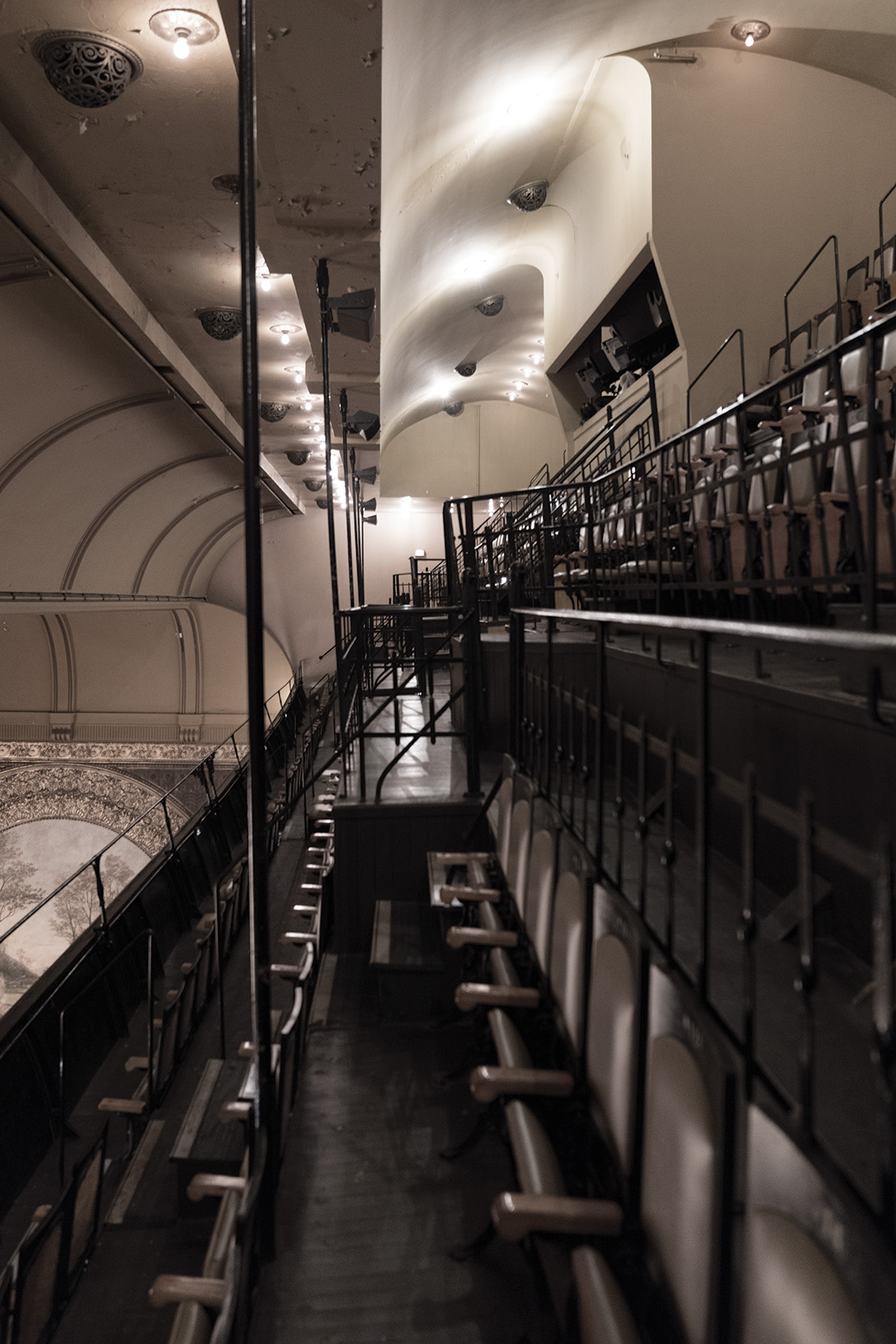
But some former students recall noticing a presence in the Theatre. One remembered sneaking into the fourth balcony at night with some friends and suddenly confronting a man in Victorian clothing who shook his finger at them. The students scrambled rapidly out of the balcony but on looking back over their shoulders saw . . . nothing.

Larry Powitz (BA, ’66; MA, ’72) remembers hearing stories of an otherworldly presence in the Theatre. “We would sneak in there at night after our late classes . . . The stillness and quiet were foreboding. I recall vividly the time that a just audible rubbing sound was heard. The bravest of the three of us boldly went to investigate. Nothing. The place was creepy.”

Dulcie Gilmore, a former executive director of the Theatre, wrote, “Anyone who has sat, alone, in the ghost light of the Auditorium Theatre knows it has a strong persona. Once the crowds have left and the actors have retired for the evening, the Theatre itself invites those from the past to come from the shadows.” In particular she reported sightings of spectral Native Americans on the stage one October night in 1987:

One lady (on a tour) asked what production was in rehearsal. I thought it an odd question, as the stage was bare. . . she, along with several other guests, asked why the person in Native American costume was on the stage. Many of them saw him cross from stage left to stage right. The chief was wearing a war bonnet headdress. . . I had seen him too, on another occasion. . . . We learned that the Auditorium Building was built on the site of a battle at which a young Indian chief and his princess were killed.”

Gilmore reported that a “cleanser” was hired to speak to the spirits and encourage them to leave. No sightings of Native American ghosts have been reported since.

The Auditorium Building

The Auditorium Theatre and its balconies have been the site of numerous ghost encounters.

The Auditorium Theatre and its balconies have been the site of numerous ghost encounters.

The Auditorium Building was once home to 400 hotel rooms, business office suites, large reception halls and a tower that rises 10 floors above the building and contains a maze of stairwells, narrow corridors and small offices. Full of students, faculty and staff during the day, late at night the Auditorium Building is silent, dark and lonely.

The architects and designers of the building, Dankmar Adler, Louis Sullivan and their apprentice Frank Lloyd Wright, occupied offices on the 17th floor of the tower. Alumna Caitlin Spratt recalled students who would wander around the building at night sometimes heard faint conversations in and near the tower. “Legend has it that if you walked by the elevator entrance to the tower, or inside the tower itself, the noises people heard were actually the arguing and fighting of Adler and Sullivan,” she said.

rufall16_pg50_2

Another ghoulish story also involves the tower. Bill Moor, who studied at Roosevelt and taught philosophy from 1968 to 1972, recalled that the tower housed Andrew Ivy, a renegade (and later discredited) researcher and biochemistry professor from 1961 to 1966 who claimed that he could cure cancer. “I saw an array of skeletonous old men coming and going to the tower,” Moor said, “ . . . a parade of doomed hopefuls.”

The Congress Lounge and other spaces on the second floor of the Auditorium Building also reportedly are the site of ghostly presences. Engineer Tony Bugajsky said that while doing night rounds on the Congress corridor of the second floor he has heard muffled conversations and twice has felt something touch his finger. “I took my flashlight and saw nothing,” he said. He has heard loud running steps behind him on the south side corridor of the eighth floor, lockers slamming in the basement office at five in the morning when no one else was in the room and banging noises on the south side of the sixth floor.

The Academic Success Center is housed just to the south of the Michigan Avenue lobby. Assistant Director Danielle Smith reported that she was alone in the office early one morning   when she put her water bottle on a sink, suddenly felt very cold, and “Bang! My water bottle flew off the sink and into the wall, I was shaken up for hours!” She also said a student told her the story of working in the 10th floor library late at night and suddenly he saw a maid start to clean the tables. The thing was – the maid was wearing “an old timey outfit” and missing her legs.

“Legend has it that if you walked by the elevator entrance to the tower, or inside the tower itself, the noises people heard were actually the arguing and fighting of (Dankmar) Adler and (Louis) Sullivan.”
Caitlin Spratt (BA, ’15)

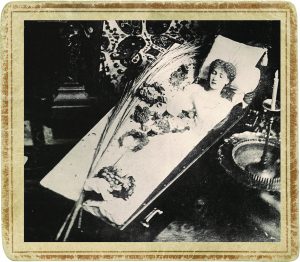
There is one room in the Auditorium Building with an especially eerie history. Generations of students have heard about the eccentric and world-renowned actress Sarah Bernhardt, who performed on the Auditorium stage from the 1890s to the early 20th century. She always stayed in Room 720 and slept in a coffin.

This story is probably true as Bernhardt, in fact, had a coffin built for travel so she could sleep in it while on tour and “better understand her tragic roles.” The coffin was lined with white satin and replete with flowers and letters from her many lovers. She also traveled with her huge Saint Bernard dog and two maids. The history and philosophy students who now use this room for seminars haven’t reported any canine or human ghostly presence during their classes . . . yet.

The ninth floor – originally the home of the Chicago Musical College and now housing the Chicago College of Performing Arts – seems to be another popular site for spectral occurrences.

“I saw an array of skeletonous old men coming and going to the Tower. . . a parade of doomed hopefuls.”
Bill Moor, Former Roosevelt student and faculty member

Joseph Extejt, a 1983 graduate, recounted the story of a young woman practicing violin in the studio of Robert Long in the late 1970s. Suddenly she saw a man in an opera costume and when she asked him, “What are you doing here?” he disappeared. “She packed up her violin with utmost expediency,” Extejt said, adding that “she passed out right there in the hallway.”

And there’s more about the ninth floor. Staff members reported hearing running footsteps in the middle of the night, objects moved in room 902 and a mysterious banging in room 908 that could not be explained by the engineers. Campus Safety Officer Clara Christmas also has heard strange noises on the ninth floor and has seen shapes “out of the corner of my eyes – I’ve seen something faintly there then not there, and thought – ‘time to go!’”

So – is the Auditorium Building haunted?

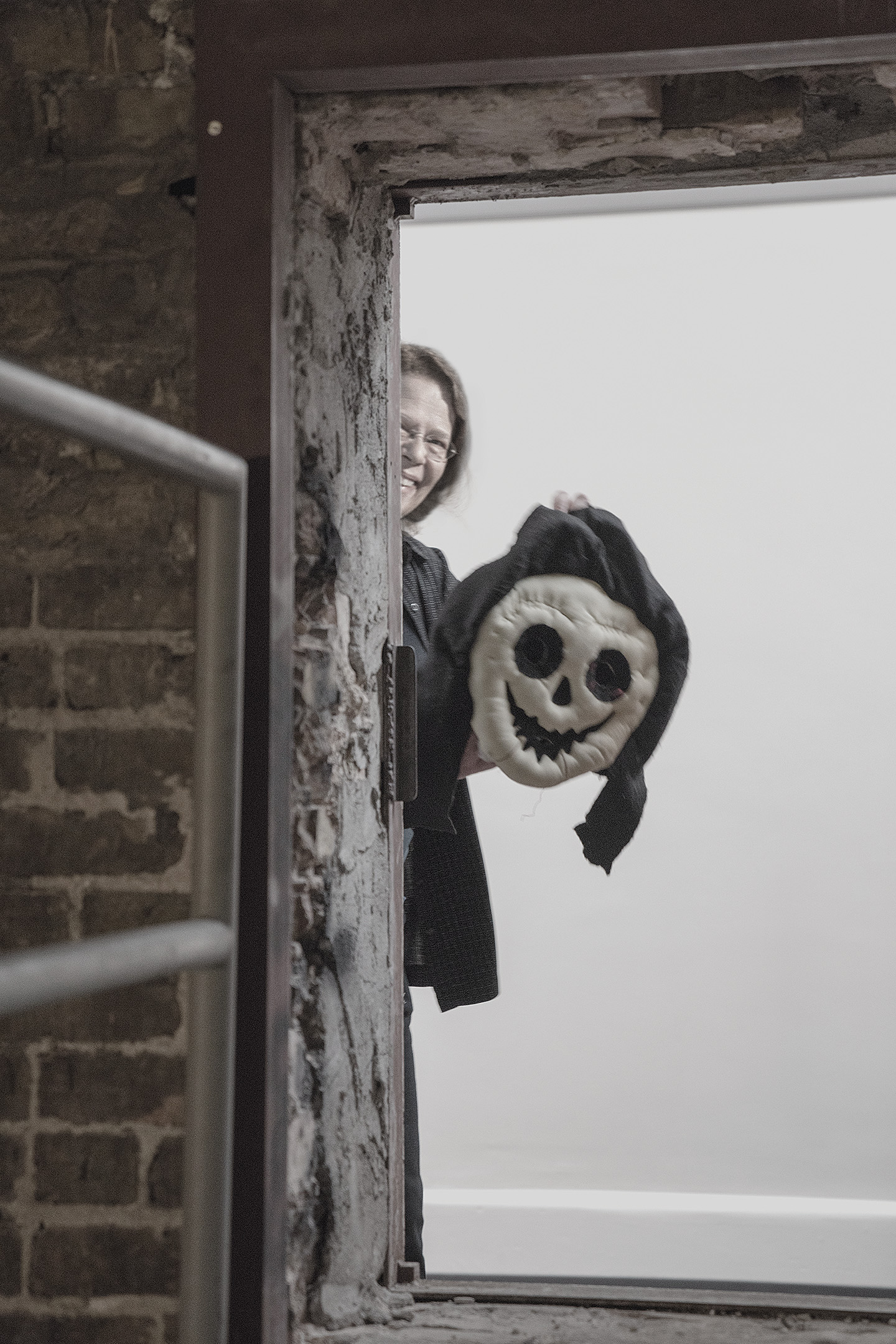
University Historian Lynn Weiner uses a prop to entice ghosts hiding in the Auditorium Building

University Historian Lynn Weiner uses a prop to entice ghosts hiding in the Auditorium Building.

Professor of Psychology Jonathan Smith, author of Critical Thinking: Pseudoscience and the Paranormal, forthcoming in January 2017, has taught at Roosevelt since 1975 and regularly offers a popular course on the paranormal. When asked about the ghost stories of the Auditorium Building and Theatre, Smith said the human brain is wired to “create a sense of ‘presence’ and the uncanny.”

The awareness of an ill-defined presence has a firm neurological basis, especially in low stimulation conditions that are dark and silent, he said. “Ancient humans who had this ability to sense something unseen were alert to very real dangers, such as predators or environmental threats, so there is an evolutionary basis as those who had a sense of presence were more likely to survive.”

“The power of the mind combined with a person’s expectations can easily conjure up the presence of a ghost in a dark place. This is child’s play for the human brain.”
Jonathan Smith, Professor of Psychology

In addition, Smith stated that once a presence is sensed, an individual’s cultural expectations and past experiences can create such hallucinations as mysterious footsteps, a tap on the shoulder, dimly heard conversations, or sightings of angels, UFOs, ghosts, or otherworldly beings. There can also be a group effect where several people simultaneously experience the same hallucination.

Actress Sarah Bernhardt posing in her traveling coffin.

Actress Sarah Bernhardt posing in her traveling coffin.

Smith said that the same brain that sees ghosts is wired to seek deeper meanings in the universe. “The paranormal,” he said, “is an incomplete notion of the larger world of wonder. The power of the mind combined with a person’s expectations can easily conjure up the presence of a ghost in a dark place. This is child’s play for the human brain.”

Author Italo Calvino wrote, “The more enlightened our houses are, the more their walls ooze ghosts.” Well, the Auditorium Building and Theatre are certainly enlightened places that exist in the larger world of wonder. Do ghosts visit our buildings at night? Just ask the night shift.

Standard