Archival Document
Feature 4, Feature Stories, Spring 2017

Treasures in the Attic: The Roosevelt University Archives

Archival Document

Roosevelt University is well known for its powerful founding story of social justice. Among its 90,000 alumni are such luminaries as former Chicago mayor Harold Washington, illustrator Shel Silverstein, and seven members of U.S. Congress.

But did you know that Roosevelt is also distinguished for its archival collections? Faculty, staff, students and alumni from around the world have used these archives to study a wide array of topics related to the University, the city of Chicago, architecture, African-American history, music education, the history of higher education, the labor movement, and the New Deal.

There are some 30 university, government and historical archives in the city of Chicago. While it is one of the city’s smaller archives, Roosevelt’s stands out for its special collections. Although the University was founded in 1945, the first (and only) full-time professional archivist, Laura Mills, was hired just 10 years ago in 2007.

“Roosevelt’s archives are incredible,” she said, “and I see my job as creating a road map for researchers to find the material they need for their work, and for the recovery of often forgotten history.”

With the help of student interns, she has taken on the daunting task of arranging the archives, digitizing the collections, and assisting researchers. Only a quarter of the collection — which consists of about 2,508 cubic feet of material — has been processed, and due to limited space in the Auditorium Building, much of the collection is stored on the Schaumburg Campus. Thanks to Mills’ work over the past decade, much of the Roosevelt archival collections today are catalogued and available to the Roosevelt community and general public.

Researchers who have visited the archives recently include Dr. Miyuki Kita, a professor at the University of Kitakyushu in Japan. She visited in November 2016 to examine documents related to Roosevelt’s founding, for a project on American universities and anti-Semitism in the 20th century.

The thousands of old papers, letters, speeches, photographs and ephemera, shelves upon shelves of books, the rapidly growing number of digital files —all are organized and preserved so that the remarkable information found within can more fully tell our histories. The following pages present some of the highlights of the archives.

Roosevelt University Archives

The photography collection preserves the institutional history of Roosevelt University, with more than 26,000 digitized images to date. The transformation of the bankrupt Auditorium Building and Hotel into a college campus is chronicled by hundreds of photos. The author of this article, Lynn Weiner, and Mills used this collection to assemble a photo history of the University, which was published by Arcadia Press in 2014.

There are also yearbooks, commencement programs and biographical files on approximately 1,000 professors, administrators and trustees, as well as the papers of former Roosevelt presidents. Boxes are filled with old class schedules; catalogs; news clippings; and student publications including The Torch, literary magazine Oyez Review, and alternative newspapers. The original letter signed by professors and staff who walked out of the Central YMCA College to protest the imposition of discriminatory admissions standards — leading to the foundation of this University — is also in the collection. So is the correspondence of the founders including such early financial supporters as Marshall Field.
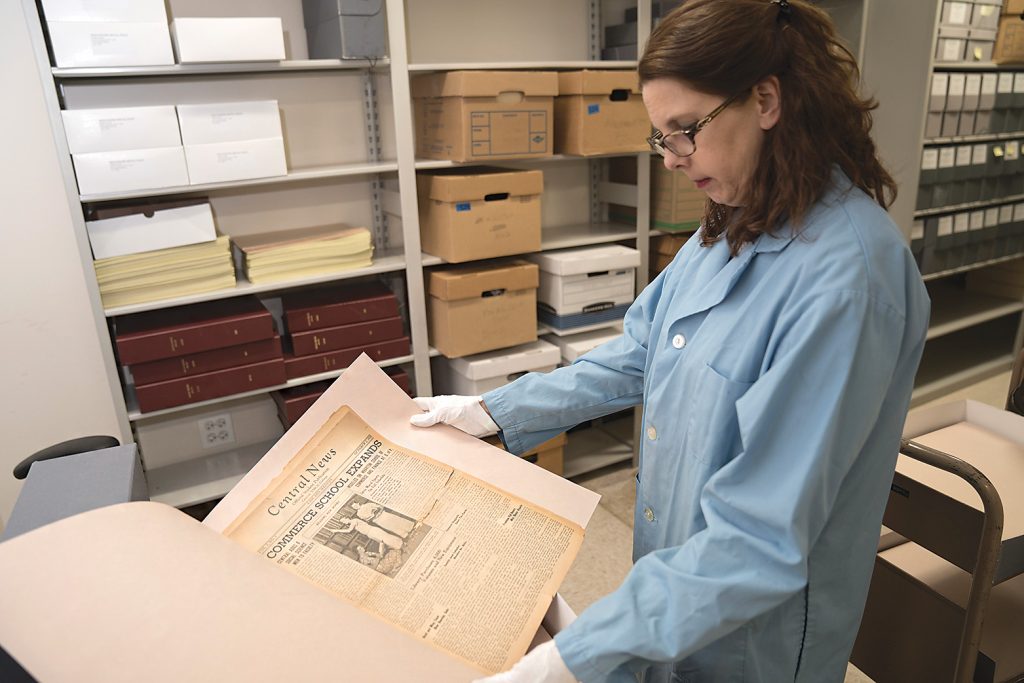
Archivist Laura Mills

Archivist Laura Mills is dedicated to working with the resources we have to protect these many significant archival treasures. Her hope, she says, is “to make more people aware of the outstanding collections at Roosevelt so they can be put to good use and become part of the evolving historical record.”

One can find speeches by commencement speakers, lecturers, and a recently rediscovered file of correspondence by Eleanor Roosevelt during the years she headed the Roosevelt Advisory Board. Papers related to the visit of Dr. Martin Luther King, Jr. in 1957 have recently been recovered as well.
There are also objects related to the University, including Harold Washington’s mayoral office chair; University flags and seals; gifts from visiting dignitaries and to traveling presidents; and flyers, posters and souvenirs related to various anniversary celebrations and special events.

The Chicago Musical College Collection
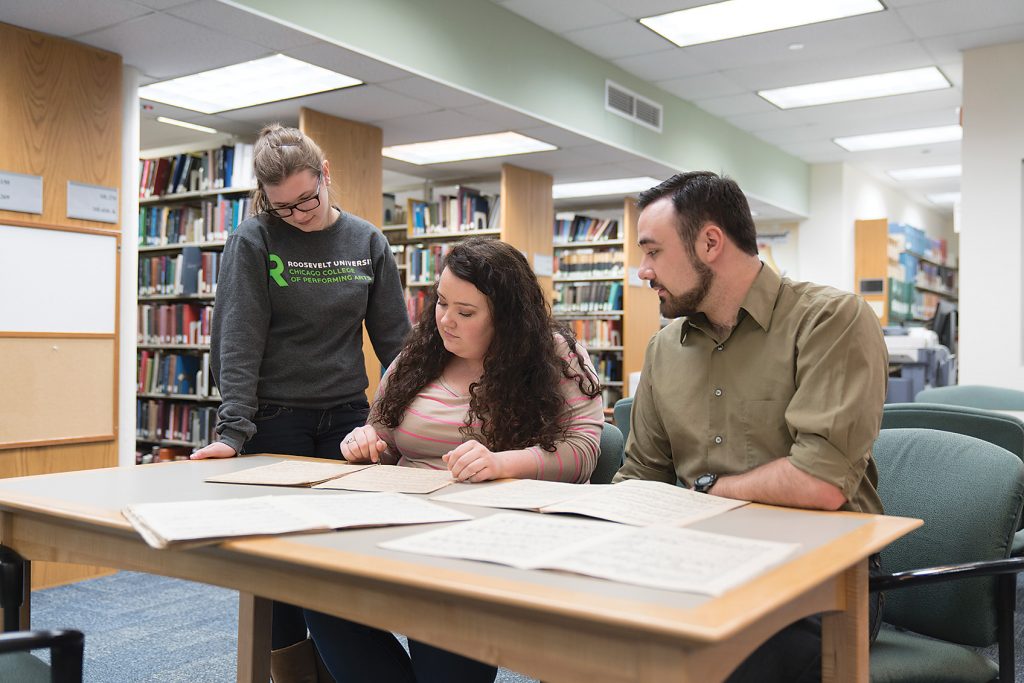
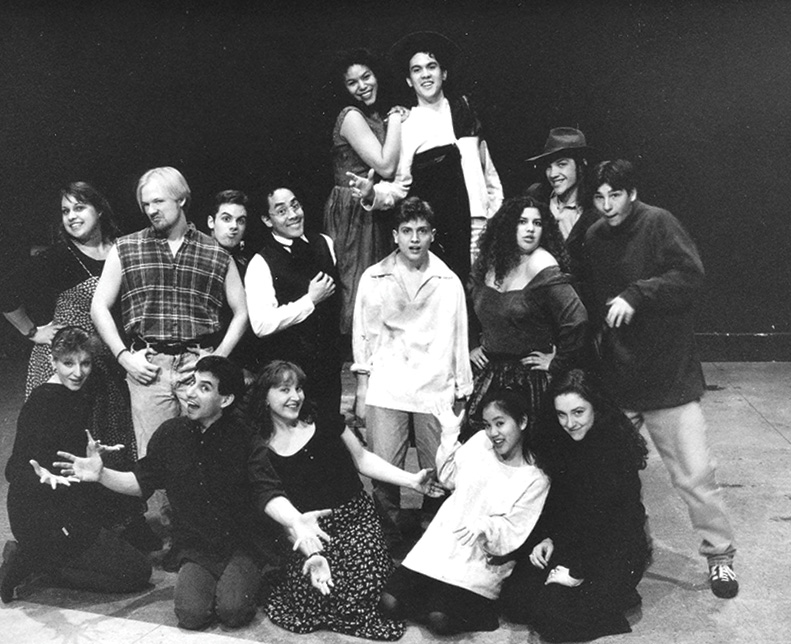
Students in Archive

A forerunner to Roosevelt’s Chicago College of Performing Arts, the Chicago Musical College (CMC) was founded by Florenz Ziegfeld in 1869 and merged with Roosevelt College in 1954. This collection includes school catalogs from the CMC, recordings on vinyl and CDs, sheet music, and student account ledgers. There are collections in the archives proper but also in the Performing Arts Library, which is the largest conservatory library in Chicago.

There are musical scores of Rudolph Ganz, the founding dean of the Chicago Musical College at Roosevelt; and collections of books, scores, or other material from musicians Humbert Luccarelli, Ellis Schuman and Bernard Brindel, theatre professors Yolanda Lyon Miller and Joel Fink, and many others.

Photo from archive featuring piano player

Joel Schick Collection

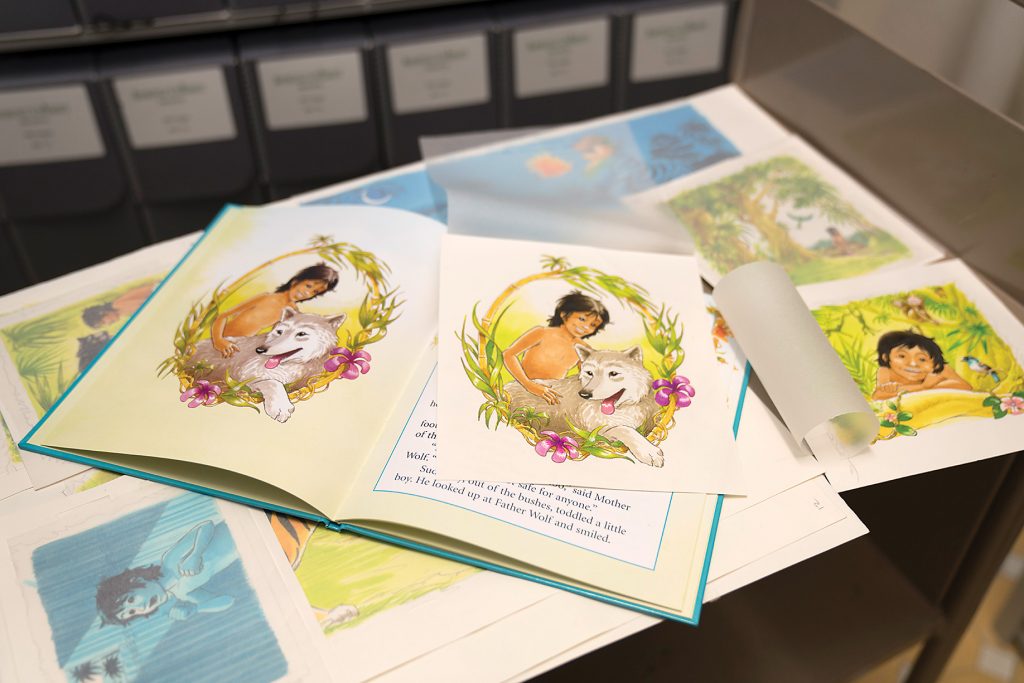
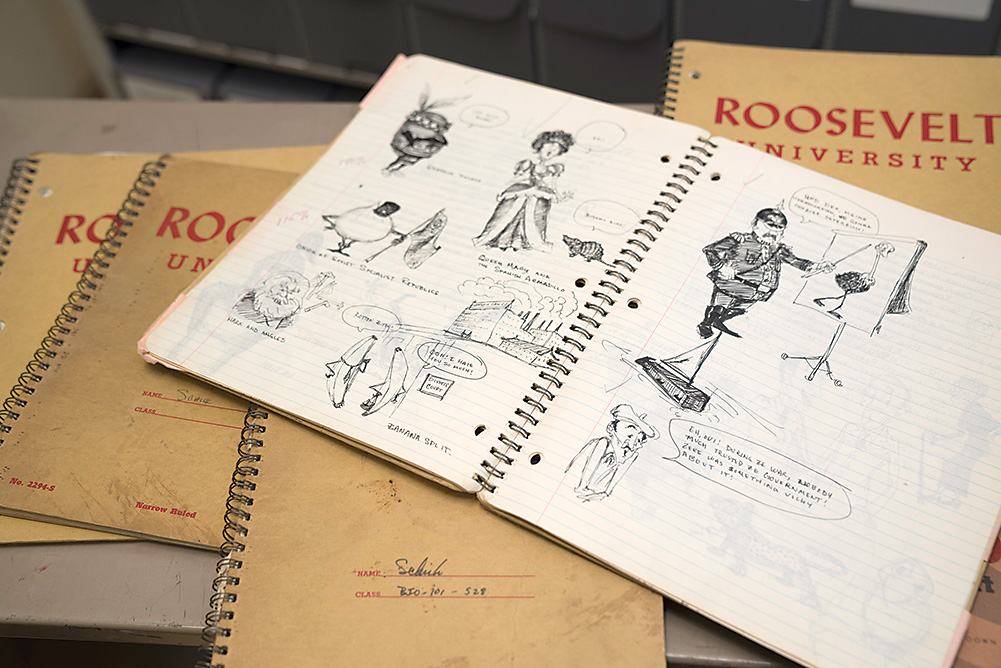
Joel Schick Illustration

Joel Schick (BA, ’68) was a children’s book illustrator and an artist for Sesame Street, donating his papers to Roosevelt in 2015. These include copies of his books, sketches, original artwork, correspondence, and even some of his old Roosevelt notebooks complete with doodles. Schick gave this collection to Roosevelt, he said, to show how art is produced — by “refining, redrawing, re-imagining, editing and discarding,” and to leave a record of a “journeyman illustrator.”
roosevelt_university_archives_photo_9

Christopher Reed Collection

roosevelt_university_archives_photo_10

Christopher Reed (BA, ’63) was a history professor at Roosevelt from 1987–2009. He has written several books on the history of black Chicago and donated his collection of papers, books and photos related to Bronzeville and other Chicago sites central to African-American history.

Center for New Deal Studies Collection
roosevelt_university_archives_photo_11

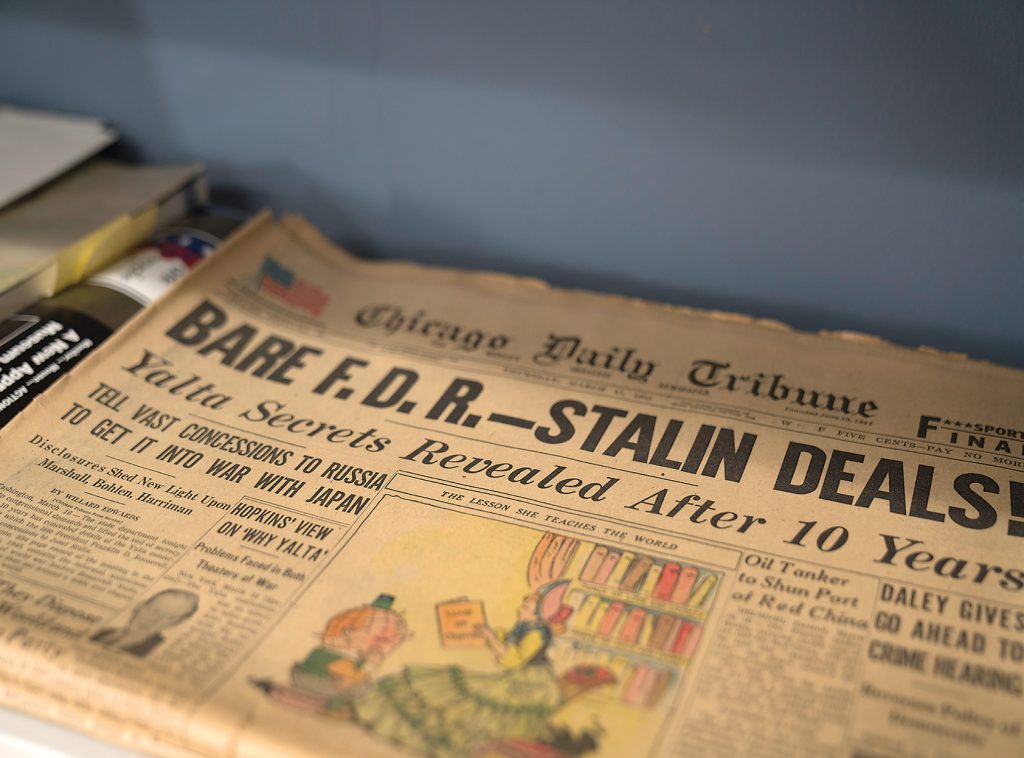
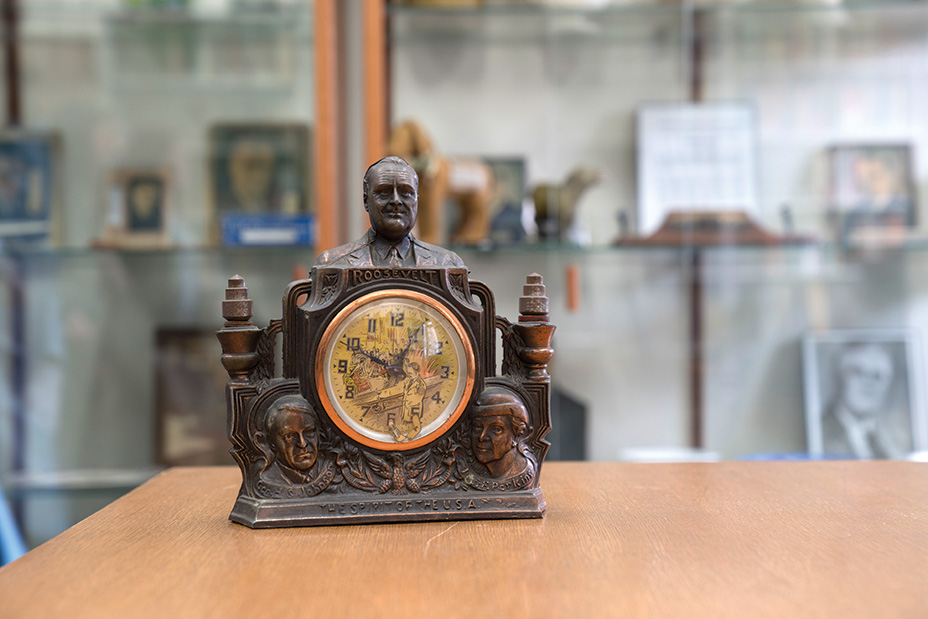
In 1996, Chicago labor attorney Joe Jacobs donated his collection of artifacts related to Franklin D. Roosevelt to the University. These include a significant political button collection, paintings, commemorative dishware, clocks, comic books, campaign textiles and advertising featuring the New Deal and FDR. Many of these are displayed in the Center for New Deal Studies office in the Auditorium Building, along with some 1,300 books related to the Roosevelts, the New Deal and World War II.
roosevelt_university_archives_photo_3

These archives are a resource for Chicago Metro History Fair competitors from area schools, and also contain the papers of Albert Lepawsky (1908-1992), a scholar of public policy and the New Deal. Objects from the collection have been featured in documentary films and exhibited at such venues as the Chicago History Museum.

roosevelt_university_archives_photo_4

The City Club of Chicago Collection

Documenting the longest-running civic forum in Chicago, this collection includes biographies of executive members; audio recordings; more than 3,000 photographs; and hundreds of program videos, featuring such prominent Chicagoans as the young Senator Barack Obama, Chicago Mayor Rahm Emanuel, and Illinois Secretary of State Jesse White.

Paul Green Collection

The archives have recently received the books and papers of Paul Green, who prior to his death earlier this academic year was the chair of the Department of Political Science and Public Administration, and a widely respected expert on politics. This collection includes his research files, book drafts, class notes, and material relating to the general political process as well as Chicago and Illinois politics.

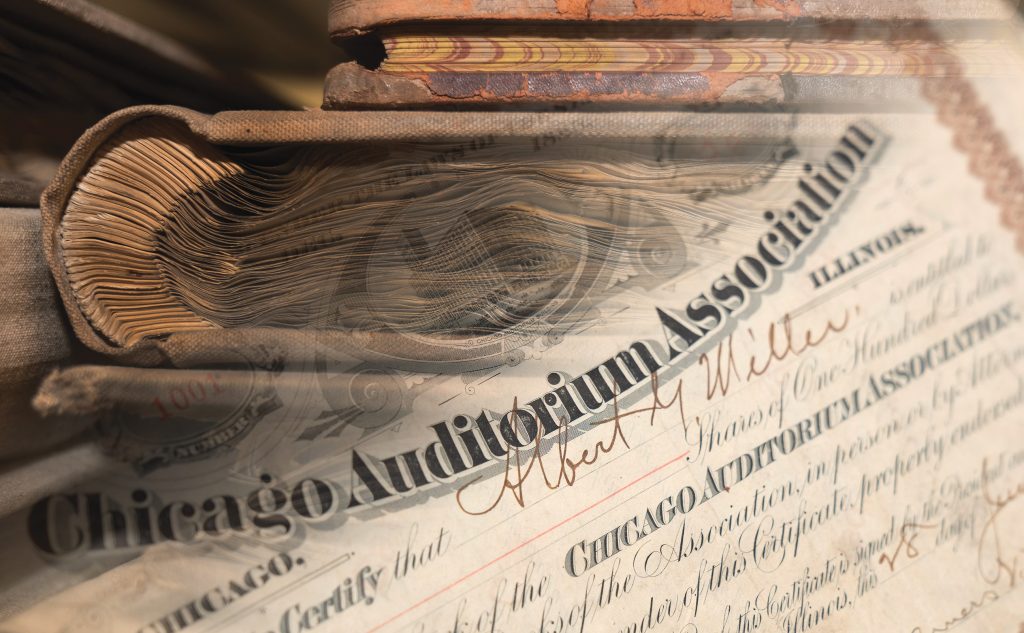
Chicago Auditorium Association Collection (1886-1931)
roosevelt_university_archives_photo_13

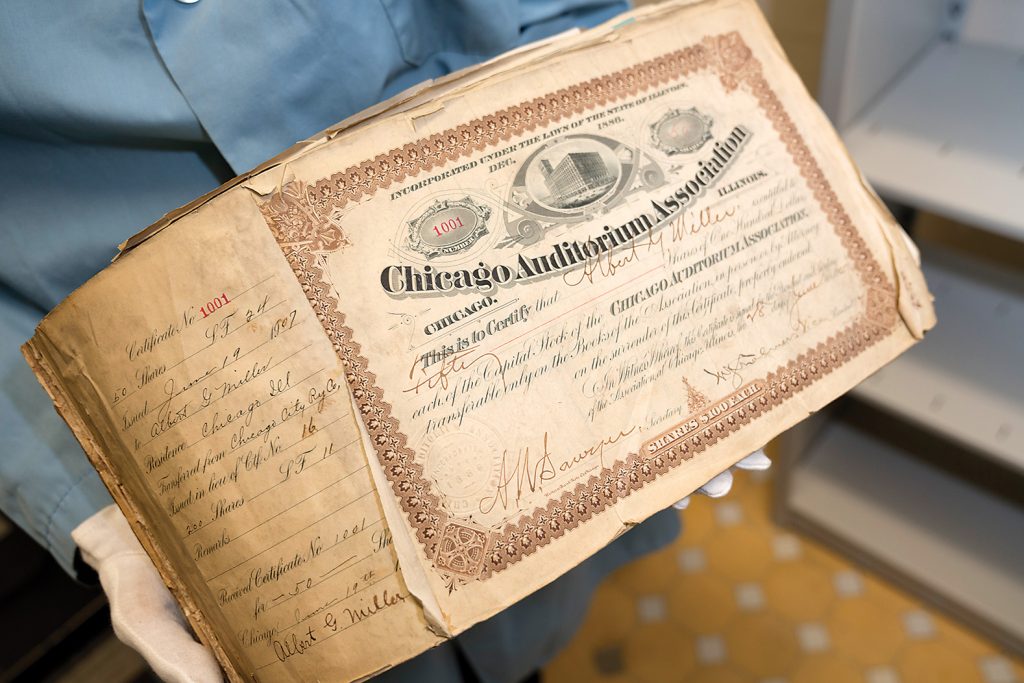
The Auditorium Building is one of Chicago’s iconic structures, created by Dankmar Adler and Louis Sullivan and opened in 1889. This collection includes some of the oldest and most important artifacts in the archives, including documents from Adler’s estate, bond issues for the construction of the building, blueprints, playbills, photographs, records of operation, tiles, stained glass and hotel room keys.

roosevelt_university_archives_photo_15

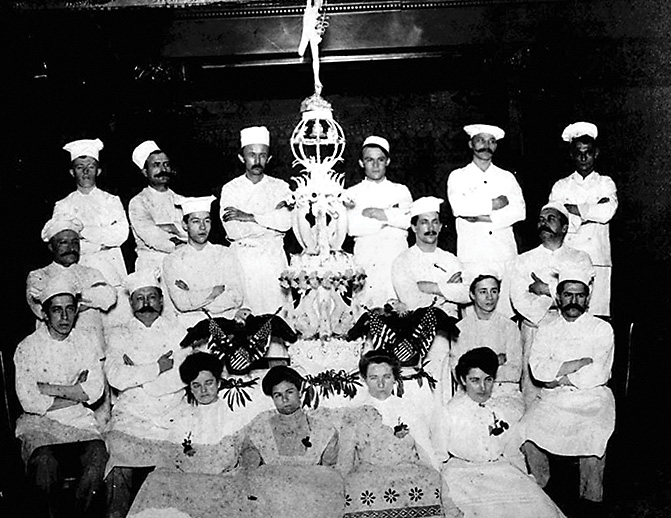
Finally, there are also contemporary accounts of the Chicago World’s Fair of 1893, when the Auditorium Hotel housed many of the fair’s visitors.
roosevelt_university_archives_photo_14

Labor Oral History Collection

Betty Balanoff was a history professor for 28 years, receiving a National Endowment for the Humanities grant in 1970 to conduct and transcribe more than 60 interviews with Chicago area labor activists. These include Mollie Levitas of the Chicago Federation of Labor, Lillian Herstein of the Chicago Teachers Union, Addie Wyatt of the United Food and Commercial Workers, and Irving Abrams and Fred Thompson of the International Workers of the World. In 2001, the Illinois State Library funded a project to digitize these transcripts, which are now available online.

The Illinois Labor History Society Papers

These documents were donated to Roosevelt in 2014 and include items related to the 1886 Haymarket riot, the stockyards and more than 7,600 photographs. There are additional collections from Teamsters Local 743, the Chicago Newspaper Guild and the Retired Teacher’s Union.

Standard
Roosevelt University Career Fair
Feature 4, Feature Stories, Spring 2017

Career Navigation with GPS: Graduation Plan for Success (GPS) Engages Students Early in Career Planning

Roosevelt University Career Fair

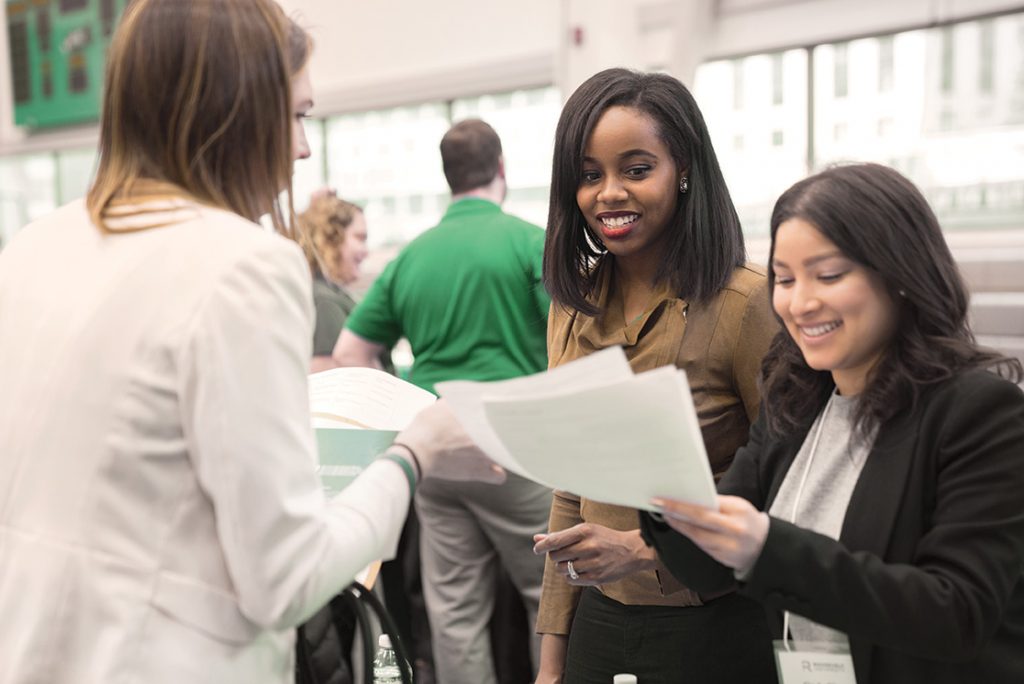
Roosevelt’s spring career fair drew more than 60 employers, including representatives from BlueCross BlueShield of Illinois.

Along with the Career Mentoring Program, Roosevelt University is piloting a new career readiness program called the Graduation Plan for Success (GPS).

Made possible in part by a grant from the Robert R. McCormick Foundation and the generosity of Roosevelt Board of Trustees members Steve Abbey and Robert Wieseneck, GPS encourages the development of skills needed for finding a job and excelling in the workplace and beyond — all while Roosevelt students are still in college.

“We know becoming a professional doesn’t happen overnight,” said Jennifer Wonderly, director of Career and Professional Development at Roosevelt University. “The GPS is a great way for a student to get started thinking about a career — even from the very beginning when he or she first arrives on campus.”

Offering myriad career preparation opportunities, the GPS began in fall 2016 and already has a growing number of student participants.

“The GPS is a great way for a student to get started thinking about a career — even from the very beginning when he or she first arrives on campus.”
– Jennifer Wonderly, Director of Career and Professional Development

In the program, students receive points for every approved career activity they attend. Students who earn at least eight points a year receive an official GPS Completion Designation for their college transcripts and resumes.

“So many of our students are the first in their families to go to college,” said Abbey, who is the GPS program’s founding donor. “Many need support in not only making it through college, but also in learning how to use their college degrees once they leave Roosevelt.

“I believe career readiness training may be a way of ensuring that students actually succeed after college, and I’m hoping the program will be a model with ingredients it takes to put new graduates on a path to career success,” he said.

“So many of our students are the first in their families to go to college. Many need support in not only making it through college, but also in learning how to use their college degrees once they leave Roosevelt.”
– Steve Abbey, Roosevelt Trustee, Founding GPS Donor

Recent GPS workshops and training sessions have included Career Boot Camp: Interviewing Tips; How to Prepare for the Career Fair; Spring 2017 Internship and Career Fair at Roosevelt’s Goodman Center; English Majors Career Panel; Build Your Own Professional LinkedIn Network; LinkedIn with Dee Reinhardt; Over 40 and Hired; Job Search Strategies; Resume Workshop; and How to Build a LinkedIn Profile.

While these sessions are geared primarily toward Roosevelt students, alumni are welcome and can also receive career counseling, assessments, resume critiquing, resume referral and access to Roosevelt’s job-bank database.

“We are getting, on average, between 15 and 20 people at these events,” said Wonderly, who is planning for even more GPS offerings in the fall. “We believe some of the student interest stems from a desire to earn points so students can obtain the GPS designation, which not only boosts one’s resume, but also may impress potential employers.”

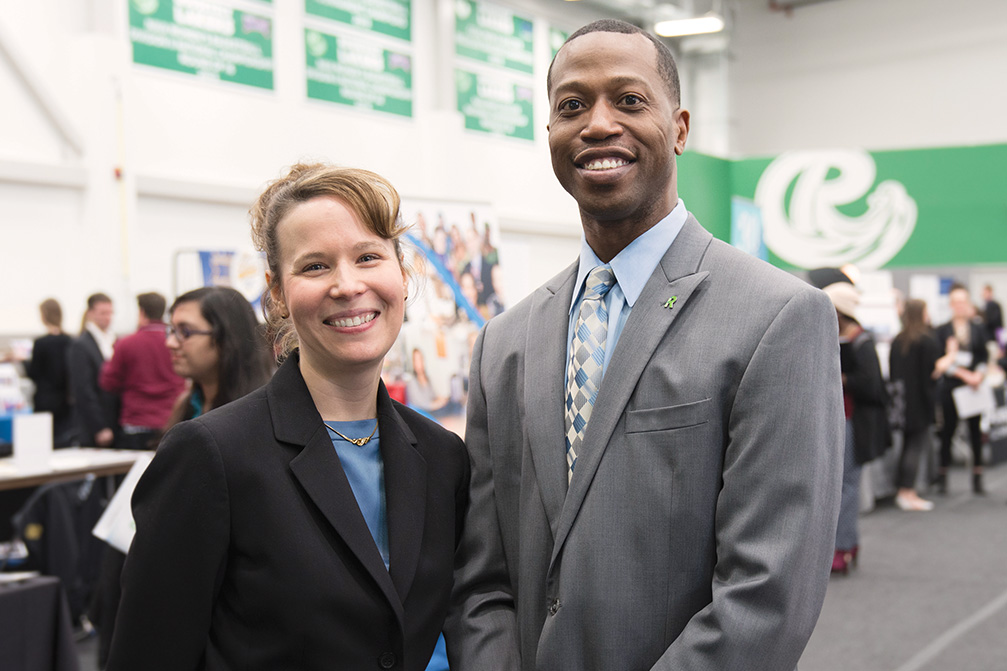
Jennifer Wonderly and Chris Willis at Roosevelt’s spring career fair

Roosevelt career specialists Jennifer Wonderly and Chris Willis at Roosevelt’s spring career fair, attended by more than 200 students.

The Office of Career and Professional Development also has begun requiring student resumes to be reviewed before they are available to potential employers, including more than 60 who took part in Roosevelt’s recent career fair at the Goodman Center.

Nineteen-year-old freshman Costen King is one of the Roosevelt students working toward his GPS designation. “I’ve taken workshops on doing job interviews and LinkedIn and I’ve gone to lectures by industry leaders in marketing,” said King, an undergraduate business major with a concentration in marketing and finance.

“A college degree alone doesn’t guarantee you a job,” said King, who hopes to move after graduating in 2019 to New York City where he wants to work for Condé Nast, doing branding for the company’s GQ Magazine. “I see the GPS as a supplement to my degree, and a way for me to actually have a leg up when I’m ready to get out there and apply for my dream job.”

Paralegal studies major Katherine Gage, 22, who graduated in May, also participated in the GPS. “The workshops and lectures I took taught me how to behave in an office environment and what to expect in the real world,” said Gage, who found an internship during summer 2016 as a paralegal.

Gage received coaching at Roosevelt in interviewing, one of the reasons she believes she landed the internship in the first place. That experience led to her being offered a part-time job during her final semester at Roosevelt.

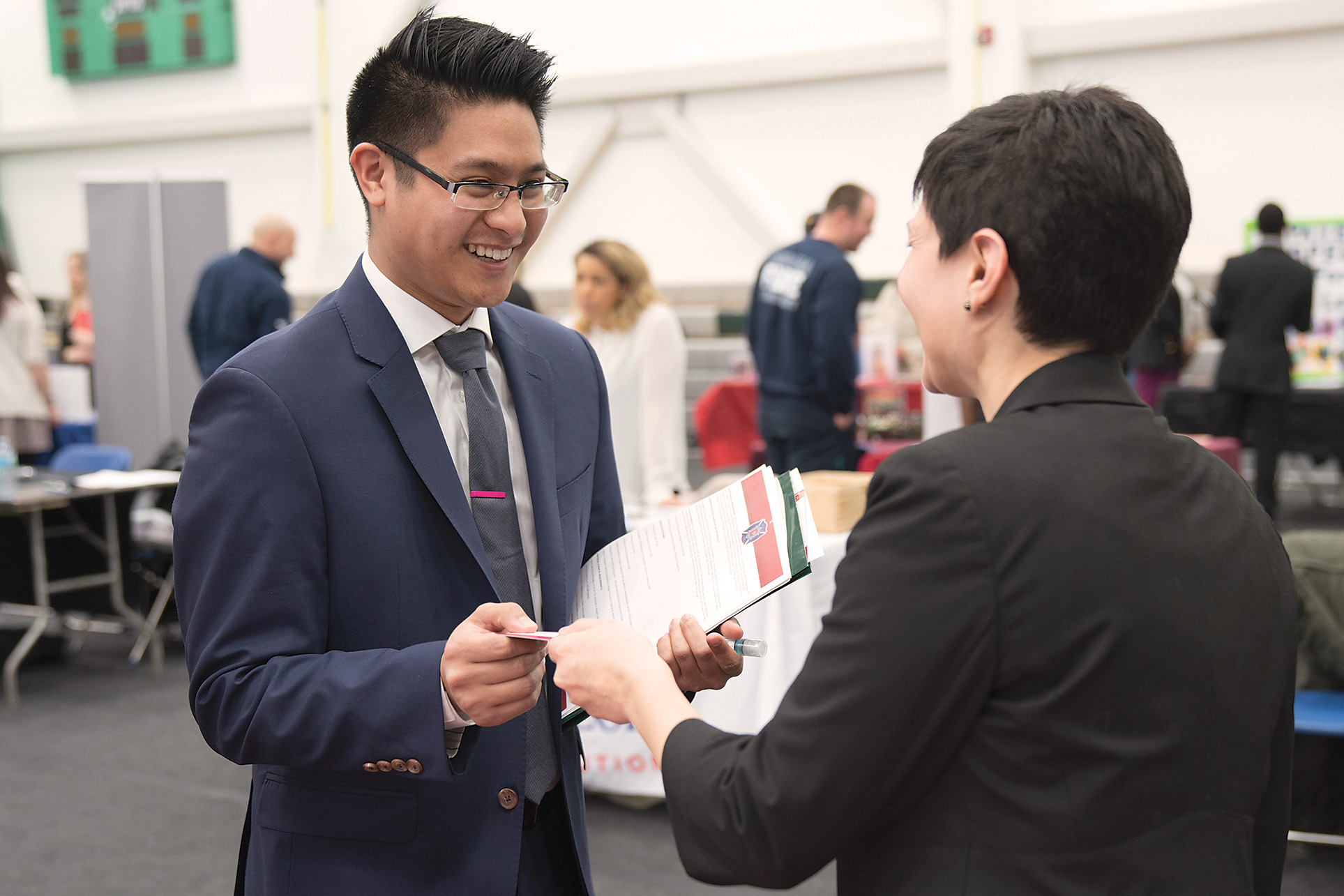
Students exchanging business cards

Student exchanges business cards with career representative.

“I’m planning on putting my GPS certification on my resume,” she said. “It will show prospective employers that I’ve been intentionally crafting myself to be a professional in the business world.”
Emily Komendera, one of three career counselors who work with students and alumni in Roosevelt’s Office of Career and Professional Development, said the sky is the limit for GPS participants.

“This is a program that gets students involved in career exploration before they actually get out on the job market,” Komendera said. “We’re helping our students to think about their options early and we’re giving them the tools and resources they need to be successful in the workplace.”

Standard
Charlie Gardner and Serhiy Kiyasov on the tennis court
Feature 4, Feature Stories, Spring 2017

Mentor Match: Two Rooseveltians Find Common Ground on the Tennis Court

Charlie Gardner and Serhiy Kiyasov on the tennis court

It was hardly coincidental for Roosevelt University’s Career Mentoring Program to match Roosevelt senior Serhiy Kiyasov with Roosevelt Board of Trustees member Charles “Charlie” Gardner.

Both are athletes. Both are gregarious. What’s more, Kiyasov, an international student, wanted a better sense of Chicago — and who better to guide the way than Gardner, with his inside track on both the city and its people?

“It seemed like a very good fit,” said Katrina Coakley, the Roosevelt associate provost for student success, whose team matched mentee and mentor after they took personality surveys and submitted to separate interviews.

Coakley’s team would not have predicted, however, that Kiyasov, an honors student, and Gardner, whose name as a donor graces the Roosevelt Lakers basketball court, would bond over the game of tennis, which they play together often.

“It’s been an amazing coincidence,” said Gardner, a retired Chicago real estate investment executive who once played professional basketball for the Denver Rockets in the American Basketball Association, and is now a tennis regular at Chicago’s Midtown Athletic Club.

“It’s been an interesting experience,” said Kiyasov, who came to the United States from Ukraine, playing for the Roosevelt men’s tennis team since 2014.

“Charlie never tries to be superior,” Kiyasov said of his mentor, the former president and CEO of Chicago Dock and Canal Trust, where he managed and sold major landholdings and served on a variety of boards and foundations in Chicago.

“He wants to share his experiences and at the same time learn something from me,” Kiyasov said. “He’s a mentor to me, and at the same time he’s a good friend.”

Since their pairing in fall 2016, Gardner and Kiyasov have played tennis at Midtown Athletic Club most Sundays, usually in doubles matches with Gardner’s friends, including a Russian executive and a prominent Chicago attorney.

“I certainly don’t put any great demands on these kids. It’s all about helping them in the way that they want to get ahead.”
– Charles “Charlie” Gardner, Roosevelt Board of Trustees member

“I don’t have my family here, and I can’t say Charlie is exactly a substitute,” said Kiyasov, who saves his questions about Chicago and how to make it in the city for a lunch that usually follows the game with Gardner and his tennis friends. “But I can tell you I always feel accepted in their company,” he said. “I have a real good time on Sundays.”

One of the first members of the Roosevelt Board of Trustees to sign on to Roosevelt’s Mentoring Program, Gardner is one of the board’s role models for what a mentor can be.

“To me, the program is about the satisfaction you can take from meeting young people and hopefully helping them to progress,” said Gardner, who so far has had three mentees, including Kiyasov.
“I certainly don’t put any great demands on these kids,” Gardner said. “It’s all about helping them in the way that they want to get ahead.”

For Kiyasov, having a mentor has meant gleaning advice on how he should present himself at his very best in a city that he wants to continue to call home.

“It’s important to tell your own narrative,” Gardner advised the paralegal studies graduate. “You always have to say what you think about yourself — and you need to know how to turn negatives about yourself into positives.”

That advice eventually helped Kiyasov land an acceptance to DePaul University’s College of Law, which he will attend in the fall.

“There’s very little hardship and a lot of reward to attaching yourself to one student and then seeing how he or she progresses at the university and beyond in a career,” said Gardner, who hopes others will join him in becoming a mentor.

Kiyasov’s relationship with Gardner won’t end anytime soon, particularly as the recent graduate starts to open new doors.

“It’s not a finish. It’s just the beginning,” Kiyasov said. “I see Charlie as someone who can help lead me in the future — and he plays a good game of tennis too.”


To learn more about becoming a career mentor, visit roosevelt.edu/mentoring or contact Katrina Coakley at kcoakley01@roosevelt.edu.

Standard