Roosevelt students travel into the Tanzanian savannah
Faculty Essay, Feature 2, Spring 2017

Hakuna Matata: Conservation Biology Fieldwork and the Larger Lessons of Life

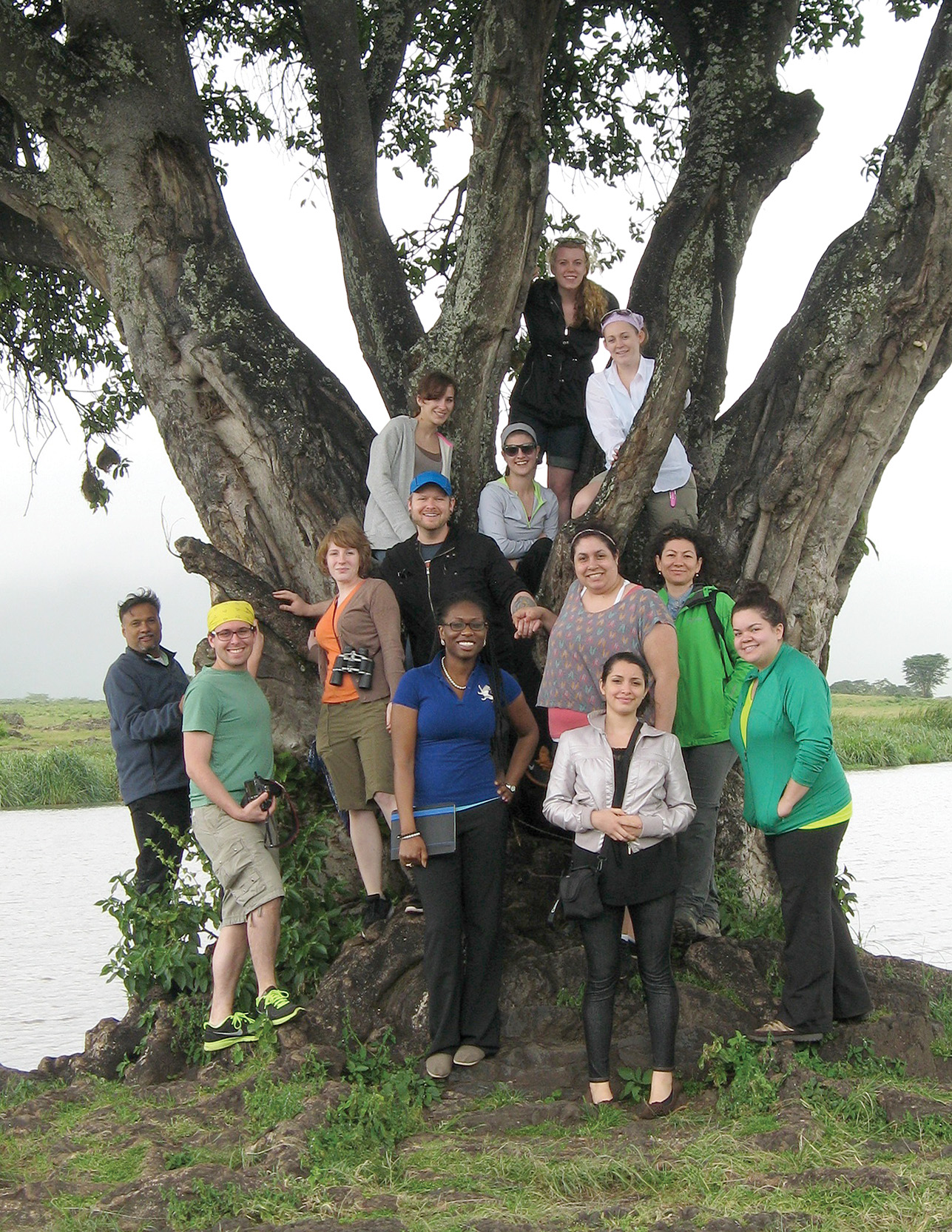
Professor Norbert Cordeiro with Tropical Biology and Conservation students

Professor Norbert Cordeiro (far left) with Tropical Biology and Conservation students at a wild fig tree in Tanzania, 2013.

A massive fallen tree blocks the only road to Mount Nilo, temporarily halting our team’s field visit to this remote, lush rainforest.

It is the early morning of Jan. 22, 2017. Though I have been to Tanzania on a number of occasions to prepare for trips with Roosevelt students taking my Tropical Biology and Conservation class, this is the first time in 22 years that I am returning to the Nilo Nature Reserve.

Together with colleagues Dr. Henry Ndangalasi from the University of Dar es Salaam, Victor Mkongewa, and Martino Joho of BirdLife Tanzania, I am certain the trip will be less about nostalgia and more about protecting the rainforest.
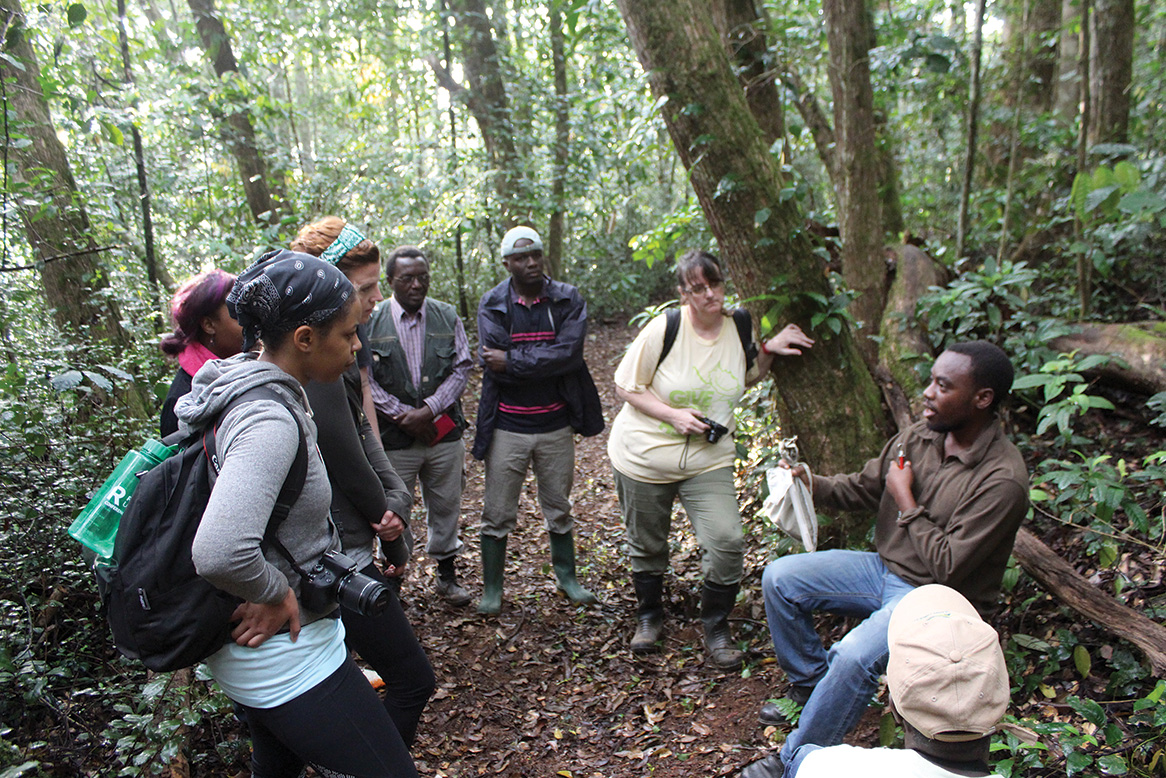
Emmanuel Mgimwa of BirdLife Tanzania demonstrates how to tag a bird for field study

Emmanuel Mgimwa of BirdLife Tanzania (far right) demonstrates how to tag a bird for field study, 2016. Pictured from left are students Brittney Austin, April Aloway, Wenke Dahl; Henry Ndangalasi, Nickson Ndangalasi; and professor Kelly Wentz-Hunter.

As conservation biologists, we are investigating how disturbance of the forest by local communities, including logging and farming, impacts the area’s globally endangered animals and plants.

The fallen tree throws a bump in our travels that could easily delay us by hours or days. However, being Tanzanian, my colleagues and I are all too familiar with the Swahili motto hakuna matata [no worries]. One way or another, we understand we will eventually make our way onward for the last hour of the trip to our camping site. All we need is a bit of patience, luck and the knowledge that an obstacle is only an obstacle if you let it be one.

Hardly 15 minutes later, along comes a noisy boda boda, a local motorbike taxi, the loud mechanical whirring of the engine drowning the rainforest’s melodious sounds of birds, shrills of crickets and tinkling of tree frogs.

For a time, the boda boda, too, is stopped by the fallen forest giant. Working as a team in typical Tanzanian fashion, we cut large tree branches and thick lianas that snake around the fallen tree. These woody vines use the tall trees to get to the forest canopy, only in this case they are to die with their fallen host.

A narrow space is carved away from a corner below the fallen tree, large enough to allow slanting boda bodas through with a little pushing and pulling.

One passes under with a passenger aboard, but the driver has given us two numbers of other drivers to call by cell. Victor calls, negotiates the fees, and within another half an hour, we leave our land rover behind, squeeze under the fallen tree, hop onto boda bodas with equipment, food and supplies, and head to our campsite.

My initial visit to Nilo in 1994 was the first time that Tanzanian biologists had visited the East Usambara Mountains since early exploration in the 1920s. On that trip, we rediscovered the endangered Tanzania mountain weaver, a bird that many believed was extinct. We also obtained the first record of the long-billed tailorbird, one of the most critically endangered species on the planet. This bird is found only in Tanzania’s East Usambaras, and is one of the reasons I returned to Nilo in January.

Our assignment was to locate tailorbird territories found earlier by the BirdLife field team in 2009, and to gauge the condition of the bird’s habitat. Climbing steep slopes and traversing about 15 miles a day for close to two weeks, we explored all 19 known territories, and discovered three new areas where the bird lives as well.

My involvement in this conservation effort is multi-faceted. I serve as BirdLife Species Guardian for the tailorbird (an honorary position), training Tanzanians in field-research techniques and collaborating with various partners and stakeholders on tangible strategies for conservation of this rare species.

Since 2005, my guardian work has allowed me to travel home to Tanzania at least once a year, giving me the opportunity to reconnect with family, friends and colleagues. These trips also reignite my love for nature and people, paving the way for development of sound conservation strategies for the East Usambaras.

I have developed important relationships in this remote area. It is not near the foothills of Mt. Kilimanjaro, Africa’s highest mountain, where I was born and raised. However, I have found the East Usambaras to be my home away from home, and the ideal place to engage my students in tropical conservation.

Perhaps there is an emotional attachment linked to raising my daughter for the first two years of her life in the East Usambaras, where her main toys were chameleons and tree frogs. Perhaps it is because the village we spend most of our time in is called Amani, which means “peace” in Swahili — a way of life embedded in the village’s aura, culture and landscape.

“Perhaps there is an emotional attachment linked to raising my daughter for the first two years of her life in the East Usambaras … No matter my personal reasons, one thing is certain: Tanzania needs all the help it can get.”

– Norbert Cordeiro, Associate Professor of Biology

No matter my personal reasons for attachment, one thing is certain: Tanzania needs all the help it can get. Approximately 65 percent of the country’s nearly 50 million people live below the poverty line. Given this circumstance, it isn’t surprising there is pressure on natural resources, like the rainforest, which has led to deforestation rates equivalent to the loss of 400,000 football fields per year over the last two decades.

Deforestation is pervasive in the East Usambaras, an area rich in flora and fauna found nowhere else in the world. We must make an effort to preserve this endangered place that is tied to local livelihoods and the environmental health of our entire planet. It is a calling we cannot ignore.

Collaboration and cooperation with others are key to preserving this environmental treasure, and my research, which frequently includes Roosevelt students, as well as my position as a species guardian, have allowed me to work with amazing people and organizations from all over the world.

Because of our efforts, I view the world as connected in inter-disciplinary ways, from professionals to local villagers, conservation managers to researchers, students to trained academics, and followers to leaders.

It is also a world where we work together to curb and remediate environmental destruction, at the same time always considering what is at stake for those who must try to get by in one of the world’s poorest countries.

With all of this in mind, I created an experiential learning course for Roosevelt students called Tropical Biology and Conservation 369-469. Since 2013, three classes totaling 40 students have visited the East Usambaras.

On these expeditions, my students learn about complexities involved in conserving the savannah ecosystem of the Ngorongoro-Serengeti; they then join local communities in efforts to combat rainforest destruction; and they plant thousands of tree seedlings that can help reverse deforestation.
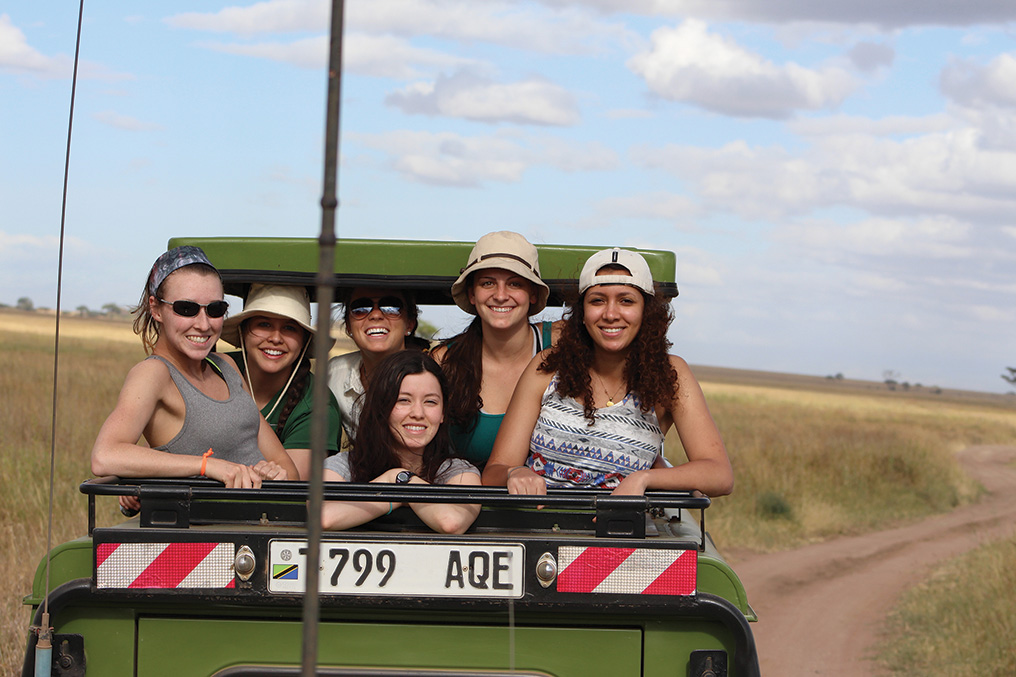
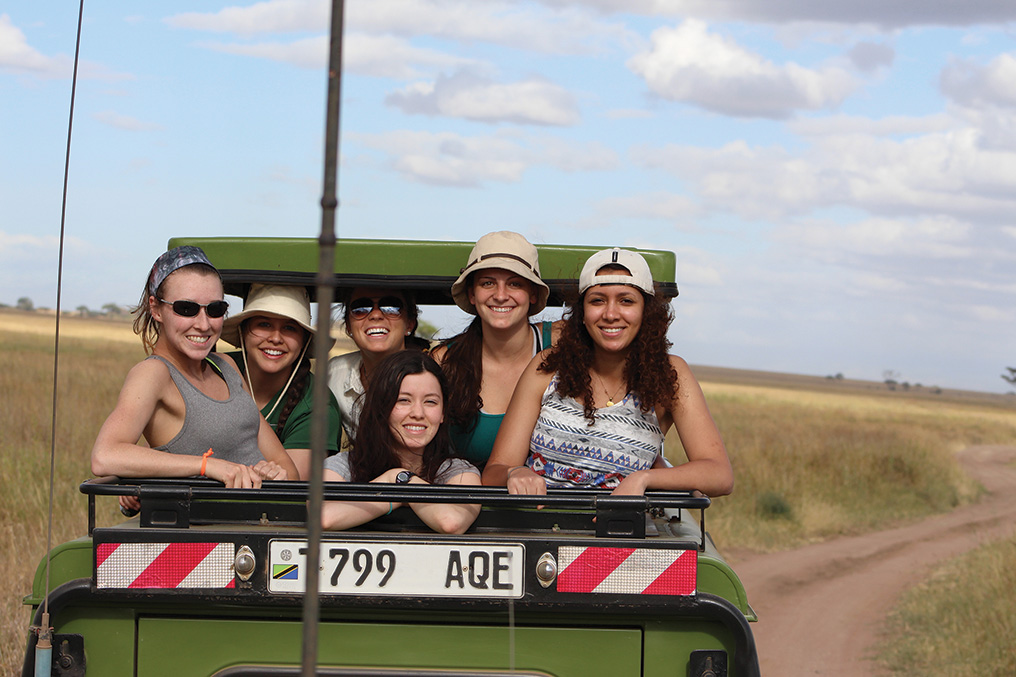
Roosevelt students travel into the Tanzanian savannah

Roosevelt students (from left) Olivia Downs, Maggie Dobek, Arielle Nausieda, Sarah Callaghan, Carli Schlaker and Najoua Alioualla travel into the Tanzanian savannah.

Learning should be about success, failure and the unexpected, as well as how to handle such outcomes in academics and in life. In this course, I want students to be aware that travel and fieldwork require flexibility.

Tanzania is a place that operates in a completely different cultural context than many of us understand. I inform my students in the classroom before we leave that they will have to work outside their comfort zone. I ask them to consider that “time” as they know it in the developed world isn’t perceived in the same way where they will be working in Tanzania. I encourage them to accept each day for what it brings.

“Learning should be about success, failure and the unexpected, as well as how to handle such outcomes in academics and in life.”

– Norbert Cordeiro, Associate Professor of Biology

In my experiences, especially growing up in Tanzania, failure and the unexpected are normal. How one perceives these outcomes determines personal and social growth. I believe not knowing what is to come, yet learning to expect the best of every situation, makes for more contentment with an experience and with life in general.

I don’t expect everyone to embrace this “glass half-full” mentality, but I do want my students to think about the concept during their travel and work in the wilds of eastern Africa.

It was therefore surprising to me that one of my former students, Roosevelt alumna Té Monoski, shared thoughts about the transformation that resulted from our first trip to Tanzania in May 2013.

“Our class trip to Tanzania was not just a momentary adventure, it was the experience that I would base future endeavors on for the rest of my life. Our trip forced me out of my comfort zone, and I loved every minute of it. Those few weeks in Tanzania, riding around in our jeep, to this day, remain one of the only instances in my life where every day was completely different from the previous. Every day I was learning and experiencing something totally new and wonderful … from birdcalls and mixed species [bird] flocks to rainforest vegetation and wildlife. It was addicting, and I felt the loss immediately upon returning to Chicago. Taking this trip to Tanzania cemented the way I choose to approach experiences in my life. Take chances, immerse yourself in new things, leave your comfort zone. Feel alive!”

Like almost all my students, Té was interested in understanding other cultures, being respectful of one another, and thinking about how we fit into the larger global environment. She and fellow student Corinna Dampf, along with the BirdLife Tanzania field team, used recorded birdcalls by a rare species known as the drongo to entice birds in the rainforest into hunting flight so that the drongo could catch insects from the birds’ wings.

The data collected studying the impact of the drongo’s habitat was the foundation for publication of a paper in the international peer-reviewed journal Biological Conservation. Their study also set the stage for further evaluation of how human disturbance affects interactions among dependent rainforest species, and the integrity of habitats.

Inquisitive, driven, inspiring — those are traits of the Roosevelt students I know and cherish. When I am with them, they give me energy and desire to keep learning new things and asking new questions. In the classroom prior to the trip, my students learn to become critical thinkers capable of problem solving while developing their projects at home and in executing those projects in the field.

Their projects have included: understanding butterfly diversity in the forest canopy vs. ground vegetation; conducting population censuses of the rare chameleons in farms vs. the rainforest; and identifying and estimating the abundance of animals in disturbed vs. undisturbed rainforest using motion-triggered camera traps.

It is awe-inspiring to see my students engaged. They learn how to work closely with local Tanzanian experts, some who speak limited English, and to eventually arrive at answers to questions their projects pose.

According to May 2016 graduation speaker Najoua Alioualla, the Tanzanian learning experience demands “many skills … such as critical thinking, adaptive learning and application strategies.” She calls it a “holistic approach to learning” that teaches not only conservation biology, but also training and implementation of independent, student-designed field experiments.

In the spring of 2018, I will return to Tanzania with more Roosevelt students. As always, I will make a reconnaissance visit as I did in January to plan, talk to local collaborators and field-test new project ideas. I am excited to work with an excellent team that includes Roosevelt biology professor Kelly Wentz-Hunter, who adds great depth by developing social interactions among students, and Dr. Ndangalasi, whose calmness and exuberance impart his immense passion for plants and all things Tanzanian.

There will be minor obstacles, like the giant tree that fell and temporarily blocked our path. However, I will be just as excited as my students about the upcoming journey, for Roosevelt students are a different breed. They ask insightful questions and are curious, open to new ideas and people, and authentically engaged in learning and activism.

“…Roosevelt students are a different breed. They ask insightful questions and are curious, open to new ideas and people, and authentically engaged in learning and activism.”

– Norbert Cordeiro, Associate Professor of Biology

I hope many will remember the motto hakuna matata when facing obstacles, as it will remind them of the resilience and flexibility they need to live in a world where each day brings the unexpected.
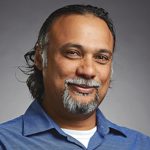

Professor Norbert Cordeiro portraitNorbert Cordeiro is an associate professor of biology at Roosevelt University. His specializations are in tropical conservation biology and ecology, and he serves as an editor for two African journals and one international journal in these fields. His research has focused in his native Tanzania, where he has spent the greater part of the last 27 years studying the ecology and conservation of the globally biodiverse East Usambara Mountains. His fieldwork with Roosevelt students has been possible in part thanks to student scholarships provided by Dr. Stuart Meyer (BS, ’56).

Standard
Feature 4, Feature Stories, Spring 2017

They Do What? Avocations of Roosevelt Faculty and Staff

Our faculty and staff sometimes take a break from their work at Roosevelt University. Many of them are bloggers, competitive runners, cooks, golfers, tennis players, gardeners, volunteers or gamers. But sometimes, their extra-curricular activities are a bit unexpected.

Martial Arts and Athletics

Jim Michael
Director of Development Corporation and Foundation Relations

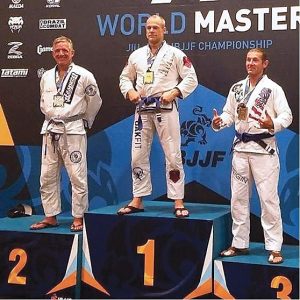
Jim Michael on award platform

Jim Michael raises money for Roosevelt, but has also won three world silver medals in the Masters 4 Division of the International Federation of Brazilian Jiu Jitsu. He has trained in martial arts and combat sports for 30 years.

Joe Chan 
Professor of Information Systems

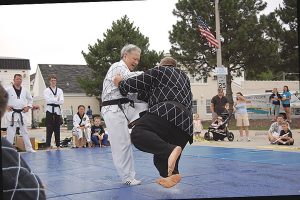
Joe Chan in martial arts match

Joe Chan has taught information systems at Roosevelt since 2002 and served twice as dean of the Heller College of Business. He has studied the martial arts for even longer — 40 years. He learned Kodokan Judo at a young age and then studied Taekwondo under a Korean master in the 1990s. He now holds a sixth-degree black belt in Taekwondo and is an active practitioner and certified master instructor of the art.

Pamela Robert
Chair and Associate Professor of Sociology

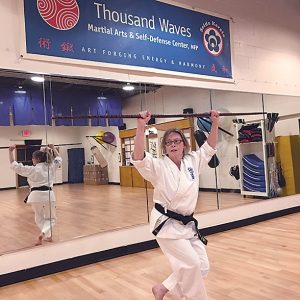
Pamela Robert practicing martial arts

Pamela Robert’s work focuses on inequality, maternal-child health, and disability discrimination. She holds a second-degree black belt in Seido Karate, a discipline she has been practicing for almost 20 years. She serves on the Board of Directors of Thousand Waves, a martial arts and self-defense center in Chicago, where she chairs the Violence Prevention and Self Defense committee. She is also an organizer and regular contributor to the Meditations on Activism program.

Adrian Thomas
Professor of Psychology

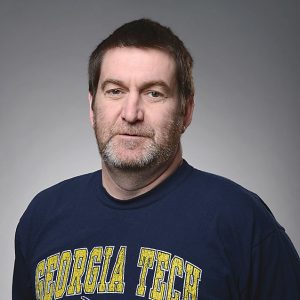
Adrian Thomas in Georgia Tech Shirt

The director of the Industrial/Organizational Psychology PhD program, Adrian Thomas is also a competitive fastpitch softball player who has been a member of four teams over the past 25 years, twice on teams which won the national championship. Since 2014, he has played second base for the North American Fastpitch Association’s Wilcom Mobil Team from Kenosha, Wisconsin, which was the national runner-up in 2015. He has twice been named All-World second baseman.

Ali Malekzadeh
President and Professor of Business

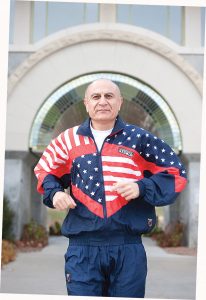
President Ali Malekzadeh in American flag work out clothes

President Malekzadeh is an experienced academic administrator known for his work on strategic management, leadership and organizational behavior. Beginning in the 1990s he began to train in Taekwondo and achieved the level of fourth degree black belt and certified instructor. Taekwondo was a family affair — Malekzadeh studied the sport along with his wife and two daughters, all of whom achieved fourth-degree black belt status as well as international rankings.

Performing Arts

Darlene Morris-Fullerton
Director of Financial Strategy and Planning

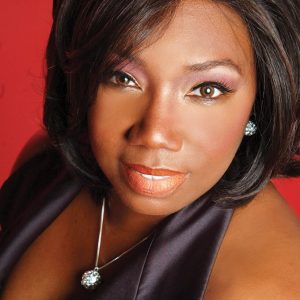
 Darlene Morris-Fullerton portrait

When she’s not overseeing Roosevelt financial strategy or studying for an MBA, Darlene Morris-Fullerton is an award-winning rhythm and blues singer, performing with her husband Timothy Fullerton in the ensemble Time Morris Featuring Diva D. She has sung for over a decade at such places as Back Room Chicago, Navy Pier and music festivals throughout the city. In 2014, Time Morris won the African American Arts Alliance of Chicago’s Black Excellence Award for Outstanding Achievement in Music — Rhythm and Blues.

Judy A. Dygdon 
Associate Professor of Psychology

An expert in learning-based approaches in clinical psychology, Judy Dygdon, with her husband Tony Conger (also a psychologist and professor emeritus at Purdue), is a competitive ballroom dancer specializing in the American Smooth style. They have been competing for 18 years, starting at the beginner Bronze level and now dance at the top Championship level of amateur competition. Previously they’ve  competed in country-western dancing and wrote three instructional line-dance books.

Edward Green
Assistant Professor of Criminal Justice

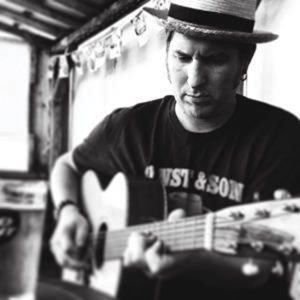
Edward Green playing guitar

Edward “Eddy” Green teaches criminal justice but is also an award-winning guitarist, songwriter and performer who specializes in bluegrass, country, blues and rock ’n’ roll. He has performed with bands that have opened for such performers as Leon Russell, Old Crow Medicine Show and many others. Green has released six CDs and in 2016 reached the semi-finals of the International Songwriting Competition.

Bonnie Gunzenhauser
Dean of the College of Arts and Sciences and Professor of English

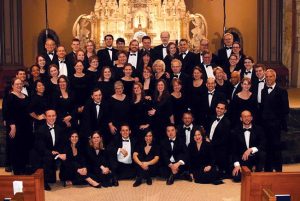
Chicago Chorale group photo

When she’s not leading Roosevelt’s largest college or researching the history of literacy, Bonnie Gunzenhauser sings alto with the Chicago Chorale, a 62-voice chorus based in Chicago’s Hyde Park. She has been a member of the chorale since 2004.

Larry Howe
Professor of English

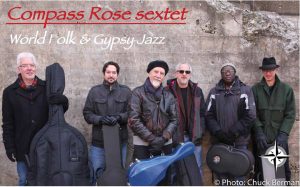
Compass Rose Sextet band photo

A specialist in Mark Twain and in film studies, Fulbright Scholar Larry Howe (pictured, center) is also a mandolin player and songwriter with the Compass Rose Sextet. Since 1999 his group has produced three CDs and performed music defined as world folk and gypsy jazz at clubs, festivals and other venues. He also writes articles about mandolin builders for the Fretboard Journal.

Bill Mackay
Senior Secretary, Dean’s Office, Heller College of Business

Bill Mackay playing guitar

Bill Mackay has been at Roosevelt for 15 years, and currently works in the College of Business. For 30 years, he has also been a songwriter, composer and guitarist, performing on 16 records (eight with his own music), touring the country, and sitting in with various groups. His newest record was published in May by Drag City Records featuring a mix of folk music, experimental rock and jazz.

Arts and Crafts

Priscilla Perkins 
Associate Professor of English

Priscilla Perkins artwork

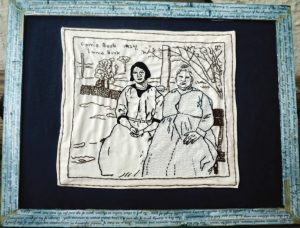
Priscilla Perkins teaches American literature and is also a fiber artist specializing in documentary embroidery. She creates works focused on historical and contemporary issues of social justice.

Debbie Yates
Administrative Secretary, Heller College of Business

Debbie Yates quilt

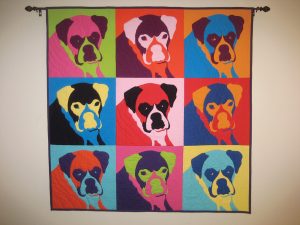
In her “other life,” Debbie Yates is an avid quilter. She has been quilting for some 35 years and is an active member of a quilt guild; her work has been featured at large international quilt shows as well as locally.

Rudy Marcozzi
Associate Dean of the Chicago College of Performing Arts and Professor of Music Composition

Rudy Marcozzi cabinets

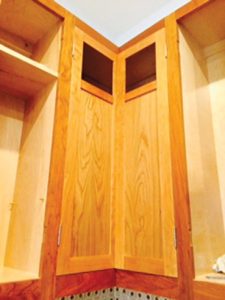
Rudy Marcozzi has been a cabinetmaker since high school. His projects have included wall units, exterior and interior doors, and most recently kitchen cabinets and a baptismal font for the Catholic chapel at Northwestern University.

Charles Madigan
Presidential Writer-in-Residence

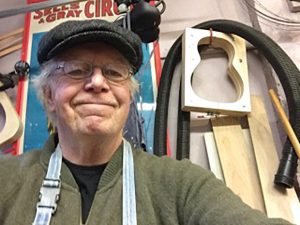
Charles “Charlie” Madigan came to Roosevelt in 2007 to teach journalism and politics after a career at a number of newspapers, including the Chicago Tribune, where he worked for 29 years as an editor, correspondent and senior writer.

Guitar

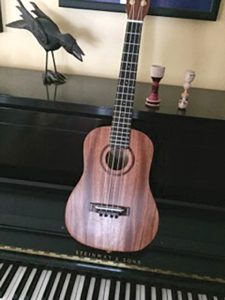
A guitarist for 54 years and a performer for 25, he now also builds ukuleles. Over the past three years he has built and sold 15 instruments, branded as “travelin’ rat ukes.”

Hobbyists and Collectors

Mike Helford 
Associate Professor of Psychology

Fish

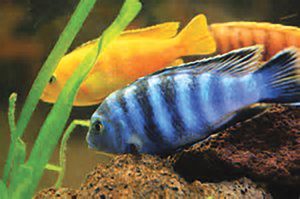
Mike Helford teaches industrial/organizational psychology and is also a fish hobbyist with 60 tanks in his basement, housing cichlids from Africa, many of which are endangered or extinct in the wild. He serves on the Board of Directors of the Greater Chicago Cichlid Association.

Paul Wertico
Associate Professor of Jazz Studies

Paul Weritco posing with train collection

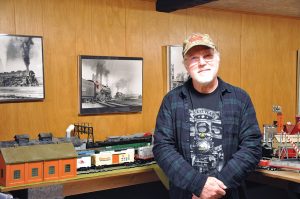
Seven-time Grammy winner Paul Wertico teaches jazz and is a percussionist who has toured the world with the Pat Metheny Group and other ensembles. Wertico has also been a train enthusiast since he was a boy, collecting model trains (he owns more than 100 of them, and 42 switches) that run around his basement in a model town called Taliaville, named after his daughter.

He collects railroad books and artifacts, and whenever he can — especially when he’s on tour — he rides or drives trains, having done so throughout the U.S. and the world in countries including Croatia, France, New Zealand and Hungary. He has a new group — Paul Wertico’s Off the Rails Trio — which performed this spring at an event for the Center for Railroad Photography & Art in Madison, Wisconsin.

Donnette Noble
Associate Professor and Chair of Organizational Leadership

Donnette Noble with baseball mascot

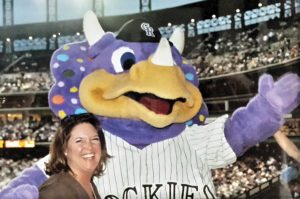
Donnette Noble’s academic field is diversity and leadership. She is also a serious (very serious) baseball fan. She has visited all 30 major league baseball parks in the United States, some of them twice if they’ve been remodeled or relocated. Why? Baseball, she simply says, is her favorite sport; she loves the game, strategy, talent, environment, history and even the umpires.

Stuart D. Warner
Associate Professor of Philosophy and Director, the Montesquieu Forum

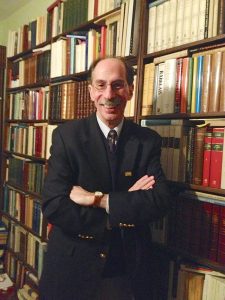
 Stuart D. Warner posing with book collection

Stuart Warner teaches courses on Montesquieu, Plato, philosophy in film, politics and literature, and much more. Before he was a professor he began a book collection by spending $32 on an eight-volume history of philosophy. His collection has grown to include over 9,000 scholarly, rare or antiquarian books, including a 1625 edition of Francis Bacon’s Essays, a first edition of Montesquieu’s Lettres Persanes published in 1721, and a first edition of Alexis de Tocqueville’s classic Democracy in America, published in 1835 and 1840.

William Host
Associate Professor of Hospitality and Tourism Management

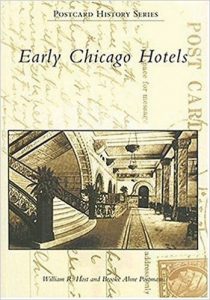
Book cover for Early Chicago Hotels

William “Bill” Host teaches courses in hospitality management and also collects postcards related to Chicago hotels and tourist sites, the bulk of which are from the first half of the 20th century. His collection of nearly 2,000 postcards was the basis for his co-authored book, Early Chicago Hotels (2006).

Unclassifiable!

Jane Curtis 
Associate Professor, English Language Program

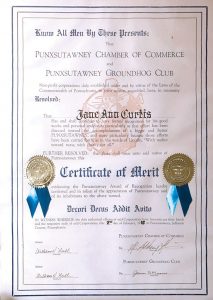
Jane Curtis certificate of merit

Jane Curtis has taught hundreds of international students in the English Language program since 1982. A native of Punxsutawney, Pennsylvania, Curtis has been named an “Official Ambassador” for Groundhog Day. She says she was tricked by her mother into baking groundhog cookies every year, and that the groundhog family tradition has emerged in the next generation, as her niece is getting married at Gobbler’s Knob this summer. Gobbler’s Knob, of course, in Punxsutawney, is the site on Feb. 2 where the groundhog annually sees — or doesn’t see — its shadow to predict the length of winter.

Ken King
Professor of Elementary Education

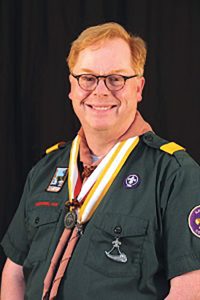
Ken King portrait in boy scout uniform

Ken King works in the field of science education, but has also participated in Boy Scouts of America continuously since he first joined the Cub Scouts in 1968. An Eagle Scout, he has served on numerous national and regional committees, helped develop handbooks for the young adult venturing program, and co-created eight handbooks for Cub Scouts and their leaders. This past May, he received the 2017 Silver Buffalo Award, Scouting’s highest commendation, for his service to young people.

Jonathan C. Smith
Professor of Psychology

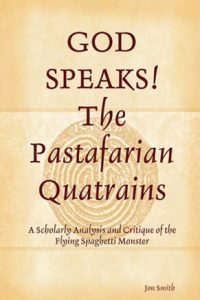
Book cover for The Pastafarian Quatrains

Jonathan C. Smith specializes in studies of stress, relaxation and mindfulness, and teaches critical thinking skills.

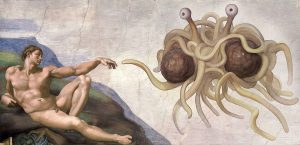
In his spare time, he founded the Reformed Church of the Spaghetti Monster and has published its gospel, The Pastafarian Quatrains. Pastafarianism, for the uninitiated, is a social movement spoofing and resisting the ideologies of creationism and intelligent design.

Standard
Feature 4, Feature Stories, Spring 2017

A Theatre for the People: New Auditorium Theatre CEO Tania Castroverde Moskalenko has a Bold Vision for the Historic Landmark

The Auditorium Theatre during a Roosevelt University Commencement.

The Auditorium Theatre during a Roosevelt University Commencement.

Tania Castroverde Moskalenko wants The Auditorium Theatre to hold a special place in the hearts and minds of all Chicagoans. The theatre’s new CEO recently unveiled the tagline “The Theatre for the People,” which captures not only her vision for the venue’s future, but that of the theatre’s original developers, Dankmar Adler, Louis Sullivan and Ferdinand Peck.

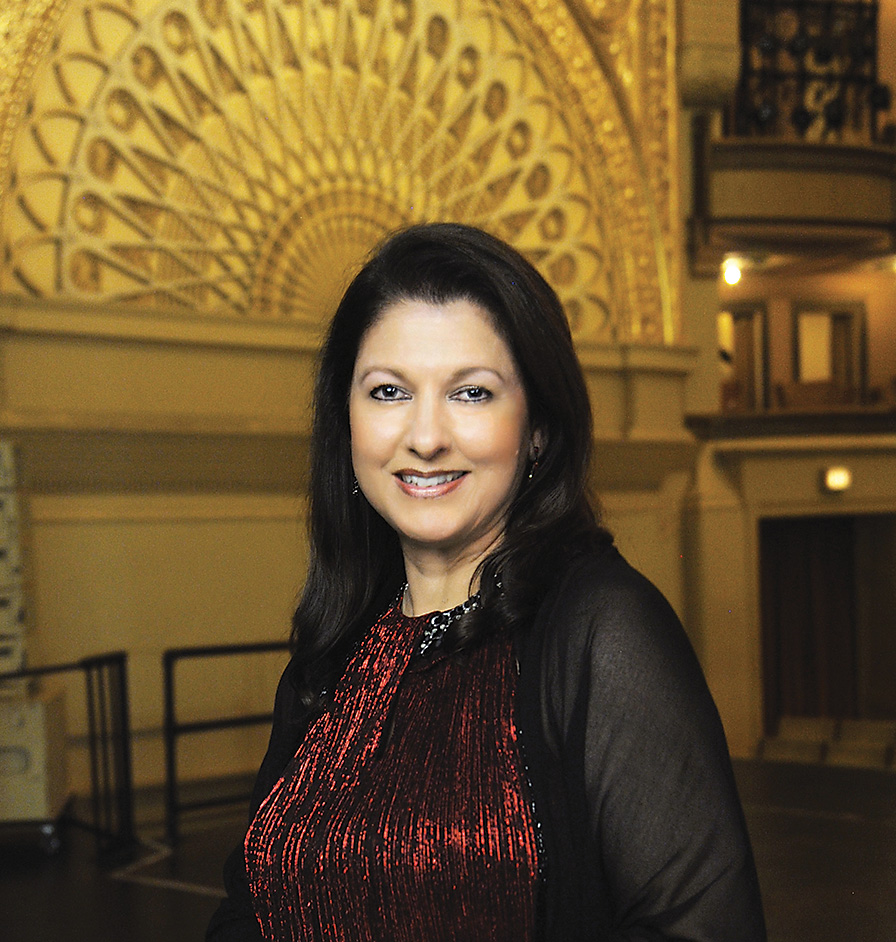
Tania Castroverde Moskalenko

Tania Castroverde Moskalenko

Castroverde Moskalenko also recently announced the theatre’s upcoming 2017-18 season, which includes performances such as Too Hot to Handel: The Jazz-Gospel Messiah, Ballet Nacional de Cuba, Shen Wei Dance Arts and the Alvin Ailey American Dance Theater tour. The theatre will also host Supreme Court Justice Ruth Bader Ginsburg, David Sedaris, and Ken Burns and Lynn Novick previewing their new documentary series.

Since joining the Auditorium Theatre in October 2016, Castroverde Moskalenko has already presented Lizt Alfonso Dance Cuba — a fitting first performance, as her family arrived from the Caribbean country as political refugees — as well as Alvin Ailey, the Boston Pops Esplanade Orchestra with Bernadette Peters, and more.

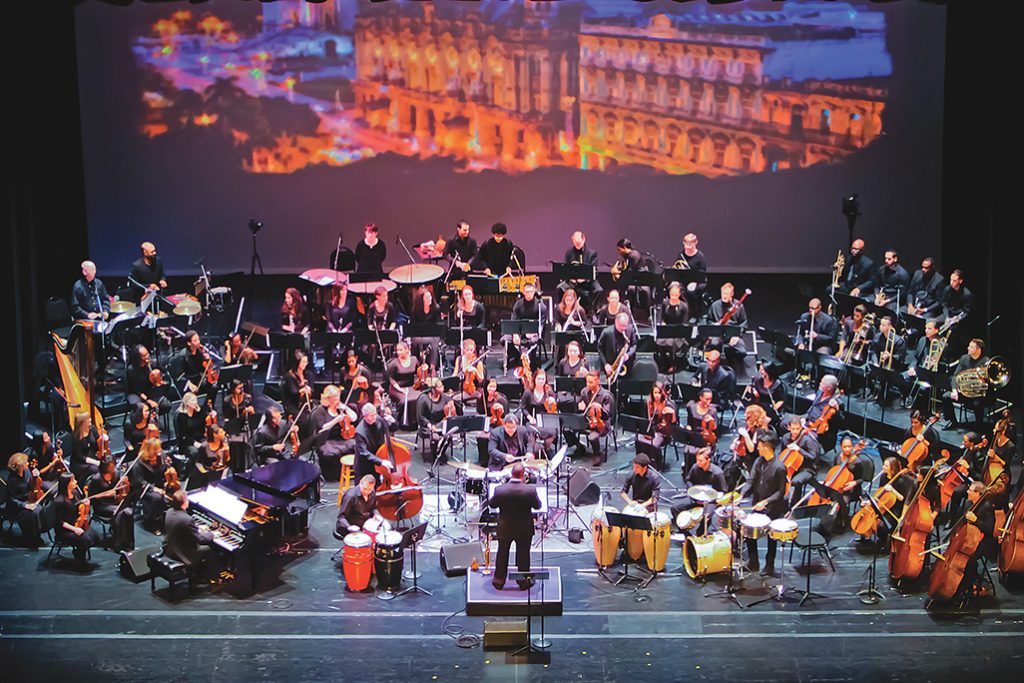
Chicago Jazz Philharmonic

Chicago Jazz Philharmonic performs at Auditorium Theatre

As CEO, Castroverde Moskalenko oversees a number of different areas, including programming, development, marketing, operations, artistic vision and strategic direction. She has made it known that she plans to expand and diversify programming, strengthening its creative engagement initiatives, including the theatre’s new ADMIT ONE program.

Formerly president and CEO of the Center for the Performing Arts and the Great American Songbook Foundation in Carmel, Indiana, as well as a former dancer who ran her own company, Castroverde Moskalenko spoke about how she hopes to use her extensive experience in the arts in her new position at the Auditorium Theatre.

Q:  What are some of your goals for the Auditorium Theatre?

A:  I have a big vision for the Auditorium Theatre, which includes ensuring that this remarkable national historic landmark is in the hearts and minds of everyone in Chicagoland and beyond. We have some work to do to accomplish this, and the first step is to strengthen our programming. We are widely known for international dance, and we will continue to present the greatest dance companies from around the globe. I am also excited to let you know that we will be expanding our musical offerings with a broad range of artists.

Q:  What do your daily responsibilities consist of?

A:  First, I will say that I absolutely love the work that I do. I am a firm believer in the transformational power of the arts and its ability to create bridges across cultures and communities. My day-to-day work focuses on fulfilling the mission of the theatre, which supports my passion and commitment to the arts. I don’t have a daily routine because each day is completely different. I oversee programming, marketing, fundraising and development, finance and operations, so I spend a lot of time in meetings moving around the giant puzzle pieces that make the organization work.

“I am a firm believer in the transformational power of the arts and its ability to create bridges across cultures and communities.”
– Tania Castroverde Moskalenko, CEO, Auditorium Theatre

Q:  What is ADMIT ONE and how can it benefit Chicagoland?

A:  ADMIT ONE is a new program funded by theatre patrons. It gives communities and their members from all over Chicagoland the opportunity to come for free to a theatre show or program. Our patrons have the option of donating to ADMIT ONE each time they purchase tickets. We then use the donations to accommodate those who might not otherwise be able to visit the theatre and see a show.

Q:  What led you to choose a career path dedicated to the arts?

A:  My family came to the United States as political refugees from Cuba when I was 6 years old. Two years after we arrived, when I was 8 years old, a truck full of furniture arrived at our newly purchased home. The first item off the truck was a white spinet piano, and my mother sat down to play it as soon as the truck was unloaded. She played the music of Ernesto Lecuona, Cuba’s greatest composer, and she began to weep. All of her emotions came to the surface when she played this music. At that moment, my love for the arts was born.

Q:  How did you express your passion for the arts early on?  Why have you remained dedicated?

A:  As newly arrived immigrants, my family was not financially able to participate in the arts, so for many years I checked books out of the library to learn about music and dance, and listened to classical music on the radio. I loved the music of classical ballets like Swan Lake. I pestered my parents long enough to convince them to enroll me in ballet lessons, which was a true luxury. That privilege was not lost on me, and it set the course for my life and career. To this day, I am completely committed to ensuring that the arts are accessible for everyone.

Q:  What appeals to you about the theatre and CEO position?        

A:  When I first saw the theatre, its amazing architecture took my breath away. I became captivated by the history and architecture of the Auditorium Theatre and feel equally inspired by the mission, vision and values of this national historic landmark, which is why I introduced “The Theatre for the People” label. I feel it is an honor and a privilege to lead this institution into its next chapter. There is much work to do in restoring this 127-year-old facility to its original glory and splendor, and I feel like I am someone who is able to wrap my arms around all that needs to be done and all that we aspire to achieve.

“ I became captivated by the history and architecture of the Auditorium Theatre and feel equally inspired by the mission, vision and values of this national historic landmark, which is why I introduced ‘The Theatre for the People’ label.”
– Tania Castroverde Moskalenko, CEO, Auditorium Theatre

Q:  Tell us about your experiences in Chicago.

A:  I moved to the city with my husband, Alexei Moskalenko, who is a former Bolshoi Ballet dancer and current associate artistic director for the Youth America Grand Prix, and our 8-year-old twins. We live downtown with an amazing view of the lake, the park and the skyline, and I have fallen in love with the city. I have read all about the “lake effect,” but after living here for five months, I think the true “lake effect” is the magic that the lake has on one’s psyche and soul.

Q:  What are some of your favorite things to do when you are not working?

A:  I love to travel, attend arts and cultural events, eat out and read. I recently finished The Third Coast: When Chicago Built the American Dream by Thomas Dyja, which is about the history of the city and Chicago’s culture. I am also working on a master’s degree in philanthropic studies from Indiana University’s Lilly Family School of Philanthropy.

Standard