Fall 2016, Feature 4, Feature Stories

Not Forgotten

Professor Anne-Marie Cusac and photographer Thomas Ferrella on community violence and the memorials left behind

Professor Anne-Marie Cusac and photographer Thomas Ferrella on community violence and the memorials left behind.

At a time when there is one shooting after another in Chicago, Roosevelt University Journalism Professor Anne-Marie Cusac and photographer and retired medical doctor Thomas Ferrella are taking a different approach to understanding the violence epidemic.

Over the last year, Cusac and Ferrella visited nearly 50 Chicagoland murder memorials where deaths have occurred and where those who have become just another grim statistic are being remembered by families and communities.
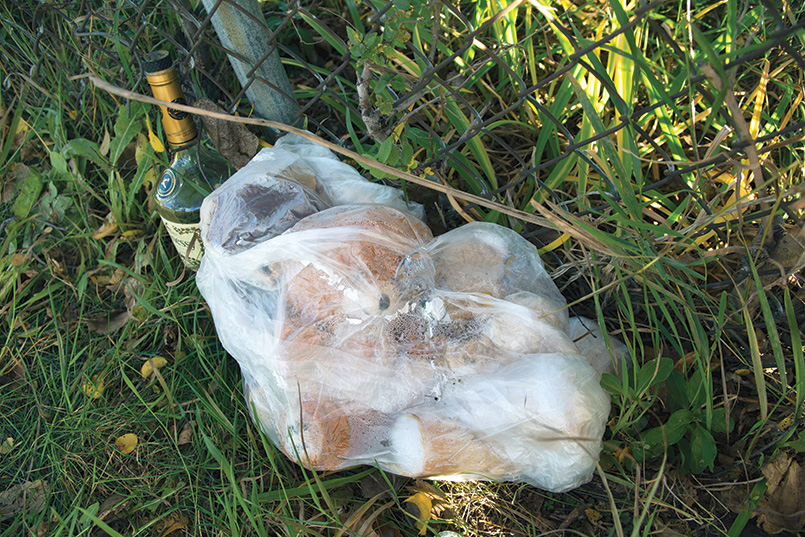
A memorial of teddy bears and liquor bottles

A memorial of teddy bears and liquor bottles.

“We wanted to look at more than just the problem,” said Cusac, an award-winning investigative reporter who has traveled some of Chicago’s most violence-prone streets with Ferrella, who is also a Wisconsin multimedia artist. Frequently accompanied by guides, the two have visited memorials in nearly a dozen Chicago neighborhoods and suburbs.

During their trips, Ferrella photographed stuffed toys, votive candles, wooden crosses, liquor bottles and other adornments, while Cusac interviewed neighbors, loved ones and passersby who know the back stories of the memorials.
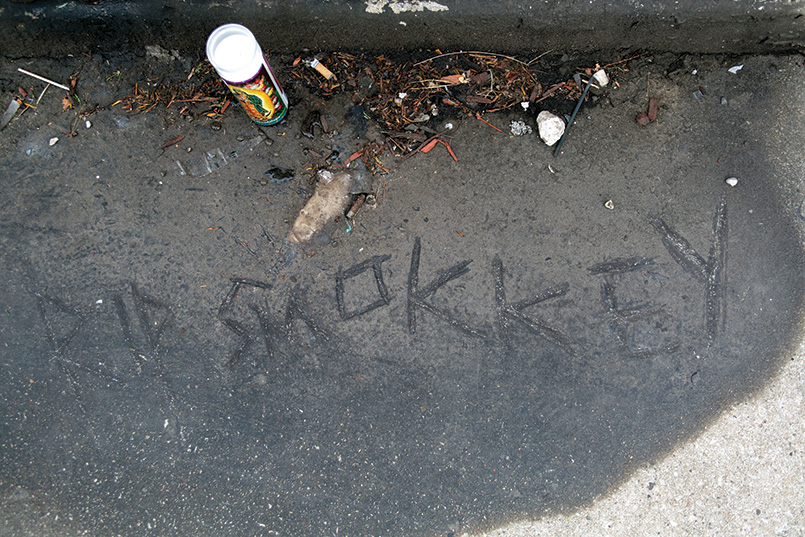
R.I.P. Smokkey is site where a mother memorializes her son on Thanksgivings with a turkey dinner.

R.I.P. Smokkey is site where a mother memorializes her son on Thanksgivings with a turkey dinner.

The result of their efforts, an exhibit called “Not Forgotten: Chicago Street Memorials,” opened last fall at Roosevelt University’s Gage Gallery at 18 S. Michigan Ave., Chicago. The show contains 34 photos and related interviews about memorials to death and violence in Chicago’s Auburn-Gresham, Back of the Yards, Brighton Park, Englewood, Gage Park, Little Village, Pilsen, Rogers Park and Uptown neighborhoods, as well as in Cicero and Evanston, Ill.

“Their work has given us a better understanding of the kind of grieving that goes on after the violence is over and the media has moved on,” said Michael Ensdorf, director of the Gage Gallery and curator of the exhibit.

Cusac and Ferrella documented memorials connected with some of the city’s recent and most notorious murders, including the gang-retaliation shooting of 9-year-old Tyshawn Lee in an Auburn-Gresham alley and the slayings of six members of the Martinez family at their home in Gage Park.

They also photographed and talked to people about markers for lesser-known crimes. At one location, there were offerings of food in the memory of a loved one. “I just want to sit and talk to my son,” Cusac was told by a mother who delivers a plate of food each Thanksgiving to the Brighton Park marker with the words “R.I.P. Smokkey,” which lies on the spot where her son was killed 14 years ago. “When I’m here, I know he’s with me. I let out my tears and I have my moments with him.”

To remember another tragedy, residents from an Uptown high-rise apartment building established a memorial to help them process the unimaginable — a newborn baby being thrown out an 8th floor window. “My cousin, because she had a newborn baby, put out Pampers, a blanket, teddy bears, flowers,” a woman who resided in the building explained to Cusac. “And then it just kept building,” a man at the site told Cusac in response to the woman’s comments.

“With this project, we gain an understanding of how people deal with hurt, trauma and loss,” said Cusac, who collected more than 30 hours of tape recordings. “It’s a project whose message, quite frankly, is as much about love as it is about violence.”

Both Cusac and Ferrella have previously delved into life’s underbelly. As an investigative reporter for The Progressive in Madison, Wis., Cusac uncovered pervasive and sometimes fatal torture of inmates inside America’s prisons and jails, leading her to write the nationally recognized book, Cruel and Unusual: The Culture of Punishment in America. Ferrella was a trauma doctor for 30 years in a Madison hospital emergency room where he treated people with injuries and conditions that at times were horrific.
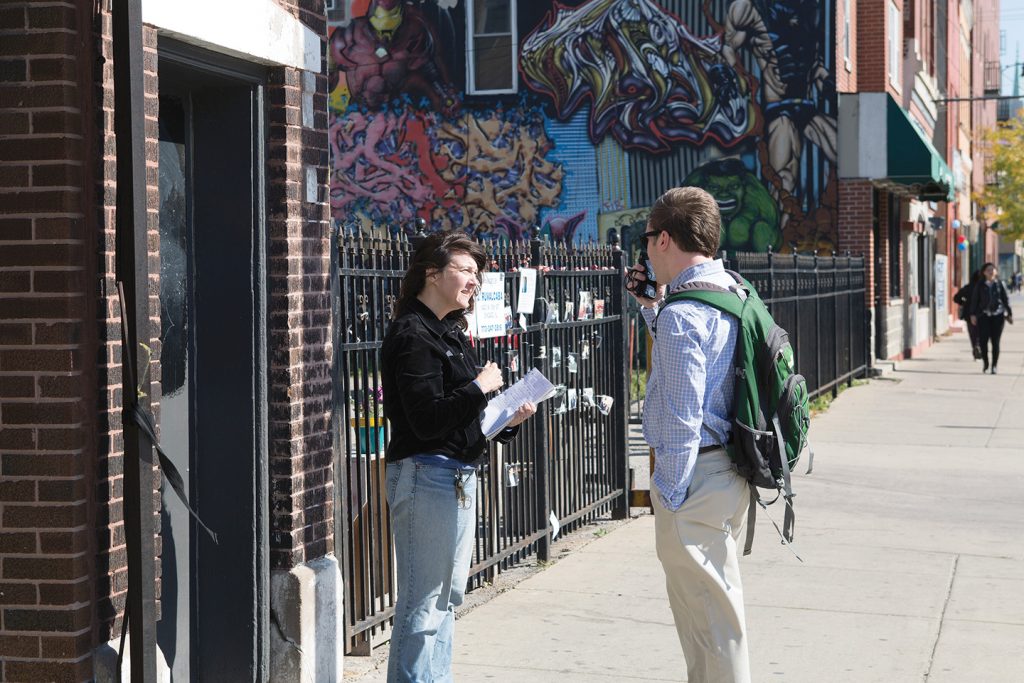
Roosevelt Journalism Professor Anne-Marie Cusac gathers facts

Roosevelt Journalism Professor Anne-Marie Cusac gathers facts.

In one case, he cared for a young woman who was brain dead after being hit by a car while crossing a street near his home in Madison. Shortly after her death, Ferrella noticed teddy bears, notes, flowers and balloons at the spot where she had been struck. It got him thinking that memorials were a beautiful and personal phenomenon worth documenting. Since then, he’s photographed 80 roadside memorials in Wisconsin.

“I needed someone to investigate their stories, including who built them, how they’re organized and what they mean to the community,” said Ferrella, whose friend recommended Cusac.

That is the underlying philosophy that guided the memorial project and what prompted Cusac and Ensdorf to ask Ferrella to consider expanding his reach from Wisconsin roadside memorials, which are mainly for drunk-driving victims, to Chicago street memorials, which largely remember those who have been murdered.
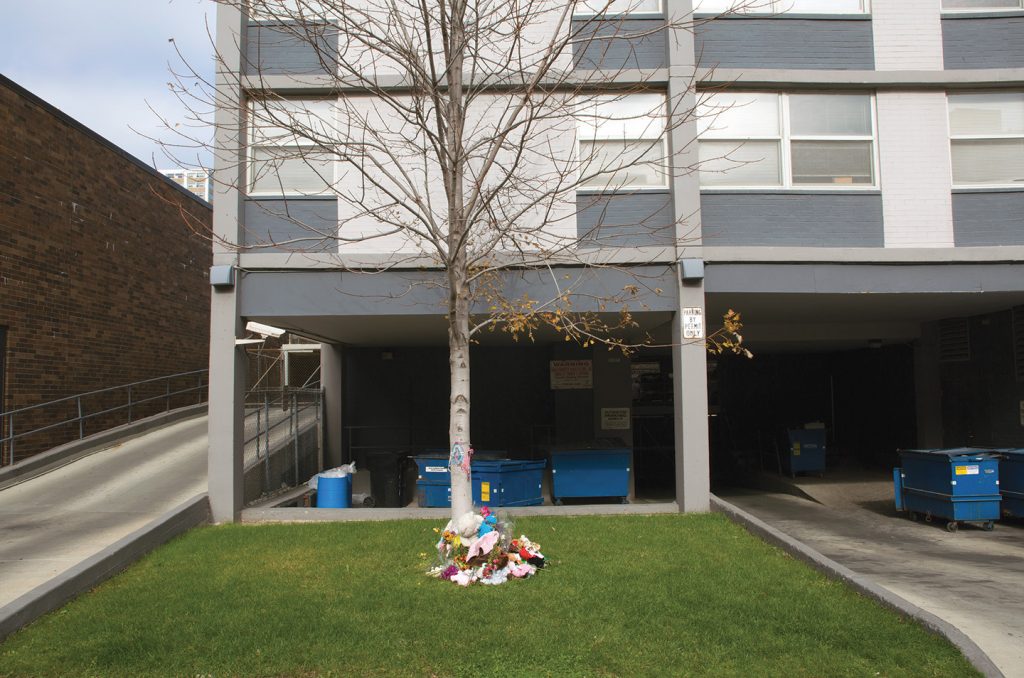
A memorial for a newborn thrown from a Chicago high-rise.

A memorial for a newborn thrown from a Chicago high-rise.

“I felt we could fulfill more of the University’s social justice mission by looking at how real people are dealing with the problem of violence in their communities,” said Cusac.

“I’ve taken care of my share of down-and-outers as well as shooting victims,” said Ferrella, who retired as an emergency room doctor about three years ago in order to pursue his artistic career. “I have seen all sorts of tragedies, but they have always been on my turf where I’ve been in control. This was a completely different experience. I found that a lot of what we did required knowing how to approach people without intimidating them,” he added. “I credit Anne-Marie for being able to do that. She’s taught me how to be a better listener.”
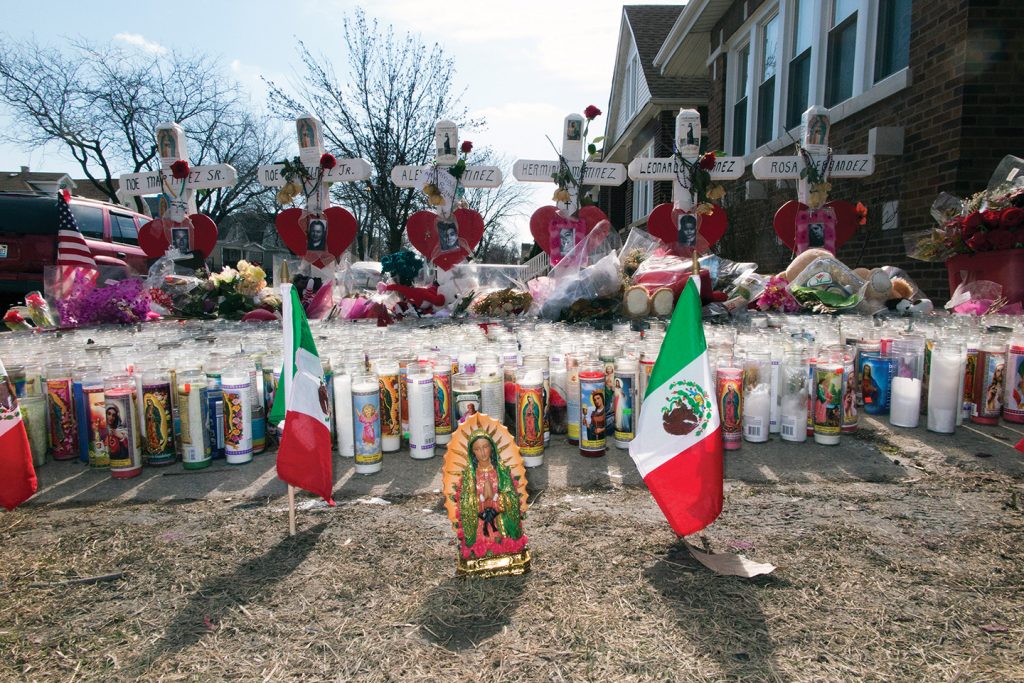
A memorial for six family members killed in Chicago’s Gage Park.

A memorial for six family members killed in Chicago’s Gage Park.

Angalia Bianca, one of the team’s guides who does outreach and evaluation for the anti-violence organization CeaseFire, believes the project is successful because it gathers opinions from those whose voices are rarely heard. “A lot of people just assume that these are memorials to gangbangers, but the truth is that they’re human beings first – and all of us need to understand that,” said Bianca.

One of the most difficult questions Cusac routinely had to ask is “Why is this happening?”

“Many of the people we interviewed have been part of the problem. They’ve seen what violence does to life and are no longer shocked by it,” said Cusac. “We looked at their hurt and found that those we talked to are becoming people who want to stop the violence that has come back to haunt them.”
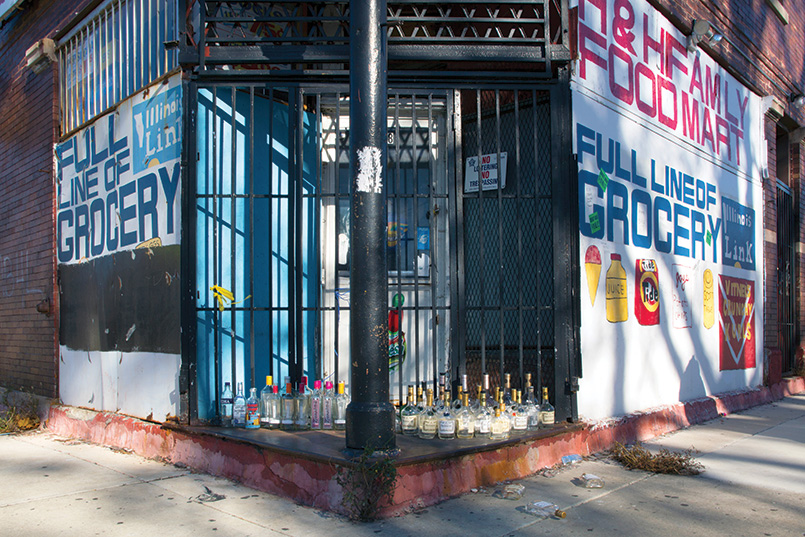
Liquor bottle street memorial.

Liquor bottle street memorial.

“This is not really a project about a problem like violence,” she said. “It has to do with cultural change in the form of street memorials expressing grief and the desire to comfort.”

At 73rd and South Morgan in Englewood, one man who had seen his share of violence talked with Cusac about the Hennessy-bottles memorial erected for an unknown victim.

“I felt we could fulfill more of the University’s social justice mission by looking at how real people are dealing with the problem of violence in their communities.”
Anne-Marie Cusac, Professor of Journalism

“Pouring out a little liquor for him. It means paying your respect for the person who ain’t here,” said the man. “You pour it on the Earth so he can drink it. Because they say when they die they go to heaven, but they come back to Earth to try to help to show people there are better ways.”

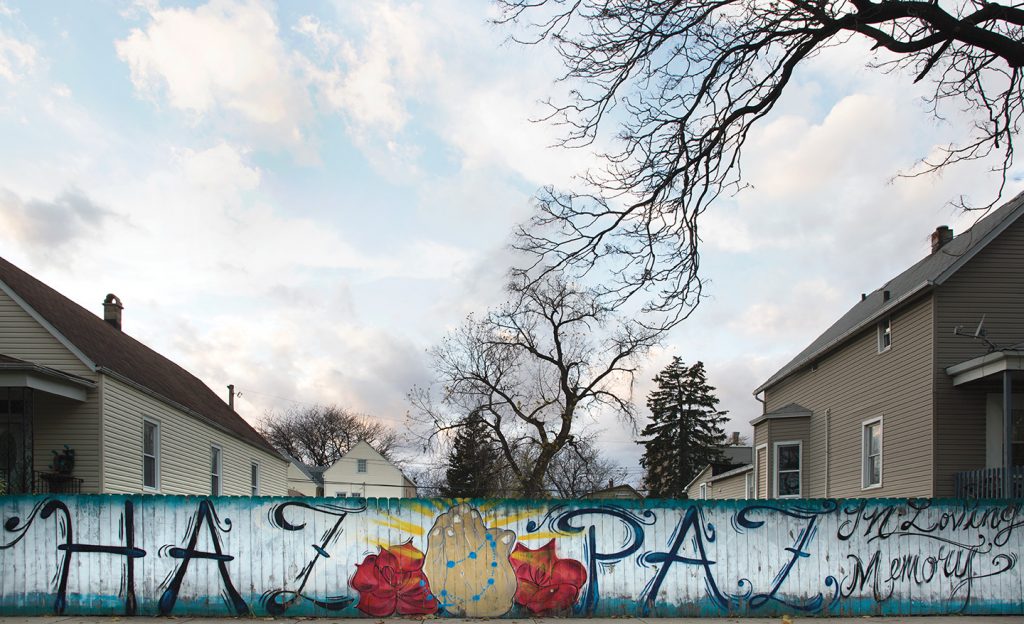
Frankie Sanchez, an interrupter with CeaseFire, showed Cusac and Ferrella a fence memorial called “Haz Paz” that had long been in the community before being painted over after a period of many shootings. It is one of the highlights of the show. “We’ve had so many guys killed over here,” a man at the memorial told Cusac. “Haz Paz means make peace.”
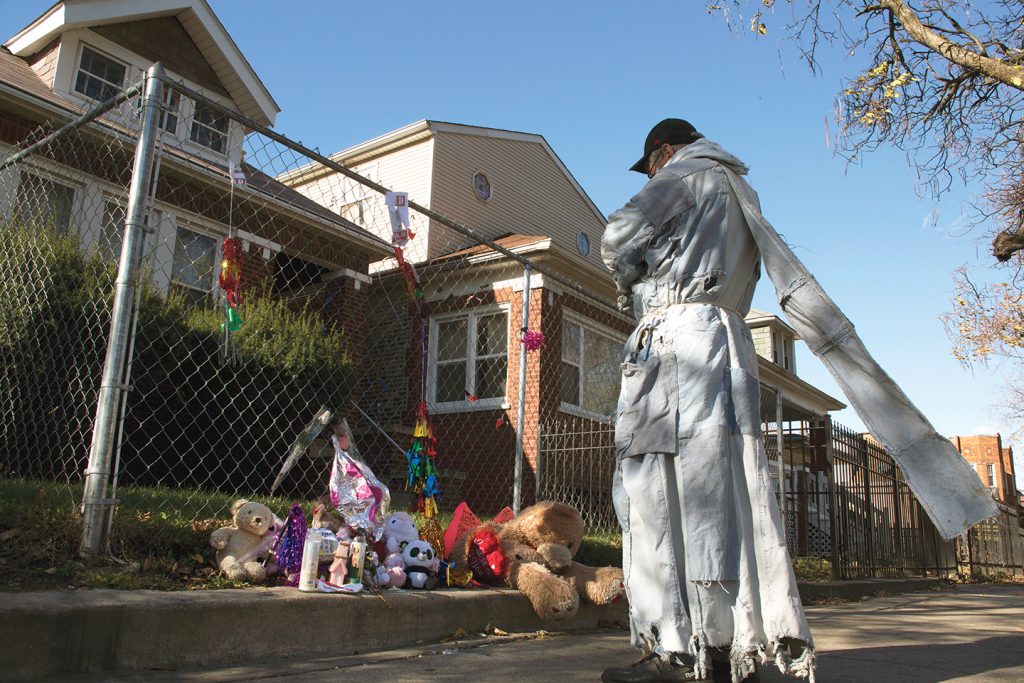
Brother Jim Fogarty at a memorial site; bottom, a memorial for six family members killed in Chicago’s Gage Park.

A memorial for six family members killed in Chicago’s Gage Park.

Brother Jim Fogarty, executive director of Brothers and Sisters of Love, said it’s not unusual to have members of the media accompany him as he ministers to gang members and others who are engulfed in Chicago’s street violence.

“The people who are out there are in need of a way to express their grief,” said Fogarty, who has seen memorials to murder victims come and go, sometimes on the order of police.

“The nice thing about this project is that these memorials become something permanent,” said Fogarty. “They are a means for healing wounds, and I know that, time after time, I heard those we visited in their communities tell us: ‘Thank you. We appreciate that you’re interested.’”


Cusac and Ferrella will be showing their exhibit on Wisconsin roadside memorials in Madison at the Arts and Literature Laboratory in May 2017.  The two are also considering doing a book about memorials.

Visit wisconsinroadsidememorials.com to learn more about the project.

Standard
Fall 2016, Feature 4, Feature Stories

Roosevelt Graduates Practicing Restorative Justice

Roosevelt University Restorative Justice

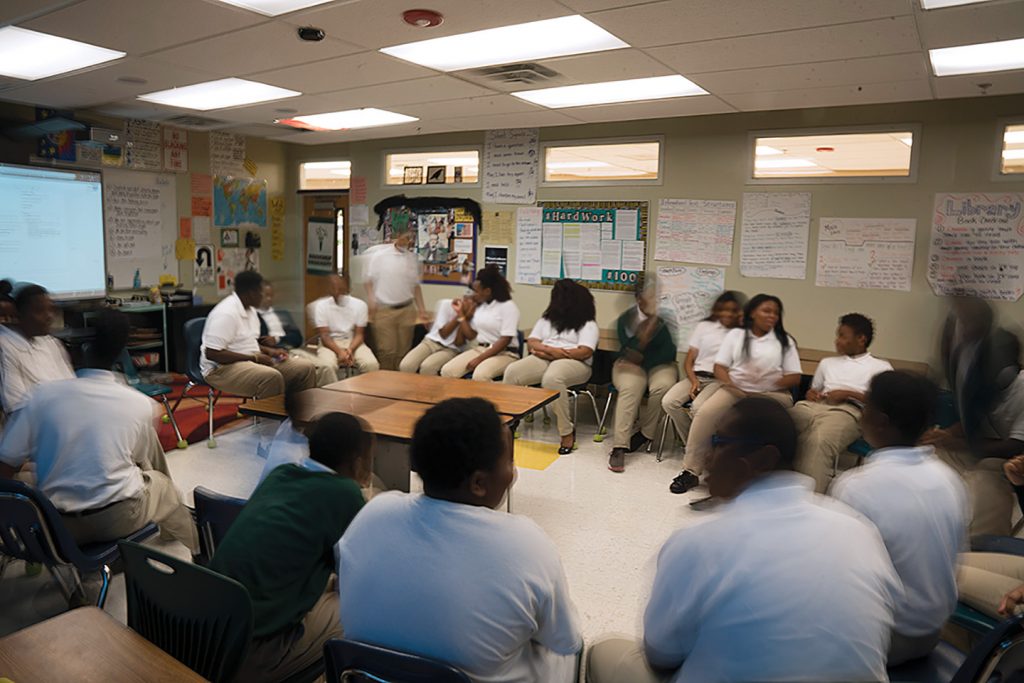
A circle discussion in Wilkie’s homeroom.

More than 50 Roosevelt University students have been trained by the Mansfield Institute for Social Justice and Transformation since 2010 in how to use restorative justice practices when working with young people.

Now, some of those trainees, who have since graduated from the University, are putting what they learned to practice in their careers.

For instance, Roosevelt alumna Emily Wilkie (BA, ’13), who spent two years working with Mansfield as a peacekeeper in several area schools before deciding to teach, has helped institute restorative justice practices at her charter school in Chicago’s Austin neighborhood.

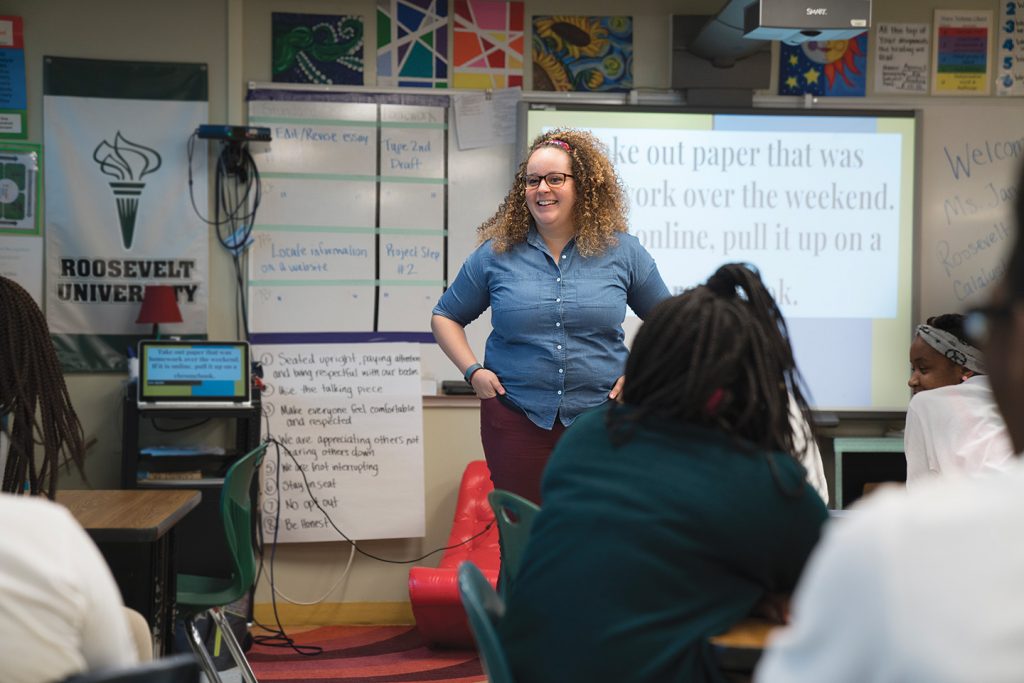
Roosevelt alumna Emily Wilkie (BA, ’13).

Roosevelt alumna Emily Wilkie (BA, ’13).

Tim Crawford, a 2014 graduate who took a restorative justice class at Roosevelt, is today working in the restorative justice field as a reclaiming interventionist with middle and high school students at an alternative school in Hillside, Ill.

And former Roosevelt student Matt Schiavone, a Mansfield intern at area schools and strong believer in the power of restorative justice, is implementing what he learned today as a program coordinator at a youth drop-in center in La Grange, Ill.

“Learning about restorative justice changed my life,” said Wilkie, who has helped change the culture at the Catalyst Circle Rock Charter School in Chicago’s Austin neighborhood.

Initiating peace circles in her homeroom shortly after being hired, Wilkie has helped change the culture of the school, from one that strictly tracked students’ bad behavior with demerit points, to a place where students and staff are encouraged to iron out differences in peace circles being held regularly at the school today.

“There’s been a total shift in mindset at the school, thanks to restorative justice,” said Wilkie. “It has been changing my kids’ learning outcomes for the better and I’m proud that I have been able to advocate for something that really matters in their lives, for the school and our society.”

As a reclaiming interventionist this fall at the Regional Safe School, an alternative school for middle and high school students in Chicagoland’s west suburban Hillside, Crawford has led circles on relationship building, community building and best teaching practices.

“I’ve been helping to develop and implement restorative practices at the school,” said Crawford, “and I can already see some changes for the better in relationships between teachers and students.”

“We had students who hated one another, and now they’re coming together and putting their pettiness aside,” added Crawford, who credits his Roosevelt experience with preparing him to lead the school’s restorative justice initiative.

Meanwhile, Schiavone believes his experience as a Roosevelt peacekeeper at a middle school in Chicago not only prepared him, but was key in his landing a job as programming coordinator at the Leader Shop, a nonprofit youth center in Chicagoland’s west suburban La Grange.

“At Mansfield, we would have talking circles and I applied that same framework to help diffuse some of the conflicts, disrespect, bullying and arguments we were seeing with kids in our summer camp,” he said.

The first to acknowledge having made some poor choices in high school, Schiavone said he believes in restorative justice in large part because it gives victims a say in determining outcomes of a dispute, while perpetrators get the chance to apologize.

“I had to learn the hard way in my life,” Schiavone said. “But I believe that restorative justice can make it easier for our young people to avoid mistakes and stay on track.”

Standard
Fall 2016, Feature 4, Feature Stories

Mastering Their Futures

Graduate Education Roosevelt University

Graduate education at Roosevelt addresses key issues in a competitive global economy.

A lot has been written during the past few years suggesting that a master’s degree is the new bachelor’s.

For many people seeking the career they want, the answer is “yes,” a master’s degree is essential in today’s professional workplace.

Jason Vincent, a marketing and communications consultant at Humana and other organizations, will enroll in Roosevelt University’s Heller College of Business this January, because he believes an MA in Human Resource Management will better position him to bring about positive changes in the workplace. “By obtaining this degree, I will gain insights into topics such as affirmative action, recruitment and performance management,” he said.

Graduate Education Roosevelt UniversityJoseph Chan, dean of the Heller College, said Vincent and many other individuals like him are doing the right thing by taking graduate school classes. “An advanced education provides the breadth and depth of knowledge that is required in a rapidly changing environment,” he said. “It transcends the know-how of today with the know-what of tomorrow.”
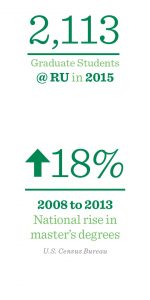
Roosevelt University is emphasizing graduate education in all of its colleges and has hired new advisers to help students make the transition to graduate school as smooth as possible. The University had 2,113 graduate and doctoral students in Fall 2015 and President Ali Malekzadeh said Roosevelt’s goal is to enroll 550 new graduate students each year.

Nationally the number of adults completing a master’s degree grew by 18 percent from 2008 to 2013, according to the U.S. Census Bureau. That’s good news as data from the Bureau of Labor Statistics projects employers will add nearly 2.4 million jobs requiring a graduate degree or higher between 2012 and 2022.

“In the College of Arts and Sciences, we focus significant attention on graduate education because we recognize that the current and future knowledge economy will require increasing numbers of intelligent people with deep specialized training,” said Bonnie Gunzenhauser, dean of the College of Arts and Sciences.

That viewpoint is supported in a 2010 report on the future of graduate education in America prepared by the Council of Graduate Schools. “The nation’s competitiveness in the global economy,” the document said, “hinges on our ability to produce sufficient numbers of graduate-degree holders — people with the advanced knowledge and critical-thinking abilities to devise solutions to grand challenges such as energy independence, affordable health care, climate change and other key issues.”

Graduate student Jada Bailey will be using the critical-thinking skills she is currently learning at Roosevelt to confront some of society’s most difficult problems. “My passion to further impact lives of people in communities I serve led me to want to pursue my graduate degree in public administration. It is my earnest desire to use my advanced degree as a gateway into legislation and to be part of the policy-making process,” said Bailey, a 2010 Roosevelt alumna with an undergraduate degree in political science.

Graduate Education Roosevelt UniversityRoosevelt offers 46 master’s, diploma and doctoral programs, mostly in areas that lead directly to jobs. For example, the College of Education has partnered with schools in Schaumburg to create an off-campus master’s program for teachers who want to become principals and teacher leaders.

The most popular majors for graduate students at Roosevelt are business administration (MBA), pharmacy, clinical psychology and integrated marketing communications. In addition to master’s-level programs, Roosevelt offers a Doctor of Psychology in Clinical Psychology (PsyD), a PhD in Industrial/Organizational Psychology and a Doctor of Pharmacy (PharmD).

The Chicago College of Performing Arts has 11 master’s programs, second to the College of Arts and Sciences, which has 16. Most graduate students in Performing Arts pursue the Master of Music degree, which provides advanced study in a specialized concentration such as voice, piano or violin. Through private lessons, coaching and recitals, graduate students become fully immersed in their area of expertise. In addition, CCPA has a new master’s program in performing arts administration to hone the management skills of current and aspiring administrators.

In the College of Arts and Sciences, the Master of Science in Integrated Marketing Communications program, like other degrees, offers flexible scheduling, instruction by industry leaders and preparation for career advancement. “Many universities focus their programs on communication theory. We are focused on preparing the people who will lead marketing communications in the business world,” said Gunzenhauser.

Other graduate programs of note include public administration, where alumni include three former Chicago police superintendents; the MFA in Creative Writing, which provides writers with the guidance they need to become skilled in fiction, creative nonfiction, poetry and dramatic scripts; and clinical psychology, where graduates are qualified to apply for licensure as professional counselors.

Graduate Education Roosevelt University

Graduate admission requirements vary by academic program, but all require official transcripts from previously attended colleges or universities with a recommended overall cumulative GPA of at least 3.0 on a 4.0 scale. Additional application requirements may include GRE or GMAT test scores, undergraduate prerequisite courses, letters of intent, resumes and application essays. International students must also submit proof of English proficiency.

Kelly Erdman, a Roosevelt graduate admission counselor, said graduate school isn’t a great fit for everyone, but for those who want to challenge themselves academically and grow individually, there’s no better environment for this than graduate school. “Ultimately,” she said, “pushing academic boundaries is the most rewarding way to identify one’s strengths and interests, with an end goal of landing a dream career.”

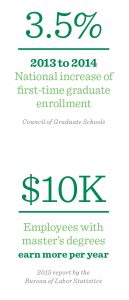
Plus, employees with master’s degrees earn on average $10,000 a year more than those whose highest degree is a bachelor’s, according to a 2015 report by the Bureau of Labor Statistics. Unemployment rates are also lower, 2.4 percent for people with master’s vs. 2.8 percent for those with a bachelor’s.

Chan strongly believes that to be successful in today’s business workplace, employees must try to anticipate changes and innovations. “Issues that confront modern day life could hardly be imagined only a decade ago,” he said. “A deep understanding of the underlying principles in a discipline allows one to adapt to new job requirements.”

In the Heller College of Business, students are encouraged to actively interact with their professors and classmates, many of whom are from diverse backgrounds. This helps graduate students in accounting, business administration, human resource management and real estate develop skills required to solve current and future complex business problems. To further facilitate career development, the college also offers networking opportunities, like internships, mentoring and professional development.

Education Dean Tom Philion uses several strategies to meet the growing need for teachers in Illinois, especially teachers of color. The college lowered the full-time tuition rate for graduate students seeking to become Illinois teachers and it created innovative graduate-level programs in dual language teacher leadership and second language special education. “We are also using online delivery options to increase access to these programs and others, like the MA in Reading,” he said.

Graduate Education Roosevelt University

Pharmacy is the only college at Roosevelt where all of the students are pursuing an advanced degree, a Doctor of Pharmacy. Students take courses in a lock-step fashion, earning their degrees in three years, as opposed to the traditional four years. The application process is competitive and a maximum of 70 students are accepted into the program each year.

Community service is one of the major ways many pharmacy alumni share their professional expertise. Liweza Yalda, a 2015 graduate, has been tending to the needs of dozens of elderly refugees from Iraq and Iran at the Assyrian American Community Pharmacy in Skokie, Ill. “These are people who don’t always understand the culture. They can’t read or write in English and yet they have multiple medications that they’re supposed to understand how and when to take,” said Yalda.

By stressing graduate education, Roosevelt is not only helping individuals get ahead, it is helping the national economy. Graduate education “is critical to the country’s strength and prosperity,” according to a recently issued report by the National Academy of Science. “Graduate education must be seen as a national priority if America is to develop the talent required to meet national needs and compete in the global economy.”

Standard