Fall 2017, Feature 4, Student Essay

First to Fellowship: CCCF Fellow Finds Empowerment in Business Program

I grew up on Chicago’s South Side as one of seven children of Mexican immigrants. In December, I will proudly become the first in my family to receive a bachelor’s degree when I graduate from Roosevelt.

Getting through college as a first-generation student at times has been a big struggle, not so much because of the course load, but rather because of all that I must do to best prepare for life after college.

For first-generation students like myself, guidance can be difficult to come by. My mother stayed at home to care for us. My father worked construction as a stone mason for many years before contracting Alzheimer’s disease, which forced him to retire. While they always encouraged me to go to college, my parents were not always able to give me all of the advice I needed to be a success in today’s professional business world.

Fortunately, I had the privilege during the 2016-17 academic year of being selected as a Clearing Corporation Charitable Foundation (CCCF) fellow. I can’t say enough about the experience, which has empowered me as a first-generation student and enriched me as a finance major with both knowledge and skills that are critical for a career.

“The program has allowed me to network with professionals as well as like-minded student fellows, and has given me the opportunity to polish myself for a professional career that I plan to have as a bank examiner.”

Monica Acosta (BSBA, ’17), CCCF Fellow

The program has allowed me to network with professionals as well as like-minded student fellows, and has given me the opportunity to polish myself for a professional career that I plan to have as a bank examiner.

As a CCCF fellow, I heard speakers, went to Microsoft Excel and Access workshops, and participated in a mock-interview session. All were invaluable for my professional development.

I also developed an elevator pitch, which goes something like this: “Hello, my name is Monica. I am a senior at Roosevelt and already have a job offer to become a bank examiner with the U.S. Office of the Comptroller of the Currency (OCC) in Chicago, where I am currently completing an internship.” In my mind, this kind of practice is worthwhile, for I hope to one day move to Washington, D.C., and even work abroad with the OCC as a bank examiner.

The CCCF program gave me the opportunity to connect with many professionals, and also provided me with a $2,500 stipend that helped alleviate to some degree the financial stress involved with being a college student. I used the stipend for books, paying rent and living expenses.

As I look forward to my graduation, I know that the skills and contacts I have made through the CCCF program will be useful in the full-time job I begin in January 2018 as a bank examiner. I also know that my parents, who never had the opportunity to go to college, will be proud when I walk across the Auditorium Theatre stage in December as the first in my family to obtain a diploma.

After nearly four years at Roosevelt, I have learned to navigate college and career: how to apply for admission, where to go for help, how to write essays for scholarships, the steps that are involved in finding an internship, what to emphasize in a resume, how to present myself in an interview, and so on.

That is information that I believe could be useful to young people. It is the reason I choose to volunteer at my former elementary school, the Ruben Salazar Bilingual Center in Chicago. I talk to kids there about the high school experience, the importance of getting a college degree and the road that lies ahead in becoming a professional. I am confident that many of these kids will be just like me — the first in their families to receive a college degree and pursue a professional career — and I want them to be ready.


CCCF Donates $1 Million to College of Business

Roosevelt University’s Heller College of Business is preparing a diverse group of students — many whom are the first in their families to go to college — for the financial workplace with a new $1.04 million gift from a local foundation.

The Clearing Corporation Charitable Foundation (CCCF), which gave Roosevelt $262,136 to start and sustain a CCCF Fellows Program during the 2015-16 and 2016-17 academic years, made its new seven-figure gift in July.

The long-term objective of the program is to promote diversity in the financial sector, and at least 40 percent of each year’s fellows are women, first-generation college students and students from underrepresented population groups. In fact, of the 40 fellows who have completed the program, 82.5 percent were first-generation students, 30 percent were female, and 25 percent were African American and Hispanic. In addition, 36 of the 40 fellows were placed in internships, many of which led to full-time jobs at prestigious financial institutions.

“After seeing the strong record of the program in its first two years, and its commitment to diversity, we became convinced that Roosevelt and its CCCF Fellows Program should be expanded,” said David Johnson, a CCCF board member and long-time supporter of the University.

This year, 10 more undergraduate business majors are CCCF fellows, and plans are to turn the initiative in fall 2018 into a CCCF Fellows Business Honors Program, which will accept 10 new fellows every year through 2022.

Tanweer Hasan, professor of finance and accounting, and founding executive director of the CCCF Fellows Program, has been credited with developing and leading the program to success.

“Thanks to this gift, we will be able to upgrade the current program,” Hasan said, “which will give our fellows more opportunities to be involved in faculty-led independent research projects and off-site field trips.”

Standard
The Auditorium Theatre of Roosevelt University. Above: Roosevelt’s Auditorium Theatre 50 years ago.
Fall 2017, Feature 4

Auditorium Theatre Celebrates 50 Years Since Reopening

The Auditorium Theatre of Roosevelt University. Above: Roosevelt’s Auditorium Theatre 50 years ago.

The Auditorium Theatre of Roosevelt University.

The landmark Auditorium Theatre of Roosevelt University celebrated the 50th anniversary of its grand reopening — marking 50 years of continuous operation — on Nov. 12 with its annual gala and an unforgettable evening of dance performances.

Roosevelt’s Auditorium Theatre 50 years ago.

Lead dancers from companies including Alvin Ailey American Dance Theater, American Ballet Theatre, Dutch National Ballet, Hubbard Street Dance Chicago, The Joffrey Ballet, New York City Ballet, Mariinsky Ballet, MOMIX, Parsons Dance, The Suzanne Farrell Ballet, and The Washington Ballet took the stage for “A Golden Celebration of Dance,” honoring the theatre’s grand reopening in fall 1967.

Closed to the public and in disrepair for more than 25 years beginning in 1941, the theatre was converted for use as a servicemen’s center in World War II, during which time the stage was used as a bowling alley. After World War II ended, the theatre closed down entirely.

Although Roosevelt acquired the Auditorium Building in 1946, its acoustically perfect theatre remained shuttered for another two decades. In 1959, Roosevelt’s Board of Trustees created the Auditorium Theatre Council, headed by Trustee Beatrice Spachner, to raise money for and oversee the restoration of the theatre.

The theatre reopened on Oct. 31, 1967 with a performance of George Balanchine’s A Midsummer Night’s Dream by the New York City Ballet.

At the time, Chicago Mayor Richard J. Daley declared the theatre a “wellspring of the arts — in literature, theatre and music.”

Suzanne Farrell and Edward Villella, the principal New York City Ballet dancers who performed on that historic evening in 1967, served as honorary co-chairs for the Auditorium Theatre’s annual gala, which took place at the Standard Club before the performance. During the gala, Sonia Florian of the NIB Foundation received the second annual Adler and Sullivan Award for her commitment to the performing arts.

“This event was a wonderful way to commemorate the Auditorium Theatre’s legacy since its grand reopening in 1967,” said Auditorium Theatre CEO Tania Castroverde Moskalenko. “We are looking forward to serving the Chicago community as the ‘Theatre for the People’ for many years to come.”


The Auditorium Theatre’s 2017-18 season continues with Too Hot to Handel: The Jazz-Gospel Messiah in January and Les Ballets de Monte-Carlo, Alvin Ailey American Dance Theater, and Hubbard Street Dance Chicago in March. For a full list of performances, visit AuditoriumTheatre.org

Standard
Fall 2017, Feature 4

Food Fight: A Brief History of the Roosevelt Cafeteria

Cafeteria scenes from the 1940s and ’50s.

College students and food have a long, conflicted history. Older alumni at many colleges may recall dubious offerings like mystery meat, weak coffee, and tuna surprise — and student complaints about cafeteria food are legion. A student riot occurred at Harvard College in 1766 because “the butter stinketh.” In 1818, a food fight at Harvard led to the expulsion of the entire sophomore class.

Cafeteria scenes from the 1940s and ’50s.

Since 1947, there has been a cafeteria at Roosevelt’s downtown Chicago Campus — though its location has changed several times. During the late 1940s, the cafeteria was located on the south side of the Michigan Avenue lobby, where the marketing and public relations office now lives.

By 1955, the cafeteria was on the Congress Parkway side of the second floor of the Auditorium Building. During the early 1960s, it relocated to the third floor, and later to the second floor corridor facing Wabash Avenue. When the Herman Crown Center opened in 1970, the cafeteria operated on the west side of the second floor. Since 2012, the current McCormick Dining Center on the second floor of the Wabash Building has overlooked the Wabash Avenue elevated train. There have also been cafeterias at two other sites: University Center Chicago and the Schaumburg Campus.

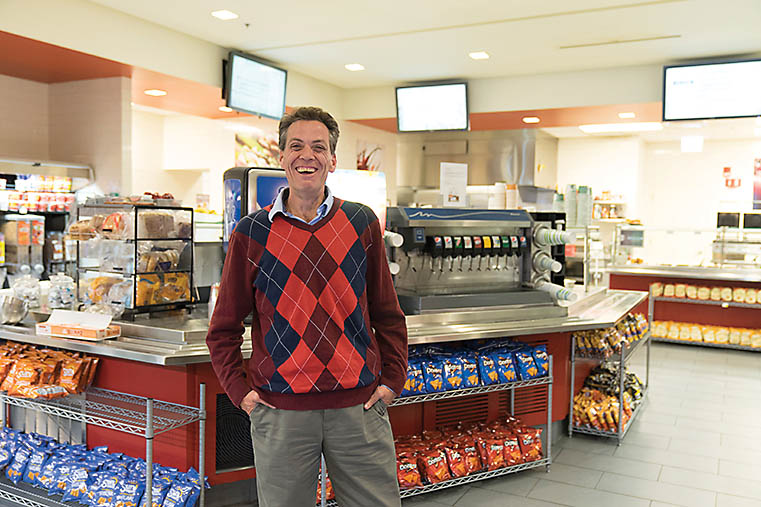
Food Service Director Bill Reich.

It was not always a serene place to be. In 1947, The Torch student newspaper called cafeteria food “sleazy and monotonous … and carelessly and amateurishly prepared.” Some students that year discussed creating a cooperative cafeteria. In 1949, the Student Council voted to boycott the cafeteria if it did not improve, and an editorial in The Torch noted the “not-so-spotless silverware, the restricted menu, the oft-times poorly prepared food, and the mediocre seven-cent coffee.”

Executive Chef Charlie Taylor; the McCormick Dining Center.

Over the years complaints continued, and in 1971, a student guide called Truckin’ Thru RU helpfully listed local restaurant alternatives because the cafeteria was a place where “plastic-wrapped sandwiches and sterile hot dishes turn our stomachs.”

Cafeteria scenes from the 1960s and ’70s.

Others have fonder memories. Earl Rodney (BBA, ’54) recalled that his favorite dish in the cafeteria was “ham hocks and lima bean stew”; Ethel Crisp (BA, ’74), some 20 years later, remembered the “delicious hamburger with lots of pickles.” One anonymous student during the 1970s treated himself every day to a Suzy Q snack cake. More recently, Arielle Antolin (BA, ’16) proposed the addition of a “grilled pepper jack cheese and burger with bacon bits on white bread.” The cafeteria adopted the suggestion and promptly named the sandwich “The Arielle A+ Burger.”

“The pizza puff: ridiculously greasy but my treat to myself after a jam-packed day of classes.”

Bianca Milligan (BA, ’17)

Michael Shatz (BM, ’50) wrote in the book Memories of the First 60 Years that the cafeteria was a “melting pot of races and nationalities” and “the heart of the school.” Similarly, retired U.S. diplomat Jacques Paul Klein (BA, ’63; MA, ’73) remembered the cafeteria as “the focal point for our debates, arguments and critiques but — most importantly — camaraderie … Who could not help but be enriched by such a multiethnic, multiracial, multicultural and diverse student body?” In contrast, others noted that there was sometimes self-segregation of students by race, religion, athletic identity, gender or college.

Standard