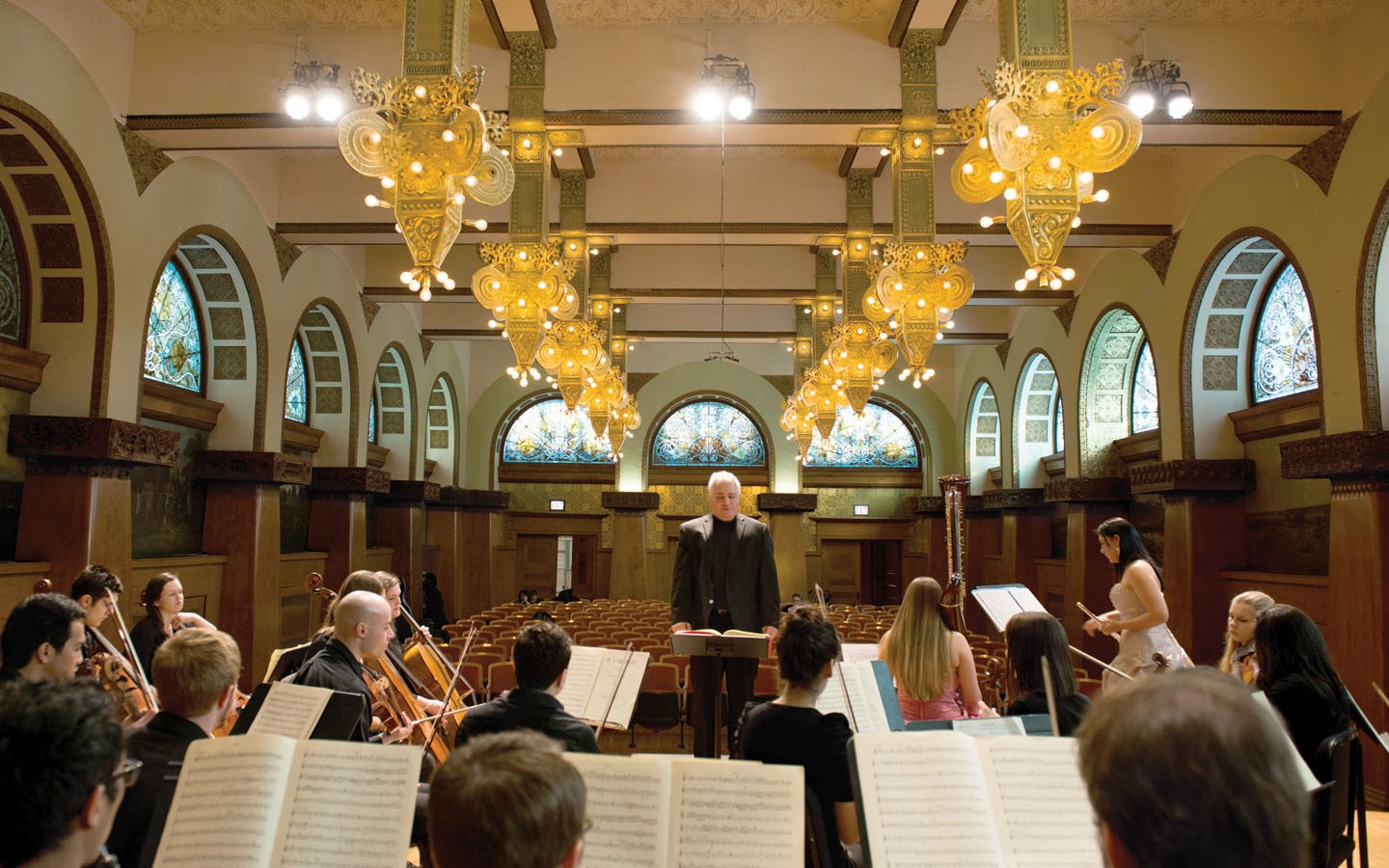
Student orchestra plays in Ganz hall directed by professor
Fall 2017, Feature 1

The Courage to Create: Chicago College of Performing Arts Celebrates Its 150th Anniversary

Student orchestra plays in Ganz hall directed by professor

Ganz Hall is a treasured rehearsal space for CCPA students.

The story is lore at Roosevelt University: In September 1871, four years after founding the Chicago Academy of Music, Florenz Ziegfeld, Sr. — father of the famous Broadway impresario — moved his increasingly popular music conservatory to a new building, which promptly went up in flames during the Great Chicago Fire.
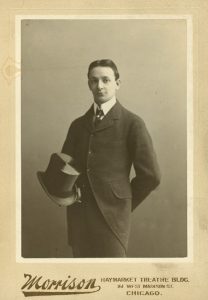
Rudolph Ganz Portrait

Rudolph Ganz

Undeterred, Ziegfeld reopened his school in less than three months. The following year, he changed the school’s name to the Chicago Musical College (CMC), charging more than 900 students “tuition” of a dollar per lesson.

Thereafter, CMC retained its name for the next 125 years, through its merger in 1954 with Roosevelt University’s School of Music and up until 1997, when the administration combined Roosevelt’s music and theater programs into a new entity: the College of Performing Arts.

Three years later, then-dean James Gandre added “Chicago” to the name in order to symbolically reconnect the college with its storied past, creating what we now know as the Chicago College of Performing Arts (CCPA).

Artistic Courage

CCPA celebrates the 150th anniversary of its founding this year. To mark the occasion, thousands of students, alumni, donors and interested Chicagoans will gather on March 14, 2018 at Roosevelt’s historic Auditorium Theatre for the college’s annual Vivid concert and fundraiser, showcasing the talent and achievements of CCPA’s students, faculty and alumni.
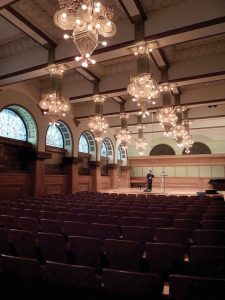
Ganz Hall with empty seats and a violinist on stage

Ganz Hall

Before the applause for that special evening dies down, however, it is worth reflecting on the spirit of perseverance and courage forged by that fire 150 years ago. It took an extraordinary act of optimism for Ziegfeld and his staff to look past the smoldering char and ash of their former building and envision a future unmarred by disaster. Like the city of Chicago itself, they used the fire as an opportunity to rebuild and rebound, to rededicate themselves to their great project of establishing a European-style cultural institution in the heart of the American Midwest.

Courage, resilience, optimism, and heart — these qualities are seared into the DNA of CCPA, and manifest themselves every day in the classrooms, studios and rehearsal halls of the college. In these spaces high above Michigan Avenue, a new generation of aspiring artists learns what it can from those who have gone before them — what it means to be an artist, a professional, a purveyor of imagination and master of artistic craft. They then take the most daring leap of all: into a public and culture that does not necessarily appreciate or care how hard they have worked to acquire their skills, only how easy they can make it look when they get up on stage to perform.

“It takes courage to be an artist,” said Joel Fink, founding director of CCPA’s 20-year-old theater program and its former dean. “The phrase I often use with my students is ‘Developing the courage to create.’ Creative courage means the ability to embrace the unknown, to create something where there was nothing before. Our job is to give our students the skills and craft to have that kind of courage.”

“Creative courage means the ability to embrace the unknown, to create something where there was nothing before. Our job is to give our students the skills and craft to have that kind of courage.”

– Joel Fink, Founding Director of the CCPA Theatre Conservatory

Most students attend CCPA with the intention, or at least aspiration, of becoming a professional musician or actor/performer. Toward that end, the college’s programs are designed to teach students not only the technical skills they will need to be working professionals, but also acquaint them with the personal and practical habits necessary to survive as professional artists.

Auditions, rejection, practice, humility, sacrifice, hustle and failure are just a few of the slings and arrows a working artist must face. That is not necessarily bad. As former CCPA dean and provost James Gandre notes, “The life of an artist has never been easy, and it isn’t supposed to be. Often, the struggle is what makes art interesting and moving.”
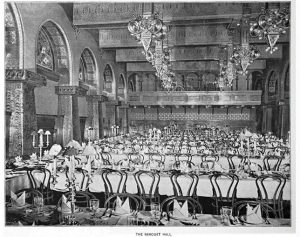
Black & White photo of Ganz Hall set-up as a banquet hall

Ganz Hall was
originally a banquet hall

However, training someone to be both extraordinarily sensitive to the nuances of a line in a play or a passage of music, say, and also thick-skinned enough not to let criticism or indifference poison their confidence — well, that’s a paradox with which CCPA faculty members are intimately familiar.

“It’s called ‘show business’ for a reason,” said Sean Kelley, associate dean and director of the Theatre Conservatory. “All of our students come in with passion for the art, but they also need to comprehend the coldness of the industry and understand the principles of business and marketing. Character development is a different avenue than business development. To make this your career, you need both.”

On the credibility front, it helps that most of CCPA’s faculty are working artists themselves — members of the Chicago Symphony Orchestra, Chicago Lyric Opera, Joffrey Ballet, as well as actors and directors from various Chicago-area theaters — people who “know what they’re talking about” because they live and breathe it every day. In truth, this ethos of collaborative generosity between working professionals and aspiring students has been part of the school’s guiding philosophy since its inception.

The Genial Genius: Rudolph Ganz
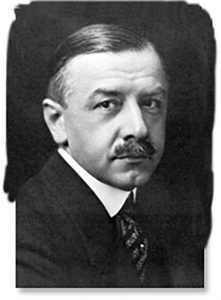
Portrait of Rudolph Ganz

Ganz spent more than
70 years at Chicago Musical College, which merged in 1954 with Roosevelt University.

No one embodied these values more fully, or articulated them more eloquently, than the spiritual father of the Chicago Musical College, Rudolph Ganz, the Swiss piano legend who joined the faculty in 1900 and remained a fixture at the school for more than 70 years.

Ganz’s piano studio on the ninth floor of Roosevelt’s Auditorium Building has been preserved both as a monument to his genius and as vivid testimony to a musical life well lived. More than 100 photographs line the walls: signed portraits from the legends of his day (Toscanini, Ravel, Stravinsky); notes of gratitude from former students, many of whom went on to have illustrious careers themselves (John La Montaine, Dorothy Donegan, Marian Hall, Joseph Bloch); along with a veritable who’s who of musical luminaries from the first half of the 20th century.

Master piano students still use Ganz’s studio to practice, drawing inspiration from the history of the room. Also on the Auditorium’s seventh floor is Ganz Hall, an architectural marvel whose lovingly restored “electroliers” and stained-glass windows assert a bold, brash beauty entirely in concert with Ganz’s own ideas about music, education and life.

In Jeanne Colette Collester’s biography, Rudolph Ganz: A Musical Pioneer, Ganz is quoted as saying, “Music is one of the most powerful and important forces of education. It teaches two virtues that we are greatly in need of today: discipline in preparation and imagination in performance.”

“Music is one of the most powerful and important forces of education. It teaches two virtues that we are greatly in need of today: discipline in preparation and imagination in performance.”
– Rudolph Ganz, Chicago Musical College

Ludmila Lazar, a former student of Ganz and beloved CCPA piano faculty member, concurs: “It was his incessant search for meaning, for character, for truth in the music which was ever present,” she said. “He made me hear more than piano sounds; they became music of the orchestra, of nature, of the human soul.”
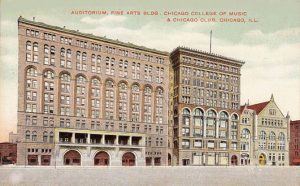
Old Drawing of the Auditorium Building

Auditorium Building, where Ganz Hall is currently housed.

This idea that music is much more than mere sound, that it has meaning and purpose and can serve as a guide to the contours of the soul, was the foundation upon which Ganz built his career as a performer and teacher. He was especially passionate about the performance aspect of the job. He taught “imagination in performance,” rather than technical perfection, because the connection he was striving for — that experience of sublime communication between performers and an audience — was based on the notion that a form of musical truth exists, and it is the artist’s responsibility to locate it.

“In many conservatories dedicated to professional training, there is a disconnect between the academic side (theory, form, etc.) and the performance side,” said Linda Berna, associate dean of the Music Conservatory. “Not here. We’ve made a conscious decision that it all works together.” By “all,” Berna means not only musical study and practice, but also literature, art, history, personal experience, intelligence, intuition and grit.
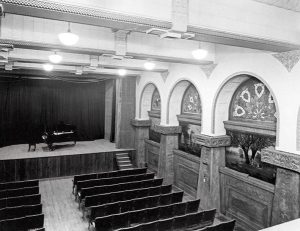
Black & White Photo of Ganz Hall

Ganz Hall

Berna came to Roosevelt 40 years ago as a piano student, and still remembers her years in the conservatory. “What struck me when I came was the atmosphere. It was vital and lively and really involved with the real world of music. The faculty were, and still are, active performers, and they taught differently. They taught us how to make music the way professionals make music.”

Though a certain level of technical excellence was expected, she said, lessons did not focus on the notes. “In piano, we’d have weekly performances and the faculty would critique us. They’d ask us questions like: ‘What are you trying to say with the music? What are you thinking while you are playing it?’ It was all about getting us to think consciously about what we were playing, and how to turn what we thought and felt about the music into a compelling performance.”

Creating Artist-Citizens

When the Chicago Musical College merged with Roosevelt University in 1954, it operated for years almost as a separate entity, due in part to the fact that not everyone in the CMC approved of the move. However, the University’s emphasis on social justice gradually seeped into the culture of CMC (and later, CCPA) via the notion of graduates as artist/citizens — people who see themselves as professional musicians and actors, yes, but also as ambassadors for the arts in the broader community and culture.

CCPA’s current dean, Henry Fogel, is a firm believer that artists are the conscience of culture, and he has solidified that belief into his mission statement and goals for the college. In fact, two of his stated goals for the future are: “To prepare our students for active and dedicated careers as socially conscious artist-citizens,” and “To develop an understanding of the need for artists of the future to advocate for the central place that the arts must hold in a healthy society.”

As a former president of the Chicago Symphony Orchestra and American Symphony Orchestra League, Fogel is all too aware of the precarious place even our most revered arts institutions occupy in the current cultural landscape.

“I think it’s important to teach students that going out and playing your instrument isn’t enough,” Fogel said. “Part of your role as an artist is to be an advocate for the arts and their place in a civilized society.”

“Part of your role as an artist is to be an advocate for the arts and their place in a civilized society.”
– Henry Fogel, Dean of CCPA

Another role important to the ongoing vitality of the arts, Fogel said, is seeding arts organizations with competent, principled leaders. Indeed, establishing Roosevelt as a leader among leaders in the arts is one of Fogel’s primary goals.

Since taking the reins at CCPA in 2009, he has created a master’s in performing arts administration program, one of the first of its kind in the country. He also recently established the Center for Arts Leadership, whose mission is “to educate the new generation of socially conscious artistic leadership” through coursework and projects that develop and reflect Roosevelt’s commitment to ethics, values and engaged citizenship.

Optimism Rewarded

Approximately 150 years ago when Florenz Ziegfeld, Sr. sifted through the ashes of the Great Chicago Fire and decided to forge ahead with his fledgling school, he could not have known or expected that it would survive as long as it has. There were only three other music conservatories in the United States at the time, so the school was an experiment, a big “what if” that offered no guarantee of success. Ziegfeld’s courage and optimism have been rewarded time and time again throughout the years, in moments both large and small.

When the performers at the Vivid 2018 showcase take the stage to share what they have learned during their time at CCPA, each performance will represent the culmination of a thousand tiny triumphs in the pursuit of artistic perfection. However effortless the performances may seem, they will in reality represent profound acts of courage — the kind of courage the CCPA has been instilling in students for 150 years, and with any luck will continue to do so for many more.


Ad for VIVID 2018. Click for more info.

Wednesday, March 14, 7:30 p.m.
Auditorium Theatre of Roosevelt University

Join us as we mark the 150th anniversary of the Music Conservatory and the 20th anniversary of the Theatre Conservatory. The upcoming showcase will feature performances by some of CCPA’s most talented students, as well as a solo performance by CCPA’s renowned head of piano Winston Choi. Alumna Merle Dandridge (BFA, ’98), lead actress in the Oprah Winfrey Network hit drama series Greenleaf who has recently returned to Broadway to star in Once on This Island, will receive the first annual CCPA Distinguished Artist Award.

A ticketed pre-show Gala begins at 5:30 p.m. For information about the Gala and sponsorship opportunities, call (312) 341-3783. VIVID 2018 is a free event, but donations are encouraged to support CCPA students and programs. Free tickets can be reserved at auditoriumtheatre.org, (312) 341-2300, or the Auditorium Theatre Box Office.

For more information, visit roosevelt.edu/vivid or call (312) 431-2352.

Standard
Fall 2016, Feature 1, Feature Stories

The American Dream Conference: What Does the American Dream Mean Today?

1,008 attendees. 4 consecutive days. 580+ service day volunteers. 6 scholarship winners. 200+ “call to action” discussion participants.

1,008 attendees. 4 consecutive days. 580+ service day volunteers. 6 scholarship winners. 200+ “call to action” discussion participants.

What does the American Dream mean today?  That was the topic of a major conference Roosevelt University hosted Sept. 12-15 at its Chicago Campus attended by 1,008 people.

At more than a dozen lectures and discussions, leading American scholars, activists and entrepreneurs analyzed the American Dream and how it affects millennials, education, health care, real estate, immigration, politics and more.

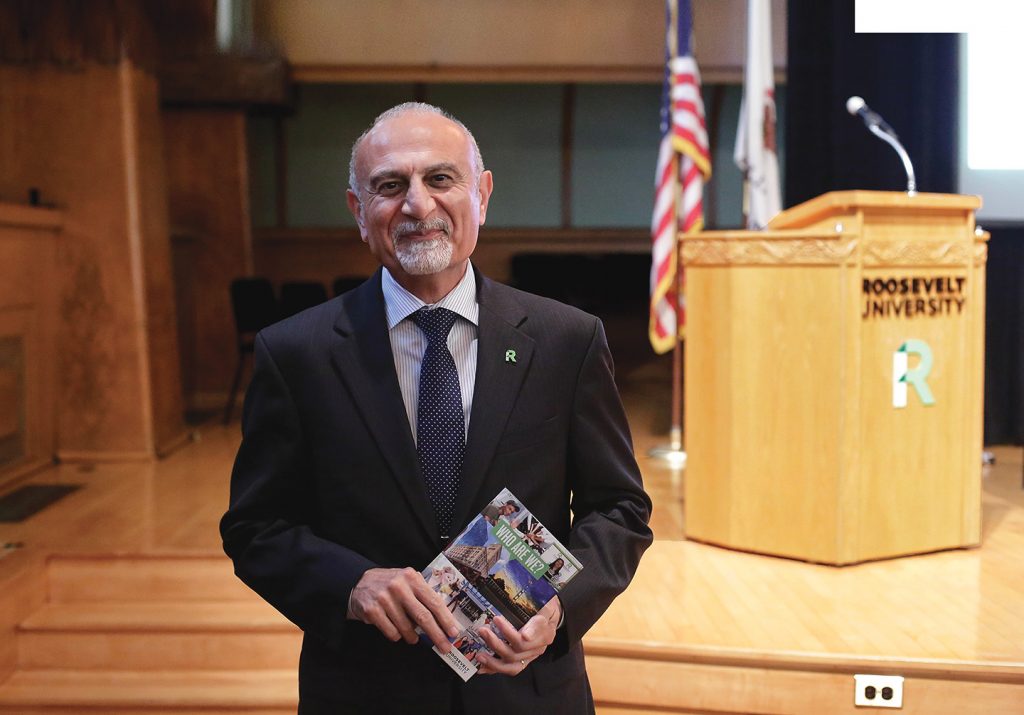
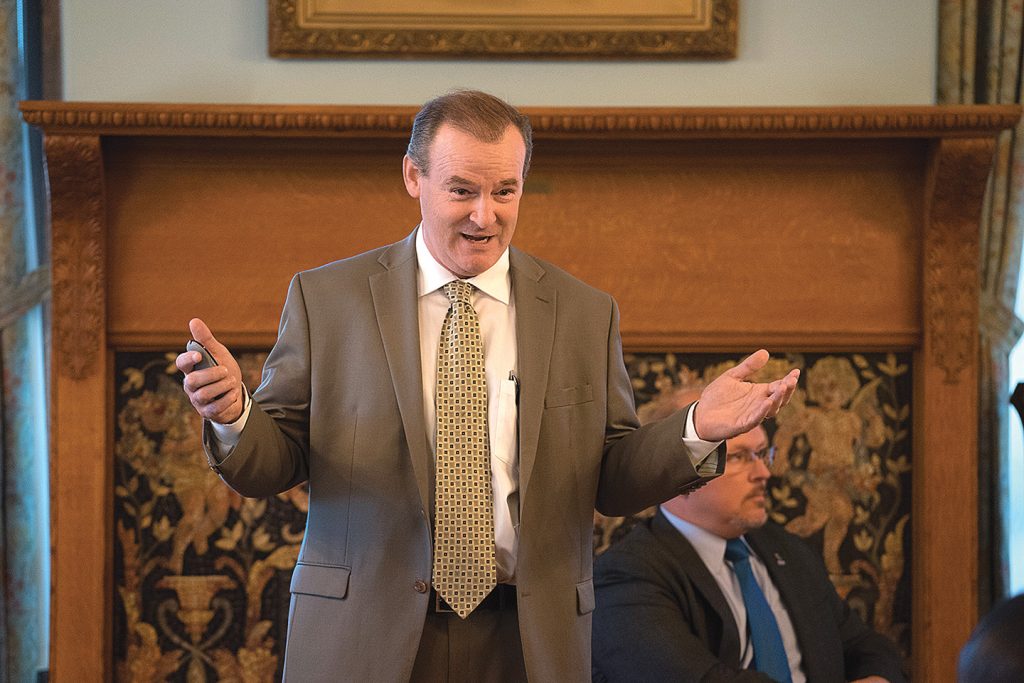
“The American Dream is about every individual who aspires to achieve more in life,” said Ali Malekzadeh (left), president of Roosevelt University and a native of Iran. “Understanding our national ethos of democracy and equality has never been more urgent.  At the American Dream Reconsidered Conference, we heard many viewpoints on what it means to be an American in these challenging times.”

The conference, sponsored by BlueCross BlueShield of Illinois, McDonald’s Corporation and other organizations, also celebrated Malekzadeh’s first year in office. It was held in lieu of the formal and expensive presidential installation ceremonies commonly held on university campuses.  Instead, Malekzadeh led an effort to discuss the future of the American Dream and he initiated a new scholarship program for six outstanding Roosevelt students.

Monday, Sept. 12

11 a.m.

Center for Diversity and Inclusion, National Racial Climate Discussion
The conference began with a discussion regarding the nation’s racial climate, sponsored by Roosevelt University’s new Center for Diversity and Inclusion. “This is a call to action,” Sharron Evans, assistant vice president for inclusion and equity, told nearly 200 participants.  “As a nation, we’re dealing with things like economic issues and police shootings. It’s a fragile time right now.  There’s been a lot of unrest and turmoil, and our goal is to figure out how we, as a university, can and should respond,” said Evans. Five task forces presented blueprints for moving forward as a university on everything from gender neutral restrooms to making classroom spaces and pedagogy more inclusive and inviting for all Roosevelt students.

1:30 p.m.

rufall16_pg18_4

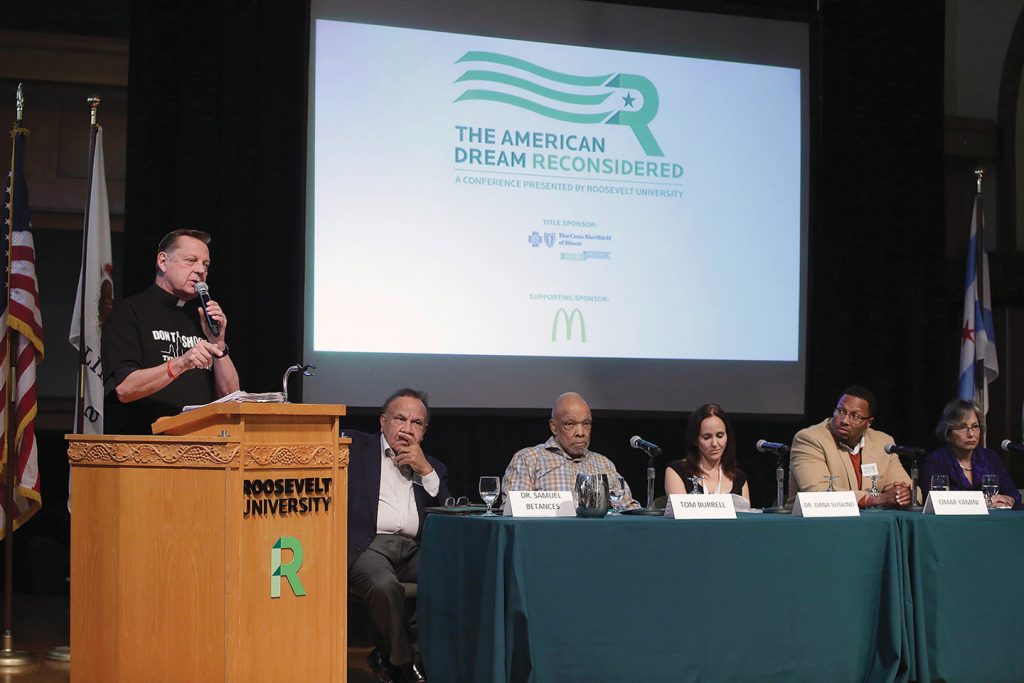
“I am concerned about all the violence in Chicago.” –The Rev. Michael Pfleger, St. Sabina’s Catholic Church

Conversation on Community Leadership and Social Justice
The conference’s first panel session, titled a “Conversation on Community Leadership and Social Justice,” explored “ways to improve the human condition.”  The Rev. Michael Pfleger of St. Sabina’s Catholic Church said stopping violence is essential if conditions are going to improve in Chicago.  He said the roots of violence are unemployment, poverty, lack of trust between police and the community, poor education, weak families and guns.  Dr. Dana Suskind, a University of Chicago physician, called early childhood the formative period of life and said it is the time when parents must focus on building their child’s brain.  By the time children are three, they should have heard 30 million words, she said.  Race and other problems aren’t going away unless there is an economic incentive for change, declared Roosevelt alumnus Tom Burrell, a retired advertising executive.  He said withdrawing financial support or hurting someone’s pocketbook is the only way change will occur.

4:30 p.m.

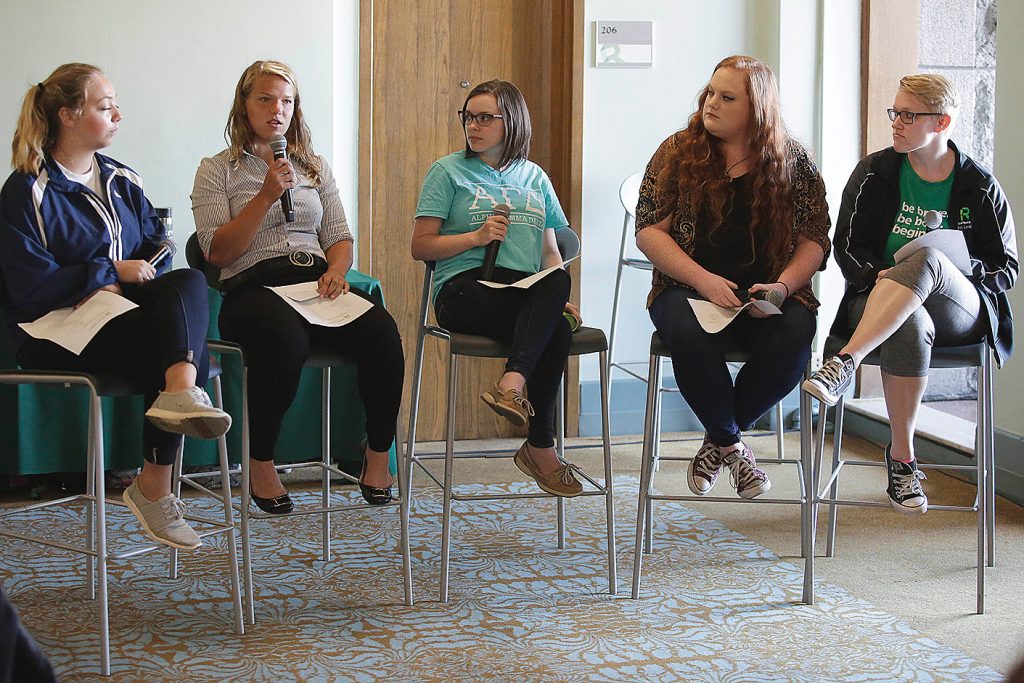
College of Arts and Sciences Student Advisory Council video and discussion: “Millennials and the American Dream”

rufall16_pg19_1

College of Arts and Sciences students discuss their interviews about the American Dream.

College of Professional Studies Alumni Discussion: The American Dream — Daydream or Promise?

6 p.m.

rufall16_pg19_4

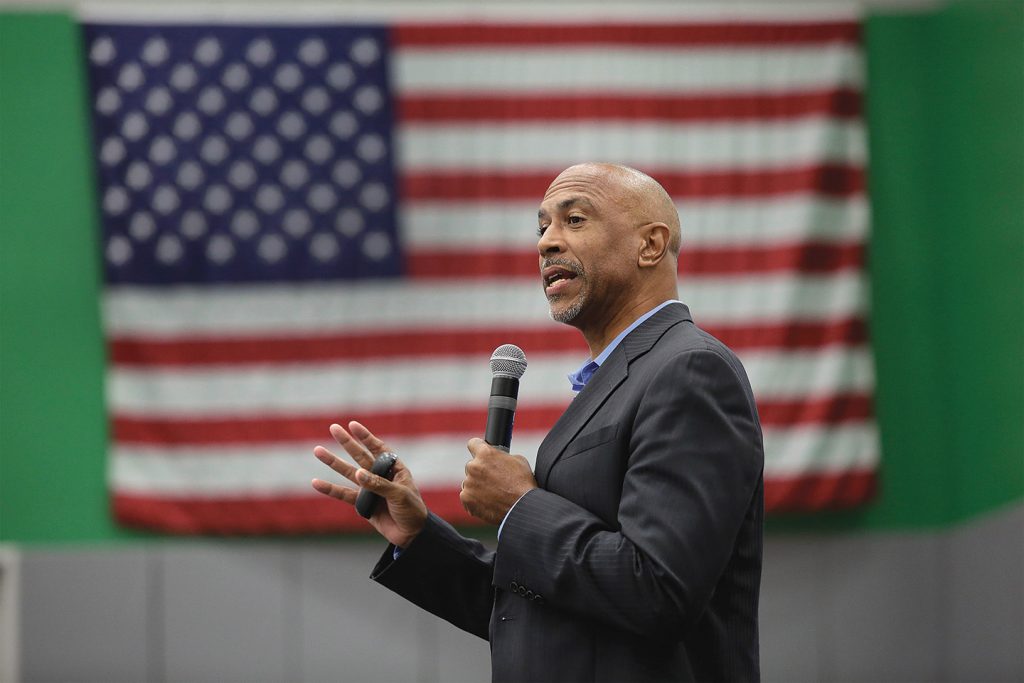
“Putting learning at the center of home and school priorities is the best pathway to the American Dream.” -Pedro Noguera, Distinguished Professor of Education at UCLA

Excellence through equity: five principles of courageous leadership to guide achievement for every student
Monday evening Pedro Noguera, distinguished professor of dducation and director of the Center for the Study of School Transformation at UCLA, declared to an audience of 150 that efforts to reform public education have failed.  Motivating students to learn is what education is all about, but too much time is devoted to creating new tests and accountability measures for schools and teachers, he said.  Noguera described creative ways teachers are helping all learners, but especially poor and minority students, to become more engaged in learning. One moving example highlighted a Los Angeles teacher who instilled a love for science, technology, engineering and mathematics in her students.

Tuesday, Sept. 13

9:30 a.m.

rufall16_pg20_1

“Homeownership has become a dream deferred.” -David Funk, Associate Professor of Real Estate

Real estate and the American Dream
Owning a house has long been considered one of the major features of the American Dream. But in a session presented by Roosevelt’s Marshall Bennett Institute of Real Estate, Associate Professor David Funk said that homeownership is now at a 25-year low.  People have become renters as they face the challenges of large down payments, student loans and other financial issues.  This is occurring at a time when borrowing rates are low and the cost of renting is not significantly different from a mortgage payment. Adding to the problem, he said, is the fact that developers are building few starter homes because larger homes are more profitable.


The Affordable Care Act and the American Dream
The Affordable Care Act (Obamacare) has been in the news as several insurance companies have pulled out of the plan.  At a panel discussion presented by Roosevelt’s College of Pharmacy, health care professionals agreed that Obamacare is beneficial because it provides access to those who previously did not have insurance.  Another important aspect is that it covers preexisting conditions, said Dr. Anita Stewart, medical director of BlueCross BlueShield of Illinois.  She also pointed out that good communication between patients and the hospital regarding their medications is necessary for better health outcomes.

12:30 p.m.

rufall16_pg21_1

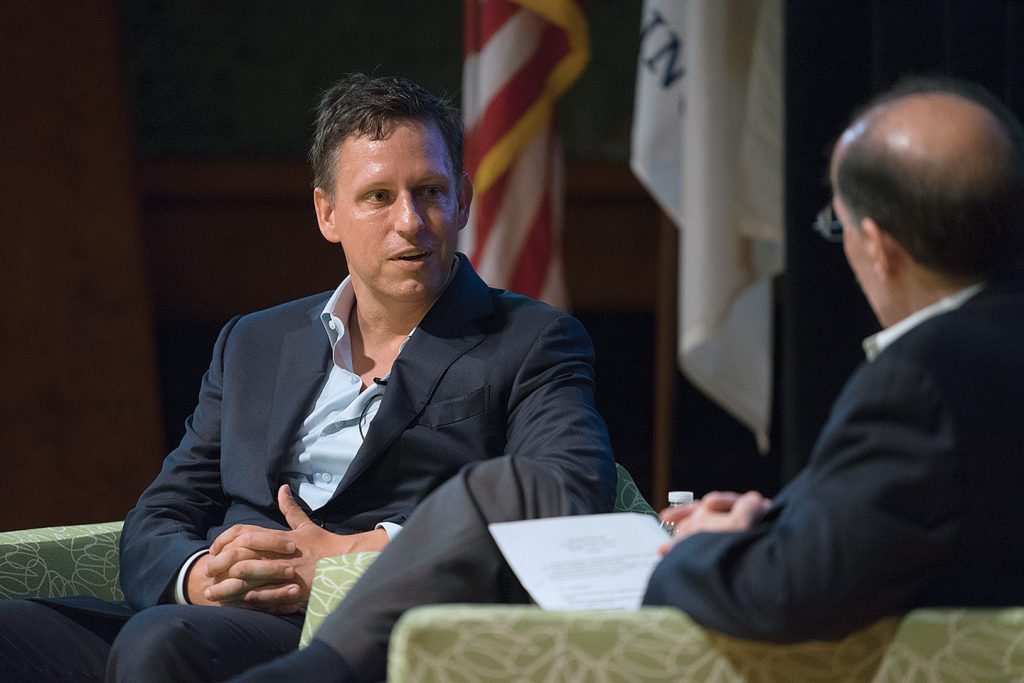
Entrepreneur Peter Thiel discusses globalization and technology with Professor Stuart Warner.

The Jack Miller Center Conversation on the American Dream: Globalization, Technology and Progress
Peter Thiel, an author and co-founder of PayPal, questioned whether American innovation is still being emulated around the world.  In a conversation with Roosevelt Philosophy Professor Stuart Warner on globalization, technology and progress, he discussed American exceptionalism and noted that both extreme optimism and extreme pessimism imply that you are not able to do anything.  Thiel also raised eyebrows with his comments on American universities and his belief that talented people locate to either New York or Silicon Valley.

3:30 p.m.

Justice, Race and the American Dream
A capacity crowd filled Ganz Hall to hear a discussion on justice, race and the American Dream featuring Martha C. Nussbaum, distinguished service professor of law and ethics at the University of Chicago and Jelani Cobb, contributor to the New Yorker magazine and professor of journalism at Columbia University. Nussbaum said the criminal justice system is concerned with payback, which ultimately does no good. “We must consider peoples’ futures,” she said. Cobb said “people want to put their thumb on the scale to produce white outcomes.” He said the Obama presidency is now defined by lack of respect and the Drumpf candidacy is rooted in fear and resentment.

Wednesday, Sept. 14

9:30 a.m.

Presidential Panel — A Conversation About the Current State of the American Dream
The final day of conference sessions began with Roosevelt University Historian Lynn Weiner putting the state of the American Dream into context.  “Both Bernie Sanders and Donald Drumpf said the Dream is dead and for many Americans upward mobility has declined.  But the American Dream has never been static,” she said, noting that many millennials remain hopeful with half  believing it can happen to them.  John W. Rogers, Jr., founder of Ariel Investments, lamented the fact that many black companies in Chicago are no longer in existence and there are fewer black CEOs and business leaders.  Melissa Bean (BA, ’02), chair of the Midwest of JPMorgan Chase and former member of Congress, said a major challenge is the shrinking middle class, while Rabbi Abie Ingber of Xavier University suggested society must invest in education.  “It is a life-changing opportunity,” he said.

2 p.m.

Constitution Day Panel- Immigration, Citizenship and the American Dream
Roosevelt University faculty members who were born in countries other than the United States told why and how they came to this country in a session titled Immigration, Citizenship and the American Dream.  Jim Choca, professor of psychology, recalled leaving Cuba in 1960. “Our plane was completely silent until it left Cuban airspace, then everyone started celebrating,” he said. “I was delighted, horrified and excited when I came to the U.S. from Bulgaria,” said Svetozar Minkov, associate professor of Philosophy.  “America is an amazing place.” Jin-ah Kim, associate professor of Early Childhood Education, said she was called “yellow” when she first came to the United States from South Korea. “I had to learn how to stand up for myself,” she said.  “I had to overcome obstacles, but it was worth it.”

4:15 p.m.

The American Dream and Politics — Perspectives on the 2016 Presidential Election
Various aspects of the 2016 presidential election were analyzed by Roosevelt professors during a panel on the American Dream and politics. History Professor Margaret Rung compared this year’s election to that of 1896, a time when there also was economic distress, class inequality, racial tensions and questions about America’s role in the world. Mike Bryson, professor of Sustainability Studies, questioned why the candidates aren’t talking about issues related to climate control. Marjorie Jolles, associate professor of Women’s and Gender Studies, talked about how Hillary Clinton is now reminding voters that she is a woman, whereas in some of her previous elections she did not mention her gender.

Thursday, Sept. 15

8:30 a.m.

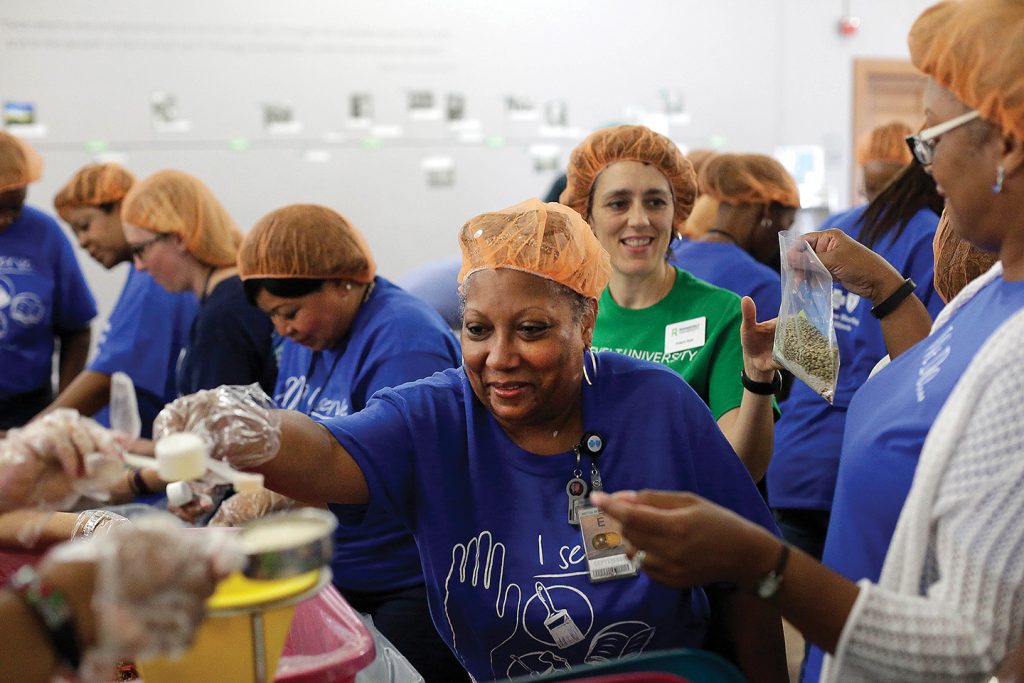
Teams from Roosevelt and from BlueCross BlueShield of Illinois put together meals for the homeless.

Teams from Roosevelt and from BlueCross BlueShield of Illinois put together meals for the homeless.

American Dream Service Day

More than 580 Roosevelt students, faculty and staff rolled up their sleeves to perform service at a variety of social service organizations on and off campus in Chicago and Schaumburg. On this final day of the conference, the first-ever American Dream Service Day began with breakfast at the University’s Goodman Center in Chicago and Alumni Hall in Schaumburg. Students receiving American Dream scholarships from sponsor BlueCross BlueShield of Illinois were formally introduced.

Other teams of Roosevelt students volunteered at locations throughout metropolitan Chicago.

Then, Roosevelt community members got to work: At the Chicago Campus, they packaged foodstuffs for the hungry, wrote letters to elected leaders, called The White House about concerns over world hunger and healthcare, and worked on teams beautifying the University’s Wabash Building roof gardens. At the Schaumburg Campus, students, faculty, staff and children from the Bright Horizons daycare center participated in a major campus-wide clean-up day. Meanwhile, hundreds left the campuses to do service. Some worked in women’s and homeless shelters in Chicagoland, while others picked up trash and cleaned up nature areas in the region’s open spaces.

Standard
Feature 1, Feature Stories, Spring 2013

[Spring 2013] Music As Medicine

Feature Image

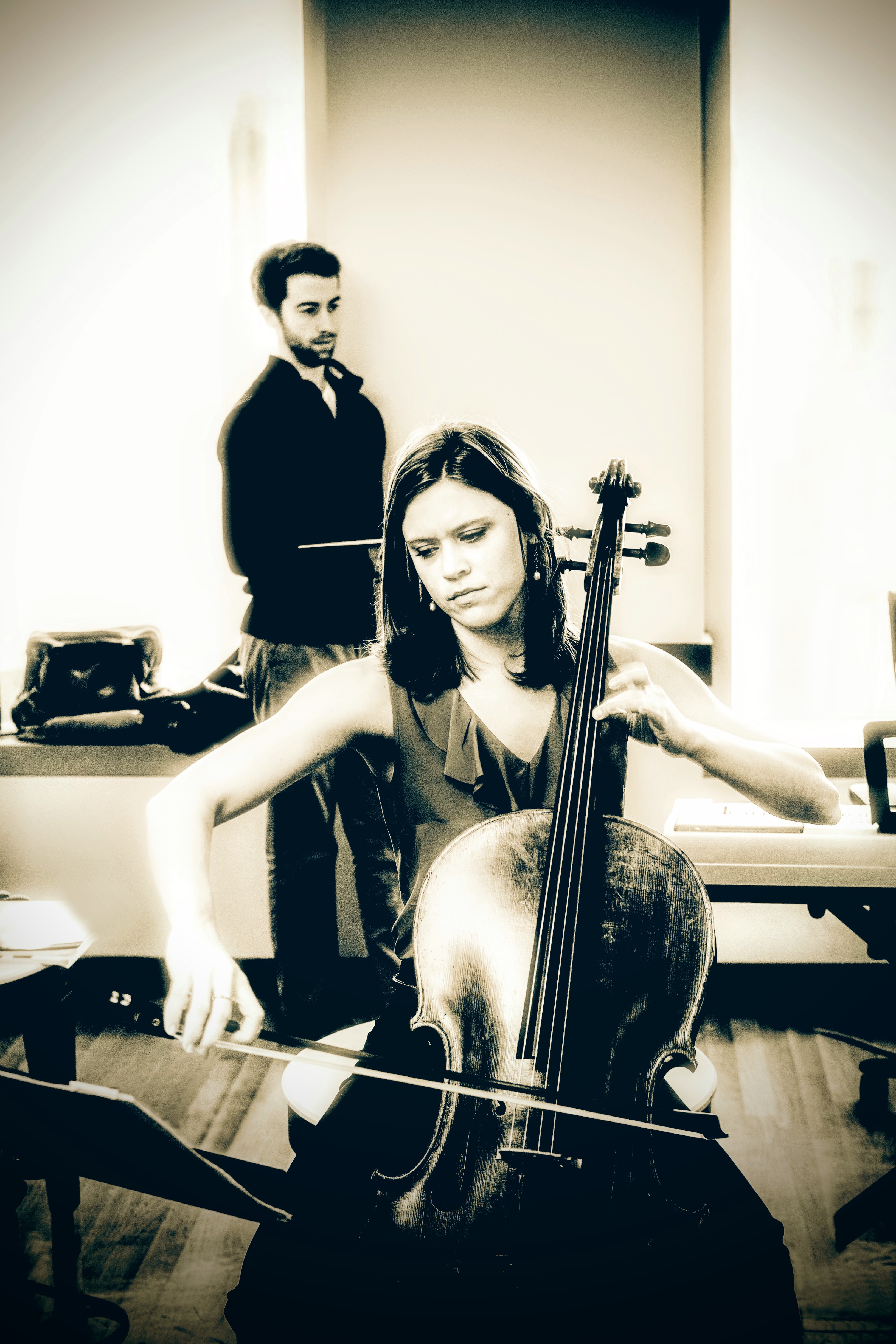
Roosevelt alumna Allegra Montanari believes her cello has power. Convinced its beauty and sound can resonate beyond auditoriums and concert halls, the 2012 graduate of Chicago College of Performing Arts (CCPA) is using the instrument to reach people confronting serious illness.

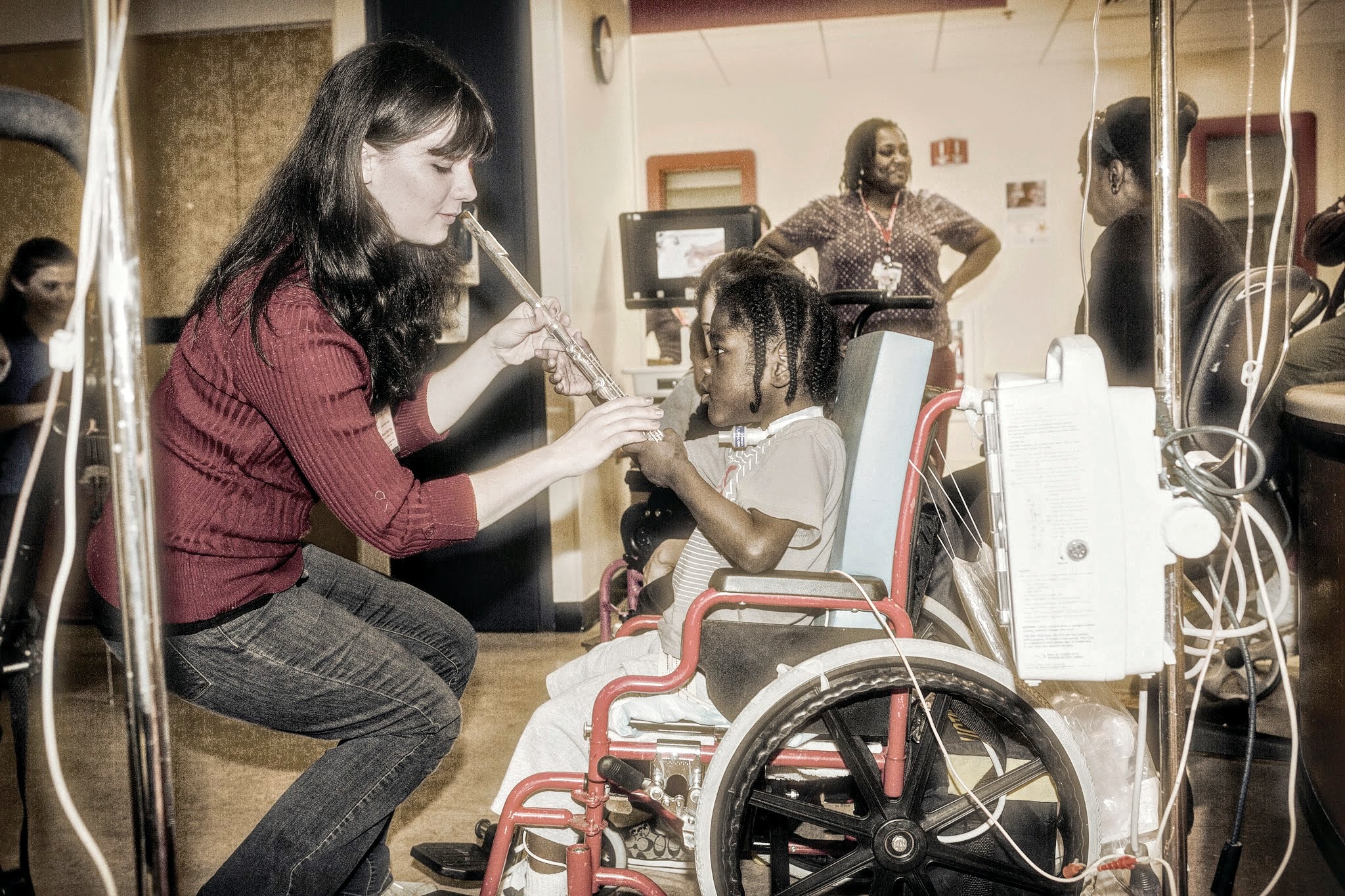
“Do you know what this is made of?” Montanari asked recently, extending the bow of her cello to a three-year-old girl in a wheelchair at La Rabida Children’s Hospital in Chicago.

“It’s from a horse – made from horse hair,” the cellist says to the child, who is suffering from a condition that requires she be fed through a tube in order to be able to absorb life-giving nutrients. Taking one of the child’s hands, and guiding it under her own, Montanari and the girl position the bow, its taut ribbon touching the cello’s strings, until the sounds of “Twinkle Twinkle Little Star” emanate from the instrument.

Among five little ones wheeled into La Rabida’s sundeck lounge for an early evening performance by the cellist and two student flutists from CCPA, the little girl is all smiles and giggles — until the bow and music stop.

“One more song,” she says, as if to bring the music and its musicians back into action for an encore. “One more song. One more song. One more song.”

That is as good an introduction as any for Musicians in Action, CCPA’s new volunteer music corps, which performs regularly at several Chicago-area hospitals. Started a year ago by Montanari, the growing initiative aims to share the comforting and healing sound of music with the sick and those who care for the sick, most of whom don’t have the time, ability or inclination to get out for live performances.

Allegra Montanari

“Music is special. It has power, life and spirituality,” said Montanari, who came up with the idea for a performance-giving organization while working on her Master of Music in Cello Performance at CCPA.

Trained by veteran Roosevelt cello instructor John Sharp, who is also principal cello for the Chicago Symphony Orchestra (CSO), Montanari has wanted to be a professional cellist since buying her own cello while in high school. This winter she landed her first professional job, a two-month position with the cello section of the Sarasota Opera Orchestra in Florida.

“Allegra is a terrific cellist and a terrific musician whose passion for music is quite strong,” remarked Sharp. “She’s also able to communicate and follow through on a business level, which aren’t qualities you often find in musicians,” he said.

So strong is Montanari’s commitment to music that she recognized, after attending Indiana University as an undergraduate and then as a graduate student at Roosevelt, that there wasn’t enough emphasis on the importance of sharing music outside the concert-hall setting.

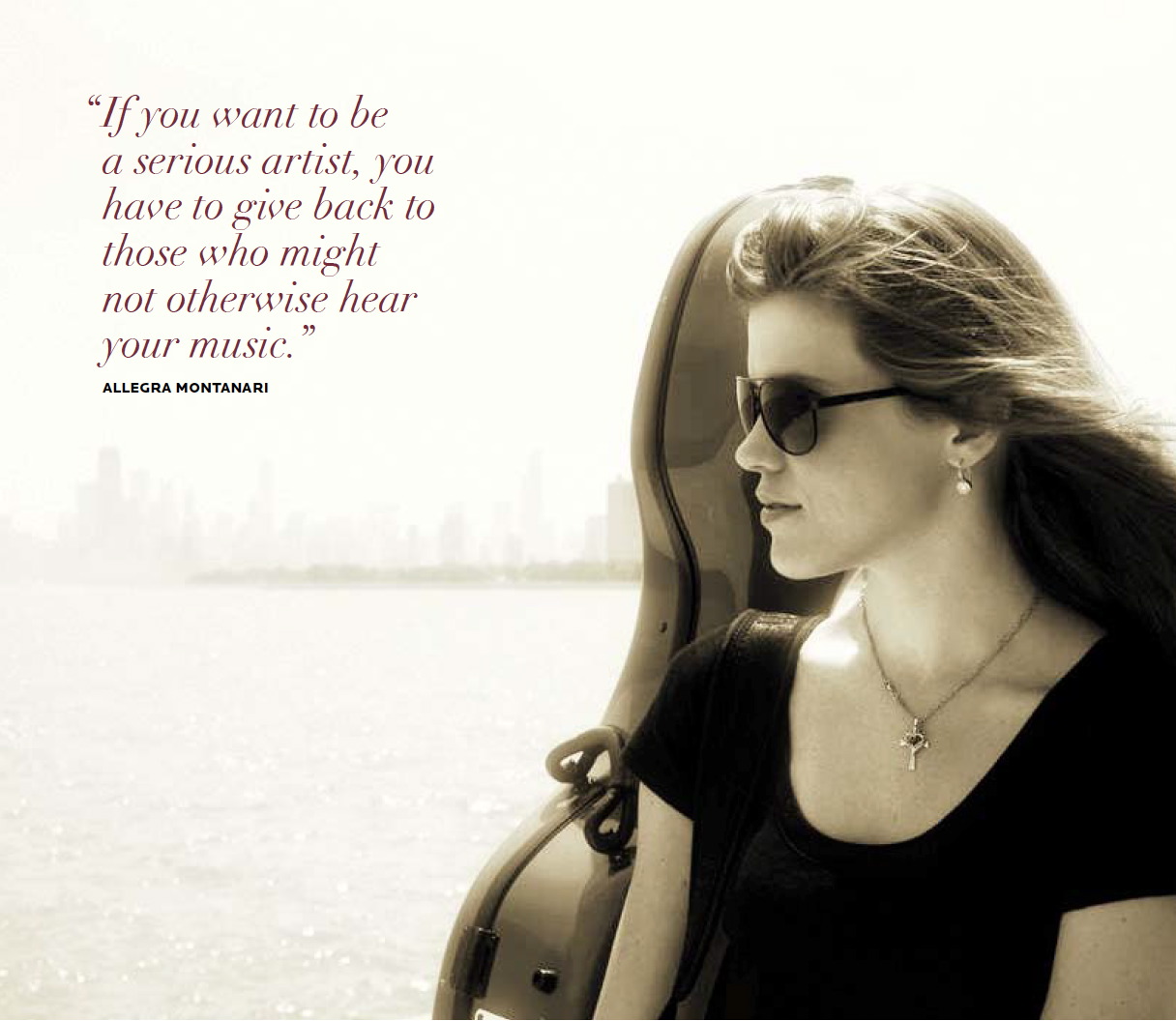
“If you want to be a serious artist, you have to give back to those who might not otherwise hear your music,” said Montanari. “I believe giving back helps create balance for those who are engaged in a craft that is intensely competitive and highly focused on the individual.”

Allegra Montanari believes that music is a gift meant to be shared widely.

Allegra Montanari believes that music is a gift meant to be shared widely.

Montanari began looking at what professional musicians’ groups were doing with outreach in order to formulate a plan. “I came to the conclusion that music is a gift that’s meant for others and it’s something that we, as college musicians, need to be giving,” said Montanari, who shared her idea shortly before graduating with CCPA Dean Henry Fogel.

A veteran performing arts administrator who has headed the CSO and the League of American Orchestras, Fogel readily embraced the idea, recognizing its potential for CCPA, its students and the community. “In today’s world, professional musicians need to do more if they are to succeed than just sit on a stage and play,” said Fogel. “They need to know how to engage with people, and that’s what makes this initiative so exciting. It also fulfills the University’s mission of social justice and it fits perfectly with a trend in which orchestras and chamber-music organizations everywhere are placing more emphasis on community engagement activities.”

Recently at Northwestern Memorial Hospital’s Prentice Hospital, baritone Gabriel Di Gennaro and soprano Sara Schabas, both graduate vocal performance students at CCPA, performed a medley of pop songs because bone-marrow transplant candidate Jim Rinehardt mentioned he enjoyed songs like “The Summer Wind,” “The Way You Look Tonight,” “Fever” and “For Once in My Life.”

“Music is special. It has power, life and spirituality.”
Allegra Montanari

“There are a lot of things with healing power,” Rinehardt remarked as he watched from a visitor’s lounge inside the hospital’s cancer ward. “There is faith in God, faith in yourself, faith in friends, your doctors, your nurses, and there is music,” he said, taking photos while wearing the plastic gloves that protect his low-immunity system from total devastation.

“It’s uplifting. It gets your mind off things you don’t want to think of,” he said. “And even though so many here can’t get out of bed, I tell as many as I can: ‘Open your door and listen. You can hear a concert. It’s positive for your attitude and maybe even your outcome.’”

Roosevelt student flutist Laura Block shows her flute to a child at La Rabida.

Musicians in Action perform at Prentice Women’s Hospital.

Hearing the music while making his rounds through the cancer ward, Steven Newman, senior attending physician in hematology oncology at Prentice, had no doubt about the group’s positive effect.

“What’s not to like?” he said, pausing in the lounge to listen. “Anything you can do to lift patients’ spirits is good. If you can make them feel calm and engage them in some way, it’s going to make them feel better,” the doctor said.

“It might seem like these kids need us, but I feel like I’m the one who needs them. Their energy is just fantastic. It’s truly a blessing.”
Rolando Hernandez, musicians in action

The group’s music also has been a delight for nurses and other caretakers who regularly focus on the needs of the sick, no matter the mood or the prognosis.

“We have clowns who come by and really inspire our children with valuable therapy,” said Julie Catarello, charge nurse at La Rabida Children’s Hospital. “But this is something a little different,” she said as the little ones bobbed, clapped and swayed in their wheelchairs to selections from Mary Poppins and Johann Sebastian Bach’s Minuet in G Major. “It’s something the kids can interact with. We really need to do this more often.”

Roosevelt student flutist Laura Block shows her flute to a child at La Rabida.

Roosevelt student flutist Laura Block shows her flute to a child at La Rabida.

Laura Block, a post-graduate flute performance student at CCPA, reached that conclusion, too, after playing the Irish ballad Danny Boy. “I was amazed that such a simple tune could evoke such memory and emotion,” said Block, whose rendition of the song in the Prentice Hospital cancer ward was particularly moving for one of the patients.

“The experience reminded me that music has a lot of power. It touches lives,” said Block, who has become a regular volunteer with Musicians in Action.

Adriana Triggs, who will receive a Master’s in Music in violin performance from Roosevelt in May, joined the group because she had previously accompanied her mother, a breast cancer survivor, to a hospital in Orange, Calif., for chemotherapy treatments.

After playing Cesar Franck’s Panis Angelicus, which brought another Prentice patient to tears, and a Wolfgang Amadeus Mozart duet with her husband and viola player, Phillip Triggs, the CCPA student regretted that she hadn’t performed in a hospital years earlier.

“If I ever move back to California, I would like to start something like this at the hospital where my mom was treated. It would mean a lot to me,” Triggs said.

Being a part of Musicians in Action also is having an impact on CCPA student musicians from other parts of the world.

“This is the first time that I’ve ever been able to do something like this, and I’m really excited about it,” said Rolando Hernandez, a Costa Rica native and graduate flute performance student who joined Block and Montanari recently in the sundeck lounge at La Rabida.

Beaming at the three-year old’s request for “One more song, one more song, one more song,” Hernandez confided: “It might seem like these kids need us, but I feel like I’m the one who needs them. Their energy is just fantastic. It’s truly a blessing.”

Roosevelt alumna Allegra Montanari greets a youngster at La Rabida Children’s Hospital.

Roosevelt alumna Allegra Montanari greets a youngster at La Rabida Children’s Hospital.

For her part, Montanari plans to form additional partnerships with Chicago-area hospitals and music organizations so that Musicians in Action can continue to bring music to patients and hospital employees.Roosevelt student flutist Laura Block shows her flute to a child at La Rabida.

“We hope this initiative will become a model for community engagement at the college level, and this is an important first step toward that goal,” said Linda Berna, associate dean of CCPA’s Music Conservatory.

During a recent performance break at Prentice, Montanari extended her cello to Jean Griffin, whose husband was dying of cancer in a hospital room in the ward. “I’ve never seen anyone play this kind of instrument before. How did you find it?” asked Griffin, who was thankful to be able to take a moment away from worry and grief to just relax.

“It’s from the 1890s, but I bought it when I was a junior in high school,” said Montanari, encouraging Griffin to touch the cello’s strings. “When you’re getting a musical instrument,” the cellist added, “it’s kind of like finding a mate.”

“It’s well worth it,” Griffin replied, taking her hand away so that Montanari and other members of Musicians in Action could perform again for the audience of patients, family members and hospital staff gathered in the visitor’s lounge.

“You play so beautifully – every one of you,” Griffin told the group. “It will always be a positive memory for me of these days spent in the hospital.”

Standard