
Marshall Bennett Institute of Real Estate Awarded 1st Place in Graduate Division of Harold E. Eisenberg Foundation Real Estate Challenge

Marshall Bennett Institute of Real Estate won first place in the Graduate Division of the 12th annual Harold E. Eisenberg Foundation Real Estate Challenge. Team members, from left, include Alexandra Martello, Ryan Watt, Leila Gathogo Win, Pamela Sanchez Munoz, Trace McGuire, Brett Berlin, Tatiana Nagornova, Jennifer Warfield and Michael Penicnak. Not pictured: Tyler Hanson.
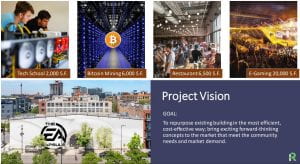
MBIRE’s winning proposal calls for transforming Johnny’s IceHouse, located at 1350 W. Madison St. in Chicago’s West Loop neighborhood, into space for a tech school, bitcoin mining, a restaurant and e-gaming arena.

Marshall Bennett Institute of Real Estate (MBIRE) won first place in the Graduate Division of the 12th annual Harold E. Eisenberg Foundation Real Estate Challenge, which culminated with final presentations on Saturday, April 23, at Wintrust, 231 S. LaSalle St. in Chicago.

The challenge tasked students with creating a redevelopment plan for Johnny’s IceHouse East, the 51,500-square-foot former home of the Chicago Blackhawks’ practice rink located at 1350 W. Madison St. in the heart of Chicago’s West Loop neighborhood.

MBIRE was among five graduate-level teams from universities across the country to participate in the program. As the grand prize winner, MBIRE was awarded $5,000 in scholarships, made possible by Wintrust Commercial Real Estate, toward its real estate program.

The winning MBIRE proposal, The Capsule, was presented by the school’s Windy City Development team and calls for transforming the building to create a lobby, 41-vehicle parking lot, 2,000-square-foot tech school and 6,000-square-foot bitcoin mining space on the first floor; a 16,800-square-foot e-gaming arena and 3,200-square-foot restaurant on the second floor; and additional space for e-gaming stations and dining on the third-floor mezzanine. The total project cost of The Capsule is $25.9 million.

MBIRE’s Windy City Development team included Trace McGuire (team lead), Brett Berlin, Leila Gathogo Win, Tyler Hanson, Alexandra Martello, Tatiana Nagornova, Michael Penicnak, Pamela Sánchez Muñoz, Jennifer Warfield and Ryan Watt.

“I’m incredibly proud of our team,” said Jon Dennis of UrbanStreet Group, who along with Andrew Savoy of CA Ventures, serve as adjunct professors at MBIRE and advisers for the team. “They performed a full market analysis to repurpose this building in a way that is exciting and forward-thinking. This competition gave them a taste of what it’s like to be a developer.”

According to the Eisenberg Foundation, the winning plan is the most economically viable and complementary to the unique uses surrounding the site. The Real Estate Challenge commences early in the year and culminates in April, when the student teams’ presentations are judged by a panel of professionals.

Supporters of the 2022 Challenge included Wintrust Commercial Real Estate, Bradford Allen and Johnny’s Icehouse.

Marshall Bennett Institute of Real Estate Announces New $10K DL3 Realty Scholarship for Graduate Certificate in Real Estate Development

The Marshall Bennett Institute of Real Estate at Roosevelt University (MBIRE) announced that DL3 Realty, a Chicago-based minority-owned development firm, has established a new DL3 Realty Impact Scholarship Fund that will award $10,000 in scholarships annually to underrepresented students pursuing a graduate certificate in real estate development. Two qualified applicants to the certificate program will be awarded $5,000 each, beginning with the 2021-22 academic year.

“DL3 Realty’s generous support will make graduate-level commercial real estate knowledge accessible to professionals of color, allowing them to reach their career potential in an industry that has long been challenged by a lack of diversity,” said Collete English Dixon, executive director of the Marshall Bennett Institute of Real Estate.

In fall 2020, MBIRE launched two graduate certificate programs: Real Estate Finance & Investment and Real Estate Development. These new post-baccalaureate options were created due to the demand from professionals wanting to advance their skills without having to make a two-year commitment to pursuing a graduate degree. An MBIRE certificate can be completed in two semesters, taking two courses each semester. Classes are scheduled in the evenings to make it easier for students working during the day.

“I know firsthand how hard it can be for a person of color to break into commercial real estate, so I want to help minority students, especially those committed to community development,” said Leon Walker, Esq., managing partner of DL3 Realty, a firm that has invested more than $100 million toward real estate developments in some of Chicago’s neediest neighborhoods over the past few years. “I am passionate about mentoring our scholarship recipients on our ‘venture development’ approach, which includes partnering with private investors, local authorities and community organizations to transform historically disinvested communities through inclusive development.”

Professionals with a bachelor’s degree, and preferably with a background in commercial real estate, can apply now for MBIRE’s graduate certificate program and the new scholarship for the fall 2021 semester.

Following are additional guidelines and criteria for the DL3 Realty Impact Scholarship Fund:

  1. Students must be enrolled in the non-degree, real estate development post-baccalaureate certificate program.
  2. Preference is given to African American or Hispanic students, and to students who demonstrate a strong commitment to diversity, equity and inclusion.
  3. Scholarship recipients must maintain a 3.0 GPA for scholarship renewal.
  4. The fund shall award scholarships to at least two students annually.
  5. Scholarship recipients must participate in supplemental programming hosted by the MBIRE and attend industry events hosted by DL3 Realty. Students will be invited to be featured in DL3 Realty publications and social platforms.

“Our ultimate goal is to create a cohort of DL3 Realty ‘Impact Scholars’ that would be comprised of at least four to eight students,” Walker said. “But to achieve that we need additional commitments of at least $10,000. There’s been a lot of talk about moving the needle in CRE diversity, and this is one tangible opportunity for other real estate firms to make that a reality.”

Walker is also offering students use of one of DL3’s development projects as the students’ “community project,” which is a graduation requirement. Other plans for the cohort include either guest lectures from the developer sponsors or two to four “lunch and learn” sessions with the developers during the academic year.

Last year, MBIRE honored Walker with the 2020 Changemaker Award at its 19th annual and first virtual Real Estate Gala. “We want to create a new narrative around what it means to be engaged in communities of color and how we execute uplifting investments that provide both financial rewards as well as a positive social impact,” says Walker. “Our projects bring light, opportunity and hope, which inspires people to take different steps and make positive choices.”

For students who do want to continue their studies, the graduate certificate in real estate development completes more than 50% of the credits needed to complete a master’s in real estate degree at MBIRE.

MBIRE Launches Prior Learning Assessment Program – Students to Earn Credits for Previous Work Experience

MBIRE announced a new initiative that allows incoming graduate students to be awarded up to 12 credit hours of academic credit toward a Master of Science in Real Estate (MSRE) degree for certain industry certifications or experience. This Prior Learning Assessment (PLA) program became effective starting with the spring 2021 semester.

“This new policy gives students a leg up in receiving their degree faster and MBIRE a competitive advantage in the marketplace as we’re the only local real estate school to offer a PLA program,” said Collete English Dixon, executive director of MBIRE. “We want to acknowledge the significant and meaningful knowledge that can be acquired through professional work experience. And the industry certifications we selected for the program require rigorous study, testing and portfolio development that is deserving of graduate-level academic credit.”

Applicants seeking credit for industry experience must provide details of the knowledge and skills they gained through their professional career and include references. Their experiential learning will be assessed and evaluated by MBIRE professors to ensure the experience matches the learning outcomes and competences of the related core class.

Under the PLA program, credit may be earned for one or more of the following four courses:

  • real estate process: a course in real estate law, capital markets, taxation, mortgage markets and real estate development
  • real estate quantitative methods: a course in real estate income statement development/pro-forma development, valuation concepts and net operating income
  • urban land economics/real estate economics: a course in location theory, real estate market analysis, public sector redevelopment/revitalizations and feasibility analysis
  • real estate finance and investments: a course in direct capitalization, proforma development, yield capitalization moding and discount rate development, real estate debt structures and equity capital structures

Through the PLA program, real estate professionals can also receive a maximum of 12 graduate credit hours of academic credit for the following designations, which are broadly recognized throughout the real estate industry for their high standards and requirements as they can take several years of study and experience to obtain:

  • MAI from the Appraisal Institute
  • CAE from the International Association of Assessing Officers
  • CCIM from the CCIM Institute/National Association of REALTORs
  • ASA from the American Society of Appraisers – Real Property Designee
  • AACI from the Appraisal Institute of Canada
  • FRICS from the Royal Institution of Chartered Surveyors – Real Property Valuation Specialist
  • CNAREA from the Canadian National Association of Real Estate Appraisers

“The PLA program allows us to offer significant savings in costs and time to qualified graduate students,” said English Dixon. “And, it may encourage people that have been on the fence to go ahead and get the additional credential of an MSRE degree when they realize they might already have a semester or two of earned credits under their belt – it gives them a jump start.”

Students approved for receiving PLA credit pay a $100 per credit hour fee at MBIRE, which is significantly lower than the current tuition fee of $1,100 per credit. Under the PLA program, students receiving the maximum 12 credits would save $12,000 in tuition. Other requirements for those awarded credit include completing at least six credit hours of MSRE graduate courses with a GPA of at least 3.0 and enrolling in a second semester of courses.

According to guidance provided by the Council for Adult and Experiential Learning (CAEL), PLA credit is increasingly common at the graduate level. “From MBIRE’s robust scholarship program to the array of networking opportunities we provide, this is just one more way we are aligning our programming and instruction with the current needs and diverse backgrounds of those looking to be future leaders in the real estate industry,” said English Dixon.